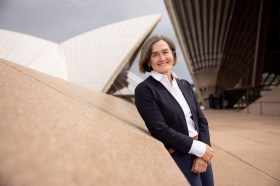
Adelaide-based Kirsty Stark, producer of Emmy-winning miniseries First Day, co-founded Epic Films in 2010 after pivoting from cinematography. Her big break came with Wastelander Panda, the first original production to debut on ABC iView.
Since then, she’s had a hand in bringing everything from prestige drama Stateless, featuring Cate Blanchett, to the ABC and Anthony LaPaglia-led feature A Month of Sundays to the big screen. You might wonder why someone the such an established business track record would sign up for Compton School’s Graduate Certificate in Creative Business.
But it was a no-brainer for Stark. ‘I’m a bit of a lifelong learner, and even though I run my own company, I’d never really had any formal training on the business side,’ she says. ‘I just made it all up as I went along and I recognised there were gaps in my knowledge.’
Having crossed paths professionally with Compton School founder and CEO David Court, she had confidence that he could help her plug those gaps. ‘I also recognised that I was going to need to start looking more globally. David’s business brain, crossed with his screen and creative industry knowledge, was amazing.’
Unlike many business courses, the Compton approach focuses on accounting and finance alongside innovation and entrepreneurship in a way that’s directly applicable to the screen industry, as led by industry experts, including Court, Ian Murray, founder of creative industry advisory firm 113 Partners, The Dry director Robert Connolly and The Dressmaker producer Sue Maslin.
‘Ian was amazing,’ Stark says. ‘I’ve done a short business course in the past where they just tried to apply everything to how many units are you selling this month? That’s just so not applicable to what we do. He could translate those numbers and theories and look at what works for the creative industries.’
Sue Maslin, co-Founder of Film Art Media, led useful sessions on personal branding. ‘The course offers a real overview of hugely different skill sets, but all focused on the creative industries, which not many business courses deliver,’ Stark says. She valued the big picture view, delivered online across a year alongside coursemates, from ‘emerging filmmakers who are just getting their first funded series off the ground all the way through to already successful people who have worked internationally.’
While offering constructive input on creating rock-solid business plans, the course also inspired a new direction for Stark. ‘I went into it going, “OK, how am I going to get my next TV project off the ground and make my business more sustainable?” And then during the process, someone mentioned a gap in the market I recognised it would be possible to fill and that I might be the person to do it because I had these new skills.’
Crew HQ will offer an easy one-stop shop for recruiting film crews. ‘So you’ll be able to say, “I need a cinematographer who specialises in underwater cinematography, has a truck licence, their own gear, a Working with Children certificate and is available on the first of December,” and those results will appear instantly,’ Stark says. ‘So it’ll cut back a lot of the time spent on logistics, especially at a point when major international productions are sucking up crew from all over the country. We really need that national perspective on who’s available.’
Sharing the knowledge
Compton School founder David Court says Stark’s business idea is an excellent example of the brainwaves that regularly spark during the Creative Business course. ‘It’s a fantastic opportunity to stop and reflect on where you want to be next, in a context where you can sound out ideas really quickly with peers, build and pressure test them, and get all the feedback you need to stop the holes and to see how it could be more,’ he says.
The course was designed with busy, mid-career professionals in mind, 40-year industry veteran and ‘jack of all trades’ Court says. He began at the then Australian Film Commission and was involved in setting up the Film Finance Corporation, moved into publishing, helped finance many film projects and set up the business unit at AFTRS. ‘About five years ago, I thought we could do this on a bigger scale, so I set up Compton School.’
Creatives are packed full of fantastic ideas – they just need a little guidance in making successful careers out of them sometimes, Court suggests. ‘Creative people generally don’t think about business very much, but sooner or later, they bang their head up against it.
‘We all run these often micro but quite sophisticated businesses, and there is a lot of business knowledge in the creative industries, but it’s in people’s heads and not often written down. Our mission is to capture that knowledge and share it.’
Drawing on the know-how of folks like Maslin, Connolly and Murray is vital. ‘Universities often struggle a bit with this space because it’s easy for people who pursue a PhD, which I’ve done, to get out of touch with what’s happening in your creative domain. So it’s really important to have people live from the field, as well as those versed in the academic discipline.
‘It’s contemporary, relevant, and responds to industry change as driven by technology, with streaming obviously the big one in the screen industries.’
The course also enables an invaluable dialogue with peers. ‘That’s something people in the industry don’t often get a chance to do,’ Court says. ‘It’s all so fast and furious, with very few chances to sit with people sharing your issues and trajectory and to swap notes. It also gives you structured time to reflect, with touchpoints that propel you forward.’
Watching graduates like Stark flourish is the ultimate reward for Court. ‘I’m in awe of them,’ he says. ‘It’s a perpetual pleasure. I’ve done all sorts of things in my career, but I should have gotten to teaching faster.’
Stark has nothing but praise for the course. ‘From a knowledge perspective, I took some things away that I wasn’t even expecting, because I didn’t know that I didn’t know them. And it’s not just the hard facts. It’s that bigger-picture thinking, the psychology of finance and business that can be applied to all aspects of life.’
Find out more about the Compton School Graduate Certificate in Creative Business 2023.