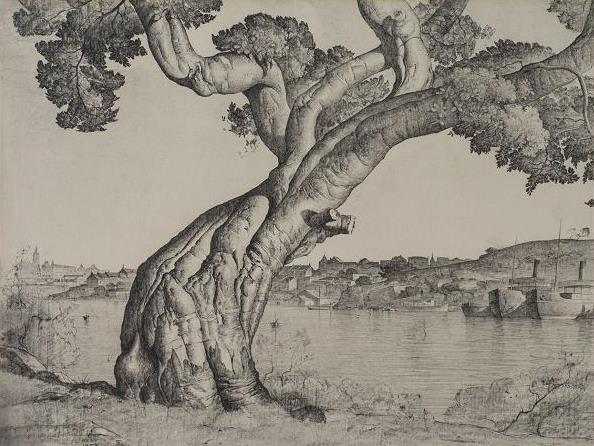
Lloyd Rees, Port Jackson fig tree 1934.
In 1927 Lloyd Rees was struggling with the emotional trauma of losing his first wife, Dulcie Metcalfe, who died due to complications following the stillbirth of their first child.
‘It was quite a devastating time for Lloyd; he lost not only his wife but his child as well. He had a breakdown following that about six months later. He had been painting for a while, wasn’t having a lot of success with that either and eventually collapsed from exhaustion,’ said Veronica Kooyman, exhibition curator for Lloyd Rees: Painting with Pencil, now showing at the Museum of Sydney.
Rees found some solace in his friendship with Marjory Pollard, who he visited regularly at her family home in Pennant Hills. While travelling across this once rural part of Sydney, he found himself waiting for a bus and decided to pass the time by drawing some of his surroundings.
‘All he had in his satchel was this very thin, light paper that you would use for pen and ink drawing traditionally, and a pencil. Of course, in those days he had been taught that the traditional method of drawing was to draw on very heavy thick paper with pencil, and the very thin paper is used for commercial pen and ink drawings. But he decided that’s all I have so I’ll just draw a few outlines of the trees and the hill.’
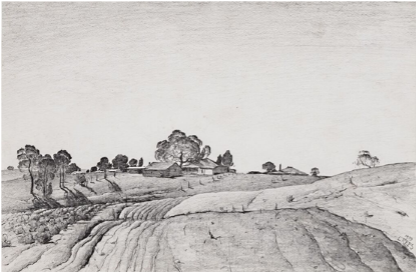
Lloyd Rees, The Slopes, West Pennant Hills 1933.
As Rees started to draw, he found that the combination of this very sharp pencil on this very fine paper created a different appearance. He could get a lot more texture into his drawings and suddenly felt inspired by the experience he was having with this new technique.
‘That really became a catalyst for this whole period,’ said Kooyman.
This moment of inspiration gave rise to a large number of pencil drawings during the 1930s. Brought together for the first time at the Museum of Sydney, Lloyd Rees: Painting with Pencil 1930 – 1936 tells a story about the man who drew them and the city he was inspired by.
‘I think he was looking for a sense of peace and calm in those years following the death of his wife and child, and these drawings he is doing between 1930-1936 of these peaceful and calmer versions of Sydney are actually him trying to find that for himself as well.’
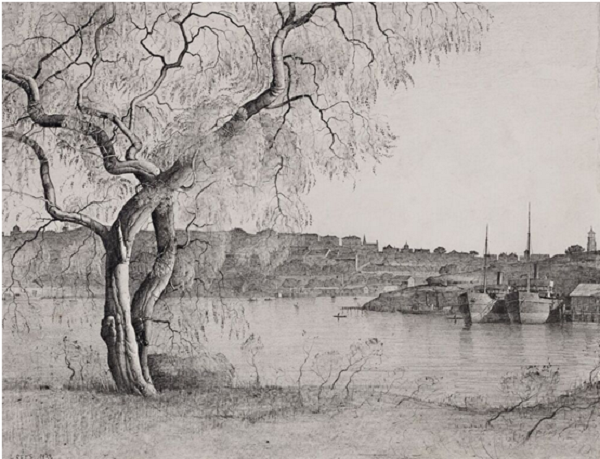
Lloyd Rees, Looking to Goat Island and Balmain 1933.
‘There has never been an exhibition that has brought together so many drawings from the 1930s before, generally exhibitions of his work quite rightly will display a variety of works from across his very, very long artistic life and will show the development of his work,’ said Kooyman.
Focusing on this specific period of Rees’ work brings something new to audiences: ‘It lets us examine our city in a different way, particularly through one artist’s eyes.’
What is striking about these drawings is not just the immense amount of detail he has included, but how Rees captured an alternate view of the hustle and bustle of a modernizing Sydney during the interwar years.
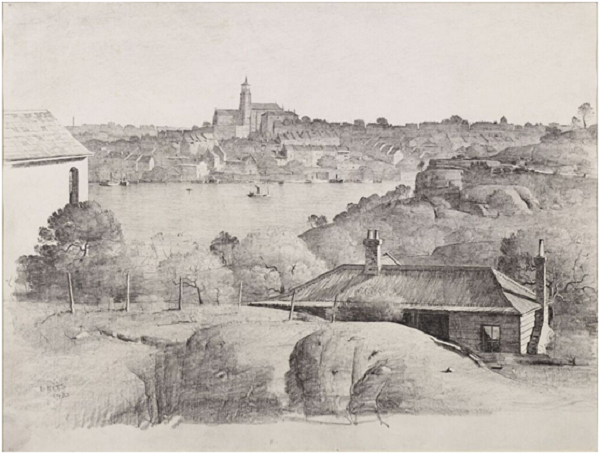
Lloyd Rees, Afternoon light, Sydney Harbour 1933.
‘They’re much more peaceful and are almost looking for a more permanent, timeless quality of the city. I think that is why he looks at more of those traditional and classic buildings and particularly featuring the headland and environment, with hints of building work here and there. They are very peaceful and calm.’
Drawing the contours of the foreshore and the headlands became almost an obsession for Rees. ‘There are 15 drawings alone of Balls Head that we are displaying and that’s not all of these that he did during this period,’ said Kooyman.
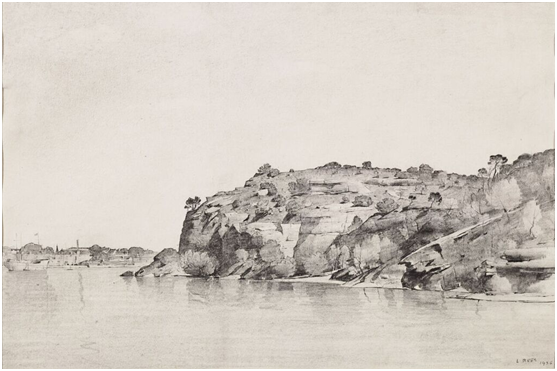
Lloyd Rees, Balls Head 1936.
‘I think it was the shape that really inspired him. We do refer to that series of drawings as the artist’s obsession because he keeps coming back to it.’
‘When we look at it now it’s covered in native vegetation, it’s quite green and it’s protected bushland, and in those days all the timber had been cut down for firewood during the depression and so it revealed this very shapely headland that he found quite interesting to draw again and again and again.’
‘Rees loved Sydney, it captured his imagination and inspired him’ said Kooyman, as she explained Rees’ involvement in the civic life of Sydney.
Rees taught drawing and art history at the University of Sydney for nearly forty years, and ‘his influence on the next generation of architects is very obvious,’ concluded Kooyman.
A short film of interviews with people who knew Rees will show alongside the exhibition.
Lloyd Rees: Painting with Pencil 1930-36
Museum of Sydney
12 December – 10 April 2016