Annual predictions are a familiar start-of-year ritual in the art world but they function less like a weather forecast and more like a momentum report. They don’t tell us what will happen so much as what is already gathering force.
What appears to be gaining traction as we settle into 2026 is a decisive shift away from scanning the horizon toward examining the ground beneath our feet.
The prevailing mood suggests that the solid ground we have been seeking will be found in cultural responsibility, local grit and lived experience, replacing scale, speed, and spectacle as the new gold standards.
Global art world predictions for 2026 – quick links
The Australian art market turns inward
After several dizzying years, the art world has often felt like a ship without an anchor. Between the whiplash of digital ‘disruption’, the speculative pressure of the market and the compounding effects of last year’s funding cuts, many artists and institutions are showing clear signs of burnout.
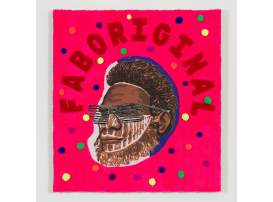
While the global scene is focused on new markets like the Middle East, in Australia the sector is turning inward to examine identity, national myths and the power of the Blak imagination. This feels less like retreat and more like a recalibration: a year of reflection that strengthens foundations rather than shrinking ambition. We are already seeing this shift reflected in programming announced for 2026.
This inward turn is also accompanied by a broader recalibration of values. After last year’s fixation on AI, there is a growing appetite for genuine voices and a tactile appreciation of the handmade. In 2026, we should expect less hype and more reality.
The least ‘sticky’ predictions for the year tend to be those that flare up suddenly, often driven by political or funding decisions, and disappear just as fast. In the current Trumpian matrix, such shifts are increasingly reactionary and, at times, destructive. These are unlikely to take root, but they remain our loudest warning. The advice for 2026: don’t listen to the static.
Prediction 1: Tariffs will temper the global market
The geopolitical elephant in the room is the Trump-era return to tariffs. With a 10% baseline reciprocal tariff now in place in the US, the movement of art across borders has become more than just an administrative headache – it’s a financial wall.
For decades, the international art fair circuit has underpinned the global market. In 2026, however, the cost of participation is simply too high for many galleries. This isn’t only a logistical issue; it signals a deeper cultural shift.
A slowdown of the global art market is likely – and arguably healthy. While the trophy end of the market will continue to dominate headlines, real growth is expected among emerging and mid-career artists, whose work is more accessible and offers a sense of hope – which we are all hankering for in our times.
Australia remains relatively insulated from dramatic global market swings due to its small collecting base. Locally, the most tangible impacts will be a cooling of art fairs and the rising cost of taking artists offshore. The most successful galleries in 2026 will not be those with the largest social media reach or the largest stable of artists, but those with the deepest connection to local needs – and the artists responding to them.
Prediction 2: The rise of the localism
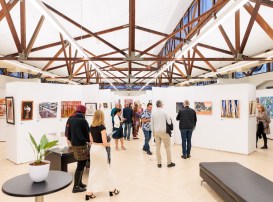
Continuing on from this, localism is shaping up to be the strategic backbone of the art world in 2026. After years of chasing global visibility, the sector has reached a tipping point where proximity, place and community are the new high-value assets.
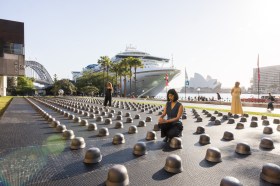
This is a ‘glocal’ shift: while the art world remains digitally connected, its emotional and economic centre of gravity is moving back to the neighbourhood. In Australia, this should not be seen as a withdrawal, but a reclamation of values sharpened by difficult times. The 5th National Indigenous Art Triennial, After the Rain, offers one blueprint, embracing localism but with global intellect.
Read: After the Rain – 5th National Indigenous Art Triennial review
Prediction 3: The ‘Middle East axis’ becomes official
Despite this embrace of the local, 2026 is widely regarded as a watershed year for the Middle East. The long-awaited opening of the Guggenheim Abu Dhabi in June completes the Saadiyat Cultural District, joining the Louvre Abu Dhabi and the Zayed National Museum.
Alongside the inaugural Art Basel Qatar, staged earlier this month, the region is transitioning from a ‘new market’ into a primary global capital for modern and contemporary art. This shift is already driving new cultural collaborations, commissions and high-level tourism. With significant financial backing, the Middle East axis is no longer speculative – it is an established reality and a space to watch closely for opportunities.
Prediction 4: The comeback of materiality and the human touch
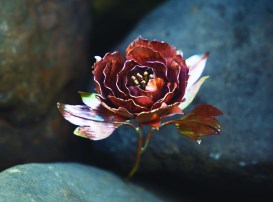
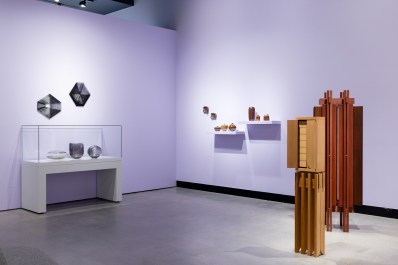
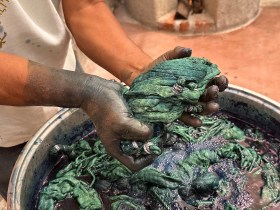
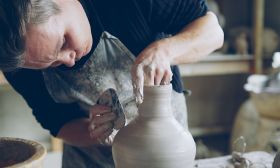
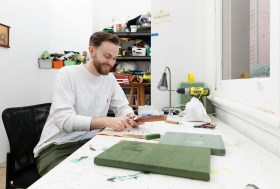
If 2025 was defined by the rapid rise of AI, 2026 will be shaped by its counterweight. While these tools will continue to evolve, there is a renewed emphasis on materiality – hand-built ceramics, complex textiles, sustainable jewellery – precisely because they resist automation.
Read: Art and AI – looking back at the major developments in 2025
In a world saturated with generative content and deepfakes, human ‘verification’ has become valuable again: walking into a studio, seeing charcoal under fingernails, sensing the physical relationship between maker and object.
Craft revivals that surfaced during the pandemic are now set to endure. Institutions are responding, from the Arthur Boyd tapestry revival at the National Gallery of Australia, to Melbourne’s Radiant Pavilion jewellery biennale, alongside the continued growth of Melbourne Design Week, Sydney Craft Week and Sydney Ceramics Market. The tone is markedly tactile, moving away from the sleek digital immersive experiences that have dominated in recent years.
Prediction 5: Sustainability as a core metric
Eco-consciousness is no longer optional. After years of eco-activism in our galleries and museum, resistance to resource-heavy sponsorships, and a push toward carbon-neutral exhibitions, sustainability is predicted as a quiet but constant force shaping programming in 2026.
One to watch is the Cairns Indigenous Art Fair, themed around reclamation and regeneration, reflecting a broader Australian turn toward ecological repair. Bio-Art practices and works made from repurposed materials found on Country are increasingly central, rather than peripheral, to institutional narratives.
Prediction 6: Renewed interest in spiritualism and mysticism
Finally, there is a growing interest in alternative ways of knowing – an anti-digital pivot toward spiritual, ancestral and intuitive frameworks.
This is evident in Monash University Museum of Art’s 2026 program, which foregrounds resistance, renewal and care through exhibitions such as Knowing Otherwise. These projects explore how artists navigate spiritual and ancestral knowledge systems amid declining trust in Western institutions.
Taken together, these shifts suggest that 2026 is less about expansion than consolidation. The art world isn’t getting smaller – it’s getting more honest.