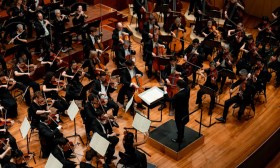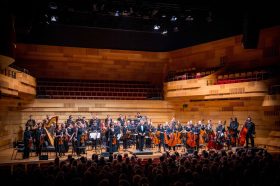
West Australian Opera is joining forces with the University of Western Australia to present Michael Tippett’s A Child of Our Time in the magnificent neo-Romanesque setting of Winthrop Hall this month. Composed around 1939 to 1941, the work could not be more timely, and when I speak to WA Opera’s amiable Artistic Director Chris van Tuinen, who’s also conducting the May performance, he’s hopeful that its message and music will resonate with today’s audiences.
As van Tuinen says, A Child of Our Time ‘tells the story of freedom from oppression. It tells the story of one man’s path, the choices that one man makes, and the fact that society and groups of people and crowds can respond in particular ways.
‘It deals with all those human condition scenarios that you would see and feel in the 1930s and 40s in Europe: how individuals react, how nations react, how societies react.’
A Child of Our Time in Perth – quick links
Meditating on the causes of violence

Tippett’s oratorio was inspired by the assassination of a German diplomat in Paris by a Polish Jew in 1938, which provided the pretext for the Kristallnacht pogroms across Germany. Unlike his friend and colleague Benjamin Britten’s War Requiem, however, A Child of Our Time is not just a searing anti-war manifesto, but a profound meditation on the psychological causes of violence and counter-violence
Tippett and Britten were part of a generation of English composers who were writing in reaction to the Romanticism and nationalism of Elgar and Vaughan Williams. They were politically progressive and committed pacifists. They were also both gay men.
Van Tuinen sees all this feeding into Tippett’s personality. ‘He’d had an interesting training where he avoided university and went through the college system. He was associating with a lot of important writers and poets; and coming to terms with his homosexuality, which was hugely challenging for men in the 1930s and 40s,’ he says.
‘He was very principled about some things as well, to the point of going to prison as a conscientious objector. He was a member of the British Communist Party, but gave up that membership fairly early on, and devoted himself to more “pure” socialist ideas.’
A psychological portrait
Tippett’s politics were also tempered by his embrace of Jungian psychology. ‘After his first same-sex relationship broke down, he got terribly depressed and underwent a long period of psychoanalysis.’ This led to a libretto using archetypes to universalise the story. ‘The four principals have titles like The Boy and The Mother and The Aunt and The Uncle, but there are no nationalities referred to. There are no names referred to; it’s completely universal.’
In the same vein, Tippett uses an anonymous chorus in A Child of Our Time to represent the shifting tides and extremes of mass psychology. ‘We see choruses supporting one part of the action and then commenting on another part of the action – but there’s no single or particular stance that the chorus takes.’
Ultimately, however, A Child of Our Time centres on the individual. ‘The whole piece is about: “I want to know my Shadow and my Light”. The real journey to understanding and enlightenment and empathy is for us all to acknowledge the darkness and light that lives within us,’ van Tuinen says.
‘Anyone’s who’s trying to frame this piece as “X is good, Y is bad” misses the point. The piece is trying to understand the human condition – the external forces, but also the internal struggle that we all face.’
Capturing the egalitarian spirit of A Child of Our Time
Van Tuinen’s harnessing of professional and student forces is true to the egalitarian spirit of the composer and the work. During the second world war, Tippet was director of music at Morley College, an adult education college in London for working men and women.
Tippett originally intended A Child of Our Time for the college orchestra, but at the urging of the conductor it was eventually premiered in 1944 by the London Philharmonic, with the Morley College Choir boosted by the London Regional and Civil Defence Choir, and four soloists (three of whom were professionals from Sadler’s Wells, while the fourth was from Morley College).
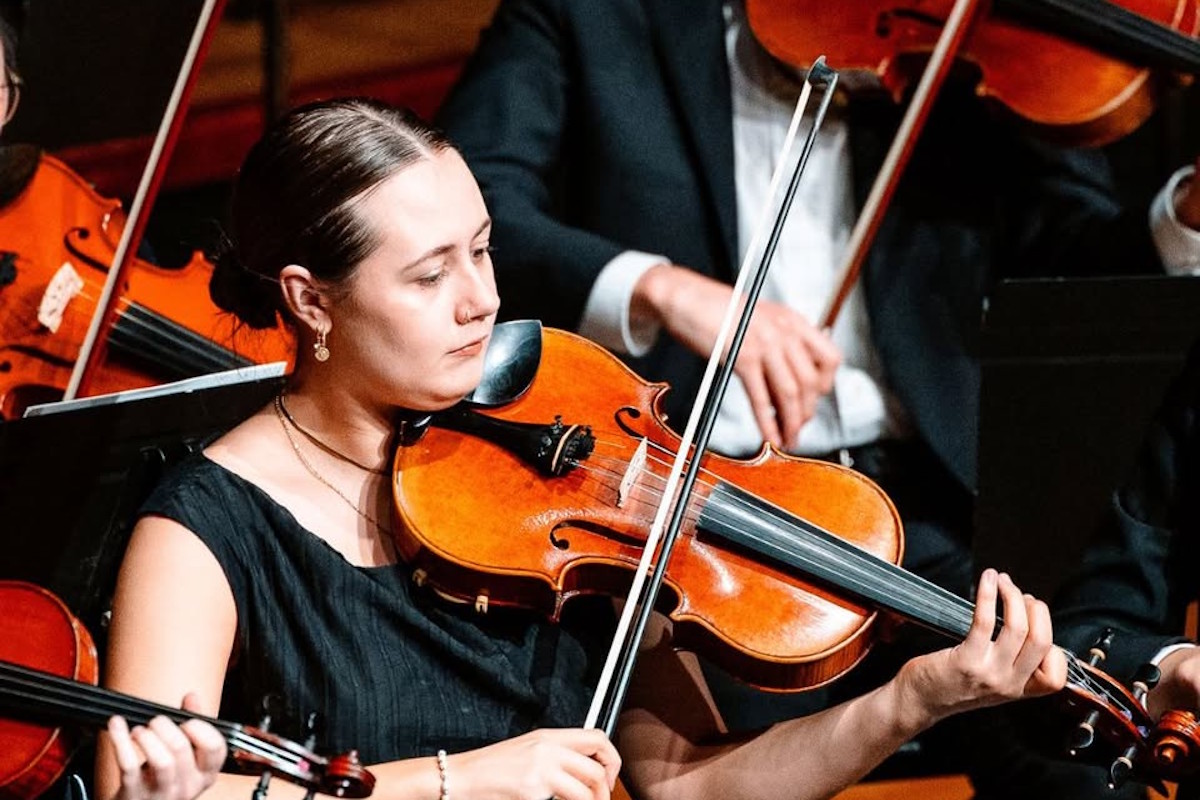
Van Tuinen has employed a similar mix. ‘We’ve got a large mixed-voice chorus – sopranos, altos, tenors, basses – there are about 70 of those. They’re the university students from the Conservatorium of Music. The Conservatorium has an excellent choir … And the orchestra is made up of instrumentalists from the Conservatorium of Music.

‘I’m the Artistic Director of the company, so I conduct these projects myself so that the students have an idea of what that would feel like, and we bring in soloists who are principals with the opera company, so the singers in the choir and the instrumentalists get to work with really top-flight soloists.’
I ask van Tuinen about the vexed question of cultural appropriation in relation to Tippett’s use of African American spirituals, which take the role of Lutheran hymns in Bach’s Passions.
Van Tuinen pauses before answering. ‘Yeah, I think about that a lot,’ he says. ‘On the spectrum of cultural appropriation – and that’s a challenging thing to say even in itself – I see so much love and respect for them in the music that I’m willing to let it slide, whereas if a composer came to me today and said, “This is what I’d like to do”, I’d ask a different set of questions.’
He adds, ‘I think a strict interpretation of cultural appropriation would rule all these pieces out, but that’s not where I live.’
At the end of the day, this seems consistent with A Child of Our Time’s underlying Jungian philosophy of acknowledging complexity and seeking internal reconciliation rather than taking sides.
For his part, Tippett conceded this was ‘very easy to say, very difficult to do’ – especially at a time when ‘god has left the light of the heavens for the dark of the collective unconscious’. In words that now seem prophetic, he said, ‘I hold it to be just possible for individuals, but impossible for collectives in our present climate of self-righteousness – of groups, societies, nations.’
Nevertheless, Tippett wanted to end A Child of Our Time on a note of affirmation. Van Tuinen is cautiously optimistic. ‘It’s very moving; it’s incredible powerful. The piece is only an hour long, but you go on such a journey across it that when you get to that last spiritual, you feel a collective presence.’