There’s an argument to be made that the reason the Melbourne Theatre Company has waited 22 years to restage The Glass Menagerie, one of the most pivotal plays of the Tennessee Williams’ oeuvre, is simply because they were waiting for Alison Whyte to age into the role.
Of all the currently working local actors adept at playing spiky and brittle characters, Whyte is perhaps the first who springs to mind. Indeed, she is such an obvious casting for Amanda Wingfield, the fraying-at-the-edges Southern belle matriarch at the centre of The Glass Menagerie, it really is a bit of a slam dunk.
More of an unexpected choice, perhaps, is associate artist Mark Wilson as director of the production. Wilson’s most recent MTC contribution was only six months ago – a version of Much Ado About Nothing that ArtsHub’s review praised as ‘full of wry humour, pointed barbs and downright slapstick’.
Now, Wilson has turned his attention to what is considered Williams’ first great work, an autobiographical memory play described by its narrator Tom Wingfield as ‘truth in the pleasant disguise of illusion’.
The Glass Menagerie review – quick links
A challenge to stage
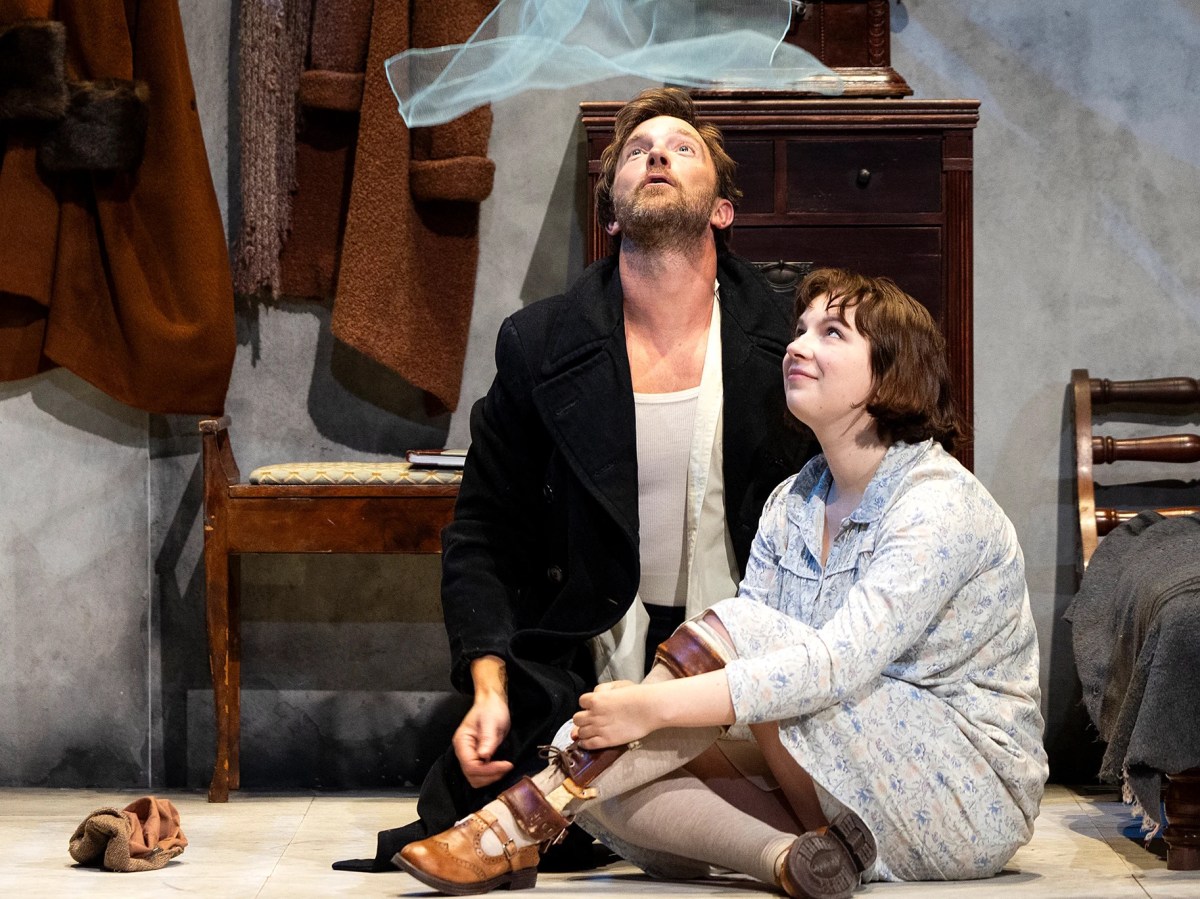
The truth here is found in the fractured relationships between a mother and her two adult children, one a restless young man, supporting the impoverished family with his job at a shoemakers’ warehouse, while the other is his younger sister, who plays with the fragile glass ornaments of the title and avoids contact with the outside world due to her debilitating timidity and physical disability.
Despite being a staple for theatre companies large and small across the world – with one set and four actors, the play is a natural for budgets of all sizes – The Glass Menagerie is actually a tricky beast to stage successfully.
In that respect, it’s not unlike another of the most lauded mid-century US plays, Arthur Miller’s All My Sons, which comes to cinema screens in Australia this week courtesy of National Theatre Live and Wyndham Theatre, with an award-winning Bryan Cranston in the lead.
Both plays are such devastatingly heartbreaking tales that any staging of them needs to lean into the humour wherever it can be found, in order to prevent the audience from leaving the theatre fully intent on slashing their wrists.
The trouble is getting the balance right. In his Wyndham Theatre production, Director Ivo Van Hove decided to start All My Sons with Joe Keller and clan at their most jovial and wise-cracking, before leaving all levity aside and wringing every inch of tragedy out of Arthur Miller’s work – honestly, they must have needed a pile of towels in the wings to soak up all the sobbing.
In this MTC production of The Glass Menagerie, Wilson takes a different route, with a larger than life, frequently stylised and sometimes laugh out loud approach. But to what extent does this overwhelm the possibility of pathos?
The Glass Menagerie’s unusual casting
In a pointed example of the maxim ‘use it or lose it’, Wilson makes his intent clear from the opening monologue. On strides Tim Draxl as Tom Wingfield – described by the play as the older narrator outside of the action and his younger self within it. But here there seems to be little distinction between the two – unless we’re to believe that Tom left home and spent decades getting even more ripped than he was as a young man.
It’s a far cry from the Toms we’ve seen before – Ben Mendelsohn in that 2004 MTC version, Sam Waterson in the 70s, John Malkovich, Hal Holbrook, Christian Slater or Zachary Quinto, to name a few. Not a body builder among them.
For the first impression we get here of Tom immediately gives Fassbinder’s Querelle, Tom of Finland or, keeping it within the Williams canon, a much more genial Stanley Kowalski vibes – tiny white vest, high-waisted trousers, fitted cap and bulging tattooed biceps that are so distracting they really deserve their own credit in the program.
The famous ‘I have tricks in my pocket and things up my sleeve’ line even doubles down on calling attention to them with an accompanying flex worthy of Schwarzenegger.
And when Draxl does don a shirt and immerse himself into the body of the play, he keeps it emphatic and, fittingly, always as a heightened moment remembered from things past. He never shuts a door in favour of slamming it with all his might, or argues with his mother so much as completely blows his top.
All Whyte for the role
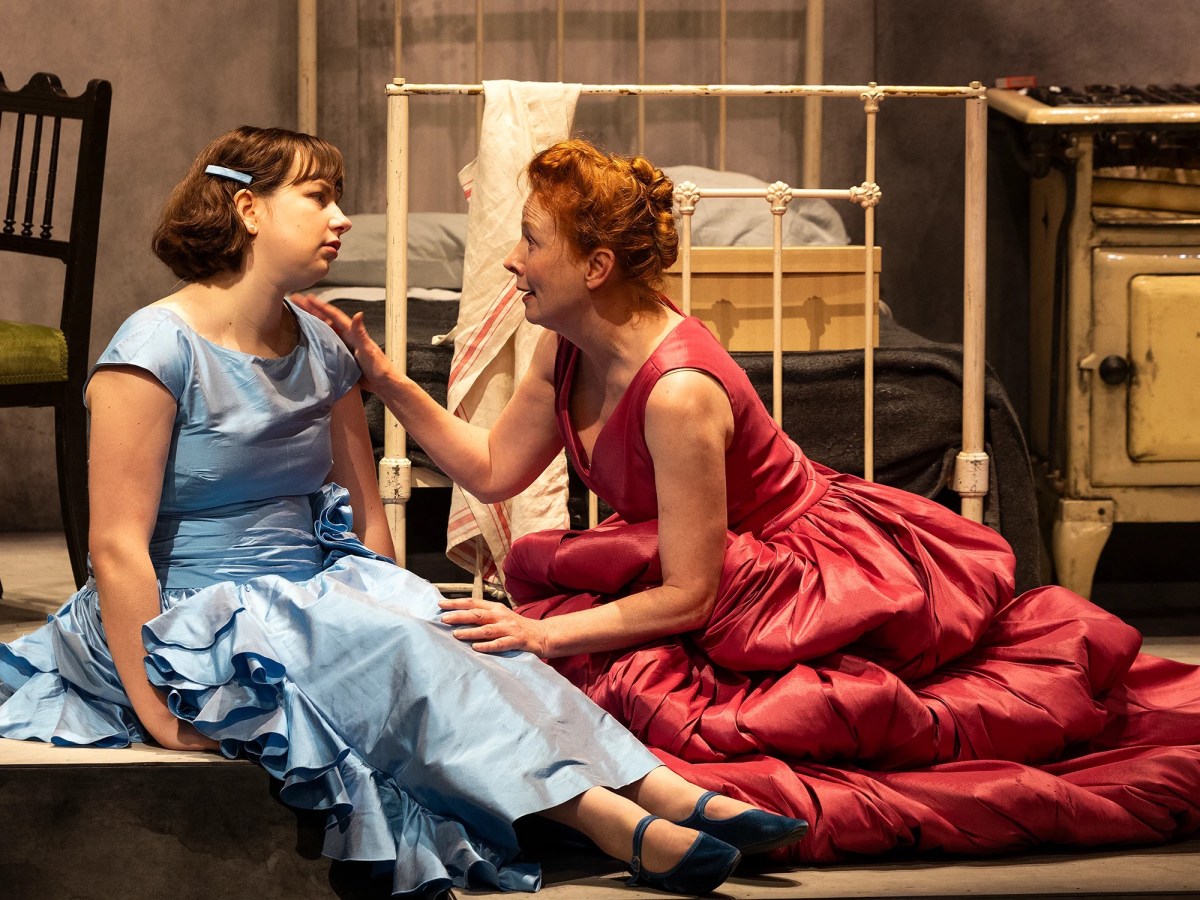
It’s clearly a directorial decision and one echoed by Whyte’s never still Amanda – obsessed and obsessive, attempting to rule over her two adult children and tiny, ‘on its uppers’ 1930s St Louis world with a desperate attempt to preserve her Antebellum roots.
Versions of Amanda appear in so many Williams plays. She’s what Blanche Dubois may have become had she married an absconder and had children rather than hitching up with a gay man and remaining childless – or even Violet Venable without the wealth and accompanying stature.
Whyte plays this to the hilt, utterly fixated on the idea of the gentleman caller – the 17 she had in her glorious faded past, or finding just one now for her shrinking violet daughter, Laura. And this is exemplified best in a moment on the fire escape when she literally blooms and grows up from Tom’s feet, stretching her tendrils towards the light.
It’s a style, and a refreshingly bold one at that. But, unfortunately, it’s not across the board and that makes for a disjointed whole.
The company notes state a desire to reimagine the play through both queer and disabled lenses, which is naturally appropriate. Tom and Laura’s relationship was inspired by Williams himself and his older sister, Rose, who eventually underwent a calamitous lobotomy and wound up institutionalised.
However, call it internalised homophobia if you will, but nobody could be harsher in his written treatment of gay men than Williams. Just look at Brick in Cat on a Hot Tin Roof or, my goodness, the fate of Sebastian Venables in Suddenly Last Summer. Here, Wilson’s direction of these elements is robust. Draxl, as Tom, draping himself all over Harry McGee’s Jim O’Connor – the gentleman caller/co-worker – is a case in point.
Putting the gloves back on
But there is a glaring anomaly when it comes to all this rambunctiousness, and that is Millie Donaldson’s Laura. Granted, it is very difficult to play an exaggerated form of shyness without it veering into caricature and killing any empathy stone dead, but as it is, the character is so withdrawn she’s almost pushed into invisibility by the stage-swallowing performances of Whyte and Draxl – so much so that the beautifully tender and delicate scene between Laura and Jim sees the production lose a great deal of momentum in the second act.
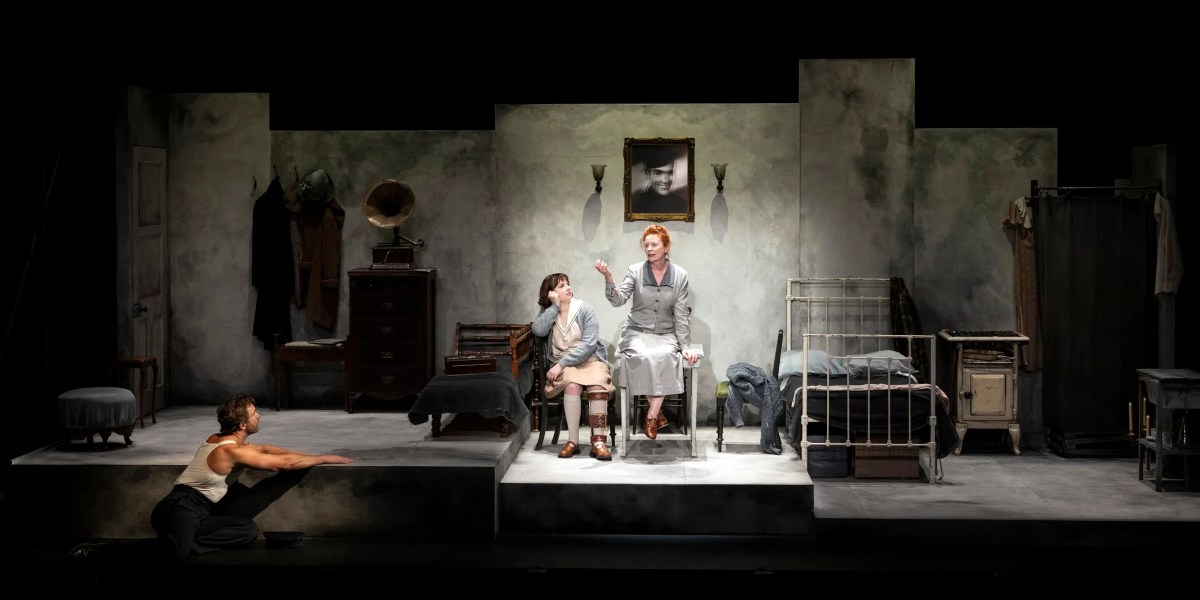
Yes, the play is written as two very distinct halves – preparing for the gentleman caller and then receiving the gentleman caller – and Kat Chan’s nicely contained set coupled with Paul Lim’s lighting plot underlines this well.
Behind an opaque then transparent brick-painted scrim, the tiny apartment is all greys until the second act, when the fittings and the lights transform it to a warmer russet brown. But it’s what the actors are doing in the space that carries the action. And if the first act is as loaded with dynamism as here, it’s perhaps asking too much to make the transition smoothly.
The nuances have just been too outmuscled. Literally.