

There was a spontaneous and sustained standing ovation at the end of the performance of Gatz. And understandably so. With a show that began at 2pm and finished around 10.15pm – lasting some 370 minutes (with around 70 minutes of breaks) it was a Herculean effort by anyone’s token.
But once the clamorous response had died down it was hard not to stop and wonder what prompted it exactly? Was it for an extraordinary production, which has been running across the US, and occasionally outside of it, for well over 20 years, picking up acclaim and awards along the way? Was it simply for the cast at having pulled off a colossal performance with nary a slip in energy or lost line in six hours and counting? Or was it merely an audience applauding itself for having the stamina to sit through such a theatrical marathon?
Perhaps it was a little of all three. Because Gatz was undoubtedly a monumental production and one with much to recommend it. But it wasn’t a flawless one. And for some viewers it may have even raised more questions than it answers. What is inarguable is the service it paid to F Scott Fitzgerald.
Gatz review – quick links
An acclaimed adaptation of The Great Gatsby
The play comprised the entire novel read out loud, mostly by its narrator Nick Carraway (Scott Shepherd). And what this did above all was remind us of the writer’s brilliance – his wit, his insight and his wonderful succinct way with words.
For this reason alone, the Elevator Repair Service production was a success – especially considering the most recent prominent version of the novel was Baz Luhrmann’s 2013 film, an adaptation in which the glitz and the glamour took precedence over any detailed examination of the text.
ArtsHub: The Great Gatsby review – Queensland Theatre Company’s vivid examination of the American dream
What was also a given were the fine performances from the entire cast. Shepherd should be commended for his excellent portrayal of Nick, but also for his vocal prowess and discipline. And for his prodigious memory – if it’s true that he wasn’t actually reading the novel, but reciting it.
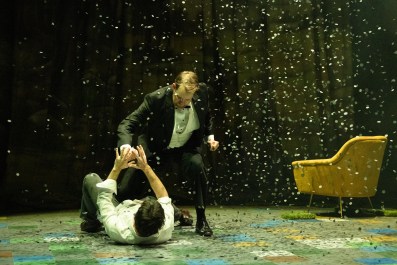
And how refreshing – after a trio of filmic Jay Gatsbys cast for their blond and boyish good looks (Alan Ladd, Robert Redford and Leonard DiCaprio) – to see a more mature actor take on the role. From the stalls, Jim Fletcher had a look of Gerald Ford about him, but as a man utterly undone by love, he was beyond credible.
Gatz moves from the office to Long Island

In Gatz (and the reason for this title rather than Fitzgerald’s original is made clear in the text), the device through which the book was brought to life was an office setting – an office at some point in the 1980s it appeared, judging by the presence of an Apple Macintosh and an ageing typewriter as pivotal props.
That early Apple computer became the catalyst for the action as Shepherd (in the guise of a nameless office worker) attempted to start the day’s work but couldn’t get the device to respond. After much futile pressing of keys and the obligatory TIOABOA (turn it off and back on again), he picked up a copy of The Great Gatsby from inside his Rolodex and began to read it aloud.
Slowly and one by one, his colleagues morphed into the characters in the novel, initially picking up the odd line and action, but eventually fully inhabiting the major players. Meanwhile the more peripheral figures were shared among the rest of the cast, including the technician, seated stage right throughout and entering the fray every so often.
A question
The first is a simple why? Why did his colleagues join in? What was the dramatic reasoning behind it? Shepherd’s office worker couldn’t access his computer, so he understandably turned to the book to alleviate his boredom. But his fellow workers were able to get on with their jobs. So why did they also fall into the world of the novel? Was Shepherd/office clerk/Nick simply imagining the whole thing?
In the early stages, before the novel took over completely, there were some uneasy clashes between the Long Island world of Gatsby and the mundane actions of the workers going about their tasks.
At one point Laurena Allan, who played Myrtle in the novel, was still in office mode and inspecting envelopes stage left. Except it wasn’t really clear what she was inspecting them for or why. But the upshot was she was so distracting it was easy to lose the thread of Nick’s narration.
There were frequent similar examples of multiple split focuses in Gatz. But just when it seemed as though the varied actions were merely haphazard and arbitrary, a cleverly timed sequence would prove just how tightly choreographed the entire show was – Jordan Baker (Susie Sokol) practising her golf swings, for example, with the sound cues absolutely in sync.
A second question
For a show that has been staged as frequently and successfully as this one, including at the Perth Festival seven years ago, how could some of the most basic tenets of stagecraft have been seemingly overlooked?

Centre stage was a large desk – the focal point of the office – which later became a table used by the Gatsby characters. But behind it, where many crucial scenes or exchanges took place was a couch. Behind it, mind you – upstage and largely masked by the desk, leading to severely limited sightlines for much of the audience whenever the couch was occupied.
It was particularly egregious in one of the comic highlights – when Klipspringer (Gatsby’s ersatz ‘boarder’) was prevailed upon to play the piano. Mike Iveson had a glorious moment in the spotlight with a song and extended mime, but sadly most of it was blocked from view.
There were also sequences where Nick sat at the desk facing upstage with his back to the audience. When there was not much else happening on stage, this was a curious choice at best.
Presumably these were all deliberate directorial decisions, but they were head-scratching ones at that.
Also disturbing was a cacophonous sound level, with the music dialled up to 11 when Gatsby and Daisy reconnected. Nick was still trying to read aloud, but was totally drowned out. Again, it was clearly deliberate, but if the fundamental idea was to bring every word of Fitzgerald’s text to life, then several lines were inaudible.
There were conventions set up and then seemingly abandoned – why, for example, did Nick himself speak most but not all of Wolfsheim’s words? The reasoning was unclear.
Last question

And speaking of unclear – and this may be a contentious query – but why pick an office setting in the first place? As a device, it seemed to be useful for the initial catalyst, but then became largely redundant. The two worlds diverged and didn’t really seem to inform each other.
Despite the slower nature of Gatz‘s first act (the action took a while to get going, and the whole thing was much livelier from the second act onwards), the cast were not given enough time to imbue their office characters with detailed personalities. So, it felt as if there was no correlation or logical relationship between who they were in the workspace and the characters they took on in the book.
But…
Putting aside all of these questions over the staging and very concept, Gatz was still an undeniably worthwhile theatrical experience. The Great Gatsby was written in 1925, and development of this version of it stretches back to the 1990s. And yet the insights it explores about the nature of unchecked ego, wealth and power are just as relevant today as they ever were, if not more so.
‘They were careless people… they smashed up things and creatures and then retreated back into their money or their vast carelessness… and let other people clean up the mess they had made.’ If ever a line seemed to accurately describe current geopolitical events, surely it’s this one from 100 years ago.