After reopening with the blockbuster Iconic Loved Unexpected in February, the Newcastle Art Gallery could easily have kept its impressively diverse permanent collection on display for many more months. Instead, three new exhibitions, including Tiyan Baker’s solo show Mouth Mnemonica and The Mordant Family Gift, have just opened, collectively mapping a vibrant world of national and global artistry.
It’s an ambitious statement of intent from the gallery, declaring a commitment to making the city a profound artistic destination. In a very meta turn of events, the three exhibitions, spearheaded by Brian Robinson’s Multiverse, have created an all-ages artistic multiverse of their own.
Newcastle Art Gallery review – quick links
The Mordant Family Gift stands on its own
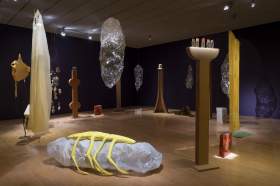
Becoming part of the permanent collection, The Mordant Family Gift comprises 25 works gifted by international philanthropists (and recent Australian ambassadors at the Venice Biennale) Simon Mordant AO and Catriona Mordant AM.
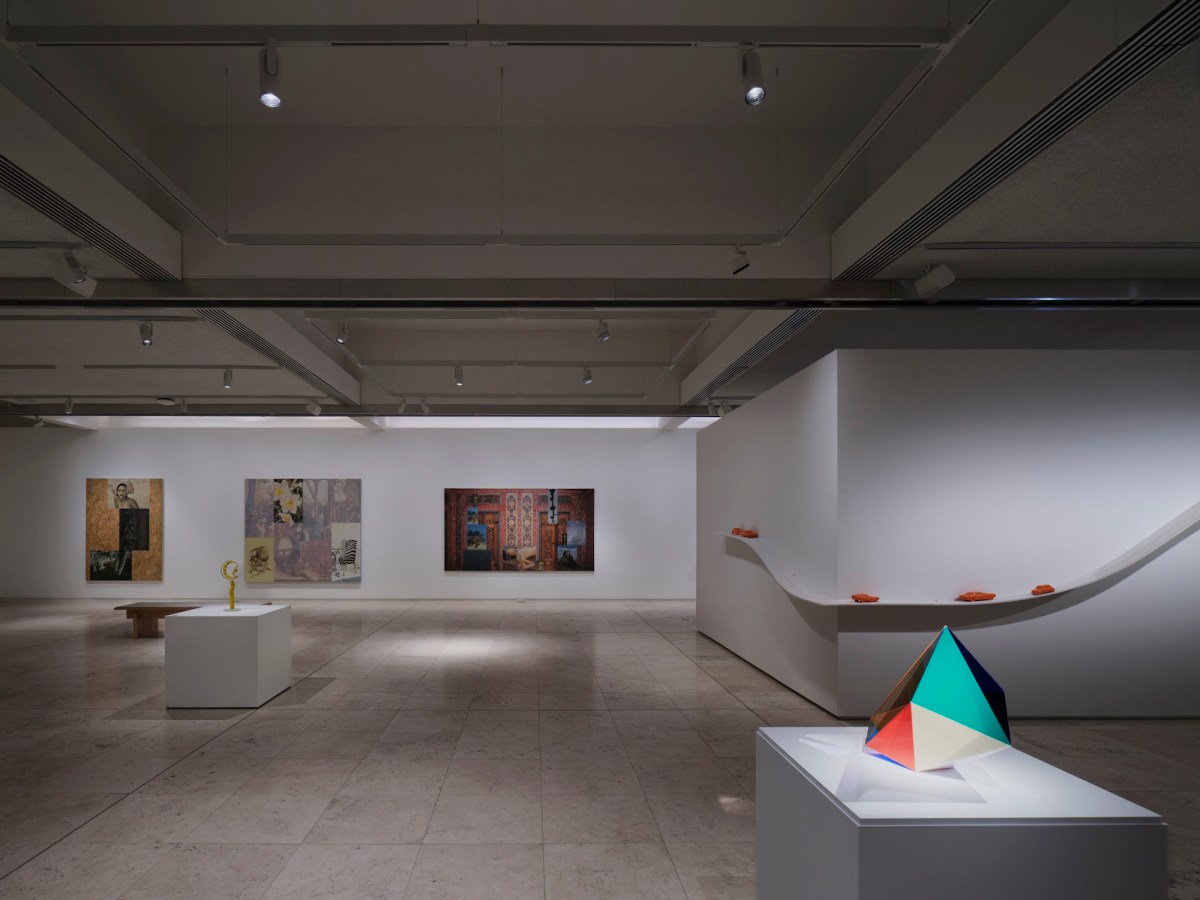
Gemma Smith’s Boulder (2009) stands firmly in the centre, an acrylic polygon that refracts and distorts light in gorgeous jewel tones. Tim Silver’s Untitled (What if I drive?) (2006), a series of orange wax crayon cars on a sloped wall path, pops out to the right. The cars drive into nowhere, off the wall, their waxy trails a reminder of the journey, if not the destination.
Last Night on Earth (2007) is tucked away in a corner. Brisbane artist Alasdair Macintyre toys with who gets to be put on display using a small clay figure of a janitor mopping acrylic paint, high on a podium.
Most intriguing is Make Out (Shadow box 8) (2009) by Canadian-Mexican artist Rafael Lozano-Hemmer. It’s a constellation of internet clips showing people, as the title suggests, making out. The clips are tightly packed onto the screen and as you move across a motion-sensor box, the individual videos light in your shape. Drawing viewers into a cheeky and voyeuristic act, the shadowbox work asks questions about who is observed and who is engaging in the act of observing.
The Mordants’ gift, ranging over such wide interests, is presented here in a way that feels bright and smartly accessible, objectively stunning but strung together to create a deeper story. Displayed parallel to the Iconic Loved Unexpected exhibition, it’s a fitting extension to the gallery, as the first of many rotating showcases.
Tiyan Baker’s Mouth Mnemonica speaks up
Tiyan Baker’s first institutional solo Mouth Mnemonica is deeply intrigued with matters of the mouth and language. Her practice touches on heritage, history and verbal exchange, as she finds different mediums to try and preserve and share Bukar, the Bidayǔh language spoken by her mother.
Hanging near the entrance, nyatu’ maanun mungut bigabu (2021) is a series of magic-eye autostereograms capturing a forest in Malaysian Borneo, near the Bidayǔh village her mother descends from. While I’ve always been hopeless at magic-eye paintings, the static images are lush and verdant, durians and rockpools unveiling Bukar words with a trick of the eye.
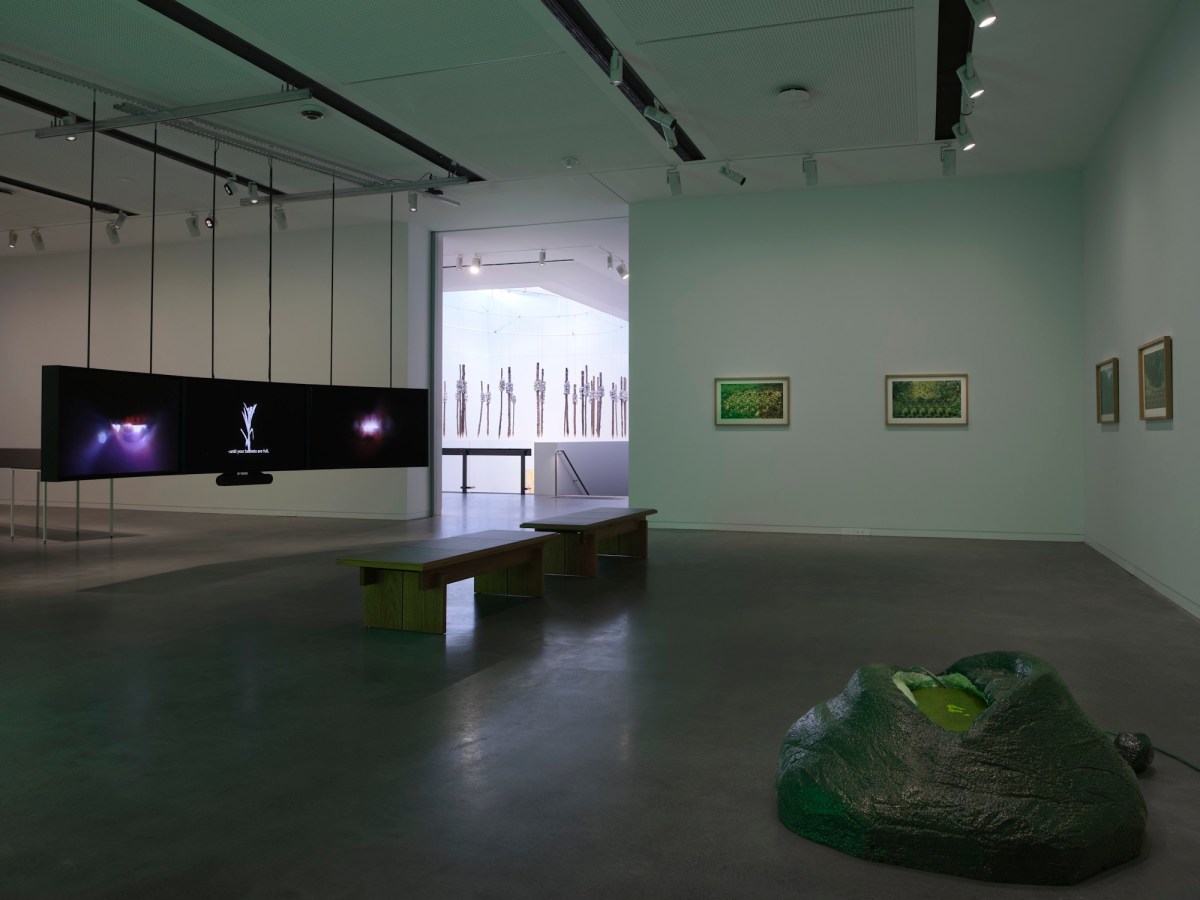
Levitating in the middle of the room is Baker’s extensive video work To tangle together like coursing water (video) (2026). Across a three-panel screen, footage from inside the mouths of Baker and her mother (taken with a dental camera) is projected alongside subtitles. The performers engage in a poetic exchange, reciting Bukar poetry to untangle her mother’s memories and the artist’s own struggle to learn the language without living in the place where it is most commonly spoken.
Much of the poetry touches on flora and fauna, such as a listicle including ‘Wild cat; Wild mango; Wild orchid’ then peculiarly followed by ‘Type of tree that causes itchiness’. Even in the obtrusive act of placing 360-cameras under their tongues, there are still untranslatable truths.
Sweeping behind the screens is Baker’s To tangle together like coursing water (mnemonic device) (2026), a series of 3D-printed enamel teeth with script etched on them. At what point, you wonder, does language become so embedded within us that we can’t lose it? What happens when it is written in the body?
Baker’s work contends with these exact ideas, and in seeking to capture something so ephemeral, it proves the act of reclaiming language and personhood will always be active and ongoing.
Brian Robinson’s Multiverse rebuilds our world
The headliner of the three exhibitions, Robinson’s exhibition is the first paid exhibition at the reopened gallery, which assumes the collection is worth a visit in of itself. Robinson’s work, integrating pop cultural symbolism and Catholic and colonial iconography alongside Torres Strait design, soars above expectation.
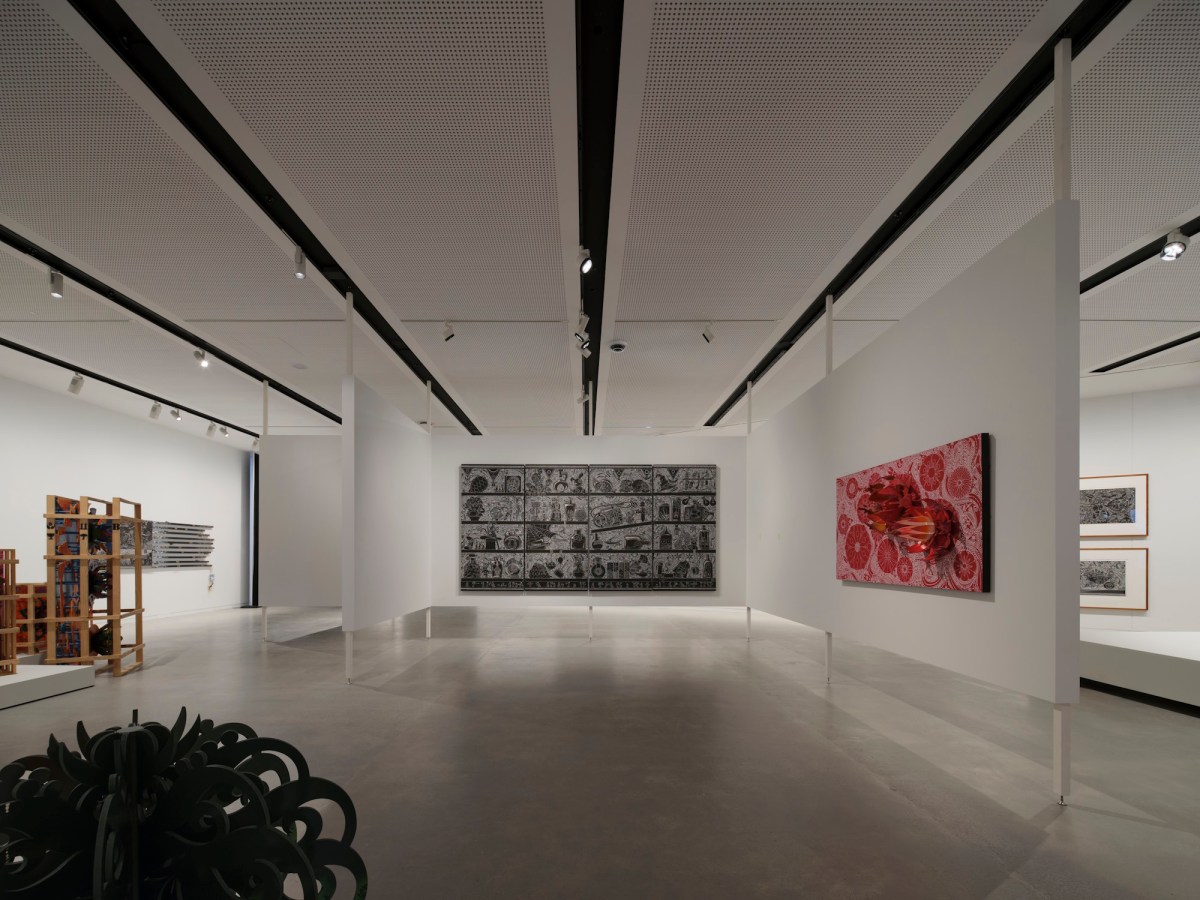
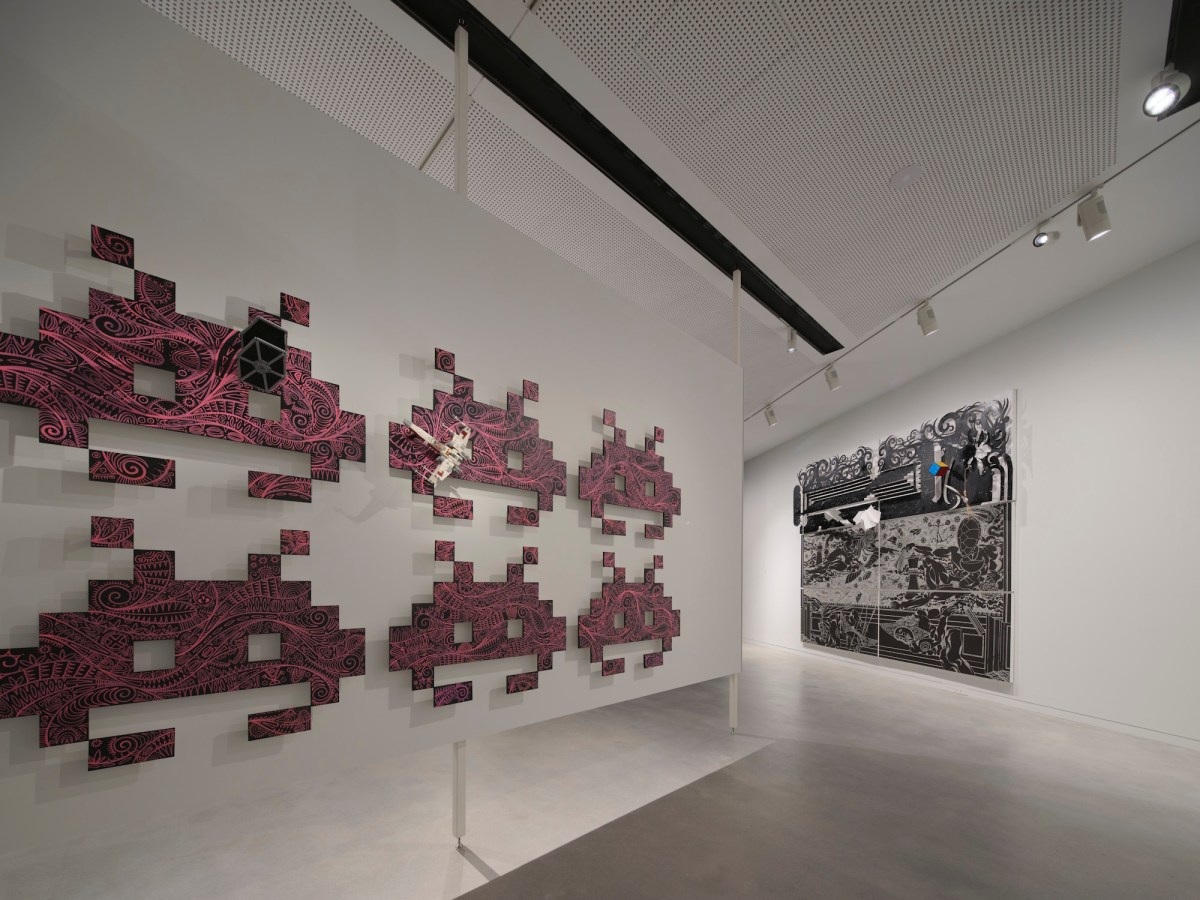
Multiverse spans over a decade of work by the Maluyligal and Wuthathi artist, tracking his growth in scale and ambition through hulking linocut prints and colourful sculpture. Banks’ Bounty: Exotic cargo (2022-24) is a hyper-saturated structure, with wooden crates holding polyvinyl foam and plasticine toys. Figures like Bart Simpson and Gary the Squid are peppered among the floral shapes, a playful intrusion in the often monotone space of a gallery.
The newly-commissioned Abracadabra: Magic, mystery, and the occasional science contraption (2025-2026) was developed through Robinson’s residency at the University of Newcastle. The four-panel linoprint is stuffed with intricate Torres Strait designs, and on carved shelves sit figures and objects representing magical entities. It’s a generous and technically impressive work that rewards deep observation.
Earlier prints illuminate Robinson’s history of historical intrusion and cultural collision. And on the sixth day he created man (2010) depicts a Torres Strait figure grasping the Vitruvian man, while By virtue of this act, I hereby take possession of this land (2017) features coloniser James Cook backed by space invaders.
These prints create a throughline from interrogation to integration, showing Robinson’s work slowly reconciling dominant cultures, not as oppositional to Indigenous ideas, but as potentially harmonious.
In curating this history, Multiverse highlights the political potency of his works. Standout new prints like the self-explanatory Miffy and friends: The usual suspects (2020) establish a new visual language for cultural exchange in so-called Australia, one which respects and uplifts its Indigenous cultures.
What struck me most with Robinson’s art was how wide-ranging it was in its appeal to audiences. Walking through the space I kneeled and squatted, wondering how a child would view each of these highly-detailed works. The work felt both exquisitely crafted and ‘school holiday friendly’, two categories sharing a fundamental curiosity for what makes us human, and what makes us spark.
Taken as a whole, the three exhibitions are an exciting and forward-facing act of curation, a strong step from the recently reopened gallery that leave me very excited to see what they have next up their sleeve.