In his short story collection Shirl, Victorian writer Wayne Marshall set an Aussie bloke up with a true blue missus, except she happened to be a kangaroo. Laconic and a little unhinged, his stories wheeled through masculinity, male friendship and the weight of cultural mythologies. Now he’s back for more with an inventive debut novel that dives straight into the ur-story of the Aussie bush and the national obsession with mateship.
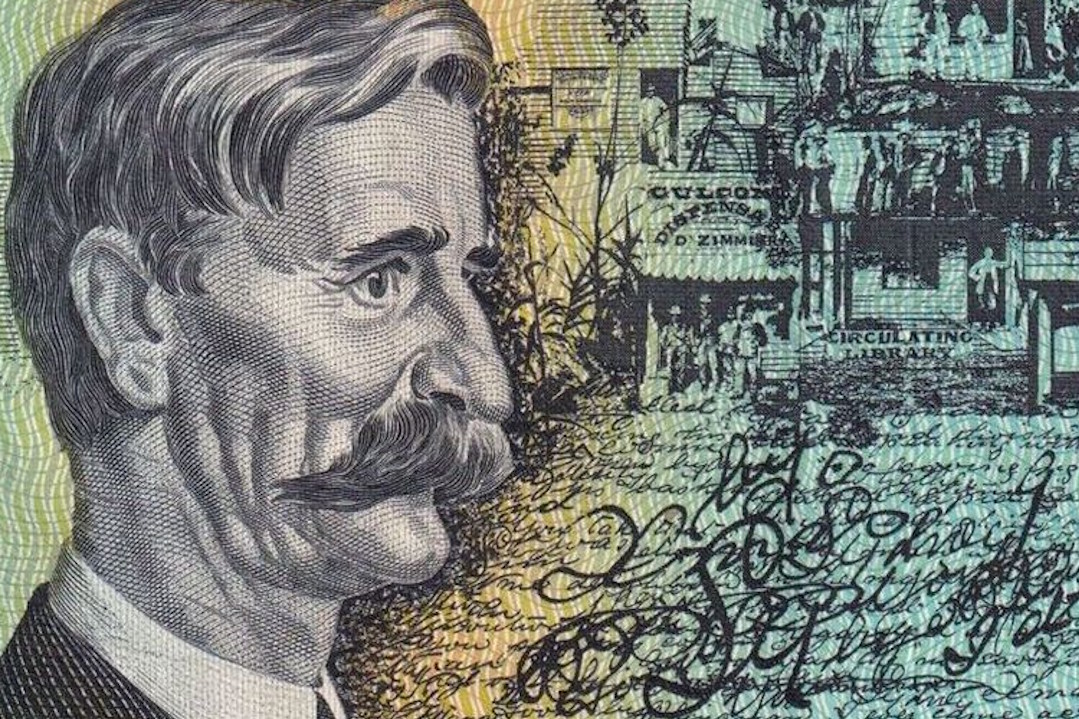
Reimagining the life of the iconic writer and bush poet Henry Lawson, Henry Goes Bush is extraordinarily fun. Lawson is a firm part of the canon these days – try to count the contemporary adaptations of his 1892 short story The Drover’s Wife and you’ll be running out of fingers – but rehabilitating this central figure of Australian literature is no easy task. He was an alcoholic and a wife beater. At various points, mental illness also saw him institutionalised and destitute.
Rather than grapple with this side of his story, Marshall picks up with Lawson as a young man, lost but full of potential. Hapless, heartbroken and very, very hungover, it doesn’t take much for his boss at the Bulletin newspaper – a man named Archibald, who’s thinking of starting a portrait prize – to press him into a trip to Bourke to dry out.
Archibald is the quiet puppeteer behind Lawson’s career, and the one who’s been encouraging him to write about the bush even though it’s not really his world. He thinks Bourke will be the making of the young writer: part fact-finding mission, part shove in the back to grow up and become a man.
Bourke, however, has other plans.
Henry Goes Bush review – quick links
Bourke gets weird
And why Bourke? It’s the town lionised by Bulletin writers as the gateway to God’s country, the point where the real bush begins to unfurl. Lawson faces this trip with about as much enthusiasm as a school detention but he takes his pocket money from Archibald and gets on the train like a good boy.
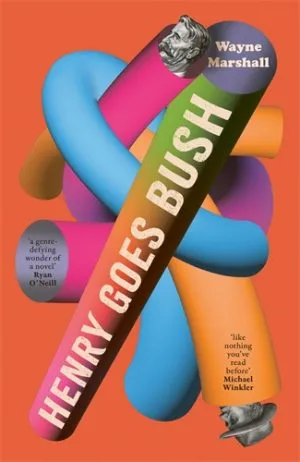
Marshall gives us a version of Lawson we can recognise: the kind of young man who might be just as easily found floating through film school in Melbourne, resentful and clueless but with an easily bruised heart underneath.
He plans to be anonymous in Bourke but as soon as he arrives, he’s hit upon by a local politician who wants him to pen some rousing bit of jingoism for his campaign about The True Spirit of the Bush. Lawson’s lukewarm on this too, but earns himself some free advice.
‘You should also look at putting a bit of meat on that moustache,’ he’s told. ‘Moustaches like that aren’t well received here.’
Marshall has a knack for dry comedy, but the encounter’s also one of the first signs that the bush means very different things to different people here.
This unstable terrain soon proves to be, well, unstable – there’s an earthquake, not that anyone in the pub seems to mind much.
Things get very strange very quickly after that, as Lawson discovers the earthquakes are opening up different versions of Bourke, each one stacked on top of the other. Then arch rival Banjo Patterson steps off the train. Lawson might not know it yet, but the battle for the bush has begun.
Henry Goes Bush: a war of ideas
To begin with, the battle for the bush was only meant to be a bit of writerly showmanship – an idea of Lawson’s to have some staged back-and-forth with Patterson in the safe, cosy pages of the Bulletin. He wanted an ally more than a rival. But speculative fiction, as Marshall well knows, is metaphor made concrete.
Henry Goes Bush relishes the chase. Patterson has a crack team behind him, including the rodeo rider Sissy Fitzgerald, the wild, exiled daughter of an upper class family. Lawson has no-one in town, at least not until he meets the young and starstruck poet Jim Gordon.
ArtsHub: More Australia book reviews and news
To make the battle even more uneven, Patterson is a lawyer, with a rigid sense of class and propriety and entirely different sort of work ethic. To him, the bush is about the honour and dignity of labour, and he faces his job in Bourke with the same lock-jawed earnestness. Lawson has always been much more ambivalent. ‘The bush’s the bush,’ he says, early in the piece. ‘To be survived. To be gotten out of.’
Marshall weaves a clever framework around these conflicting colonial views, positioning them – and particularly the fear of the bush – in contrast to Indigenous perspectives, though it’s lightly done. The focus here is on the literary hero figures of Lawson and Patterson, and the comedic swing between ideological and physical warfare. But is really their war or someone else’s?
Writing an icon in Henry Goes Bush
It’s a relief to see a writer taking on the great weight of the Australian literary canon with this sort of playfulness. Henry Goes Bush is serious too, though, and in many ways, Marshall’s novel is working from the same place as Ryan O’Neill’s biting take on Ozlit, Their Brilliant Careers (2016), which, apart from poking fun, was also just trying to unpick how Australian culture got the way it did.
More meta than Zuckerberg, Henry Goes Bush is very aware that it’s dealing not just with Lawson and Patterson and everything they wrote, but also with the kaleidoscopic array of stories about them, and the various political agendas that have put their creations to work.
The many-worlds version of Bourke is a clever way to send Lawson careening through different aspects of this legacy but perhaps more critically, Marshall also uses it to offer the reader the prospect of alternative futures for Lawson – ones where maybe he doesn’t always end up addicted, violent and destitute.
It’s that sense that anything can happen that keeps the reader on side with this soft, tender-hearted young man. And as he grapples with his loneliness, Henry Goes Bush reveals itself as a novel with (surprise) mateship at its heart. That’s explored with the acolyte Jim Gordon, with whom there might be faintest spark of something more, as well as in later buddy hijinks and the battle with Patterson too.
Henry Goes Bush is a ride, the kind of action-packed caper that revels in surprises. While there might be the odd moment when the meta-narrative about Australian literature is stronger than the actual narrative, it remains a rare beast of a novel: a serious look at where we’ve come from that also points to how utterly absurd that story really is.