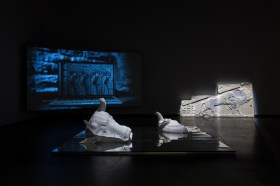
The first thing that registers walking into the exhibition Man on Fire: Visions of Nebuchadnezzar is the light. Carefully calibrated throughout the Bundanon Art Museum, it lifts Arthur Boyd’s paintings from the walls with remarkable clarity, allowing bursts of fiery yellows, electric blue and pungent greens to flare against the neutral setting.
Rather than presenting Boyd as a familiar monument of Australian art, the exhibition restores the visceral energy of paintings that remain unsettling more than half a century after they were made.
Curated by Bundanon’s Head of Curatorial, Sophie O’Brien, the exhibition brings together one of the largest presentations of Boyd’s Nebuchadnezzar series to date, drawing on Bundanon’s holdings alongside major loans from the National Gallery of Australia and private collections. It rewards close looking not simply because of the calibre of works assembled, but because O’Brien has shaped the exhibition around Boyd’s central idea: transformation.
Man on Fire review – quick links
Arthur Boyd’s Nebuchadnezzar series
The main gallery belongs entirely to Boyd. Produced largely in the 1960s, the paintings unfold as an immersive sequence of psychological states rather than illustrations of a biblical narrative or held religiosity.
Boyd was never interested in retelling the Book of Daniel – the Old Testament story of the King Nebuchadnezzar, punished by God for his greed and pride, and condemned to live as an animal in the wilderness for seven years.
Instead, Boyd isolates moments where certainty fractures: Nebuchadnezzar clutching his wealth, struck by lightning, consumed by fire, crawling naked through the undergrowth, before slowly surrendering to the natural world.
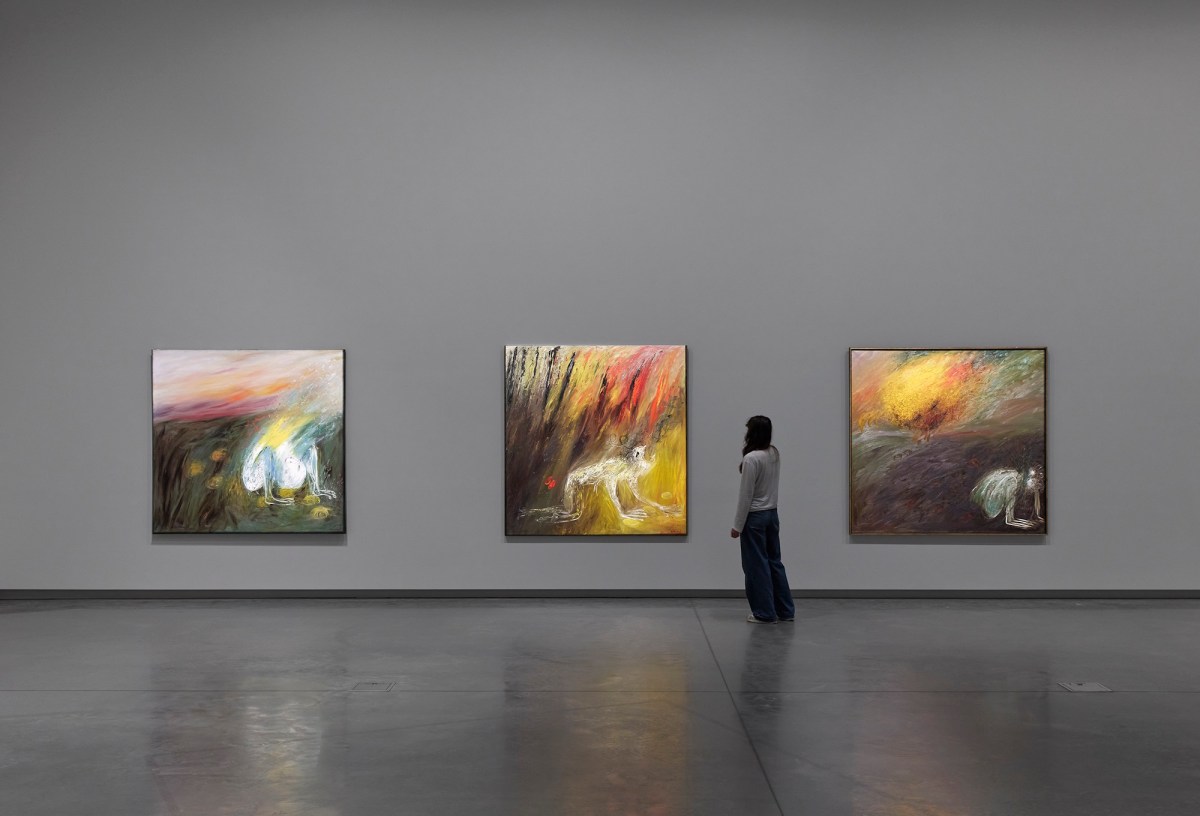
O’Brien’s installation reinforces that emotional trajectory. A long wall accumulates images of torment and physical collapse before gradually giving way to quieter works where trees emerge from bodies, clouds become extensions of the self and nature offers the possibility – not certainty – of renewal. The exhibition asks viewers to linger with Boyd’s most difficult paintings before allowing any sense of release.
Painted largely during the Vietnam War while Boyd was living in London, the Nebuchadnezzar series has long been understood as a protest against conflict. That political reading remains vital, but this exhibition broadens the conversation. Boyd’s fallen king becomes an allegory for masculine pride, empire and moral reckoning, exposing the fragility beneath power.
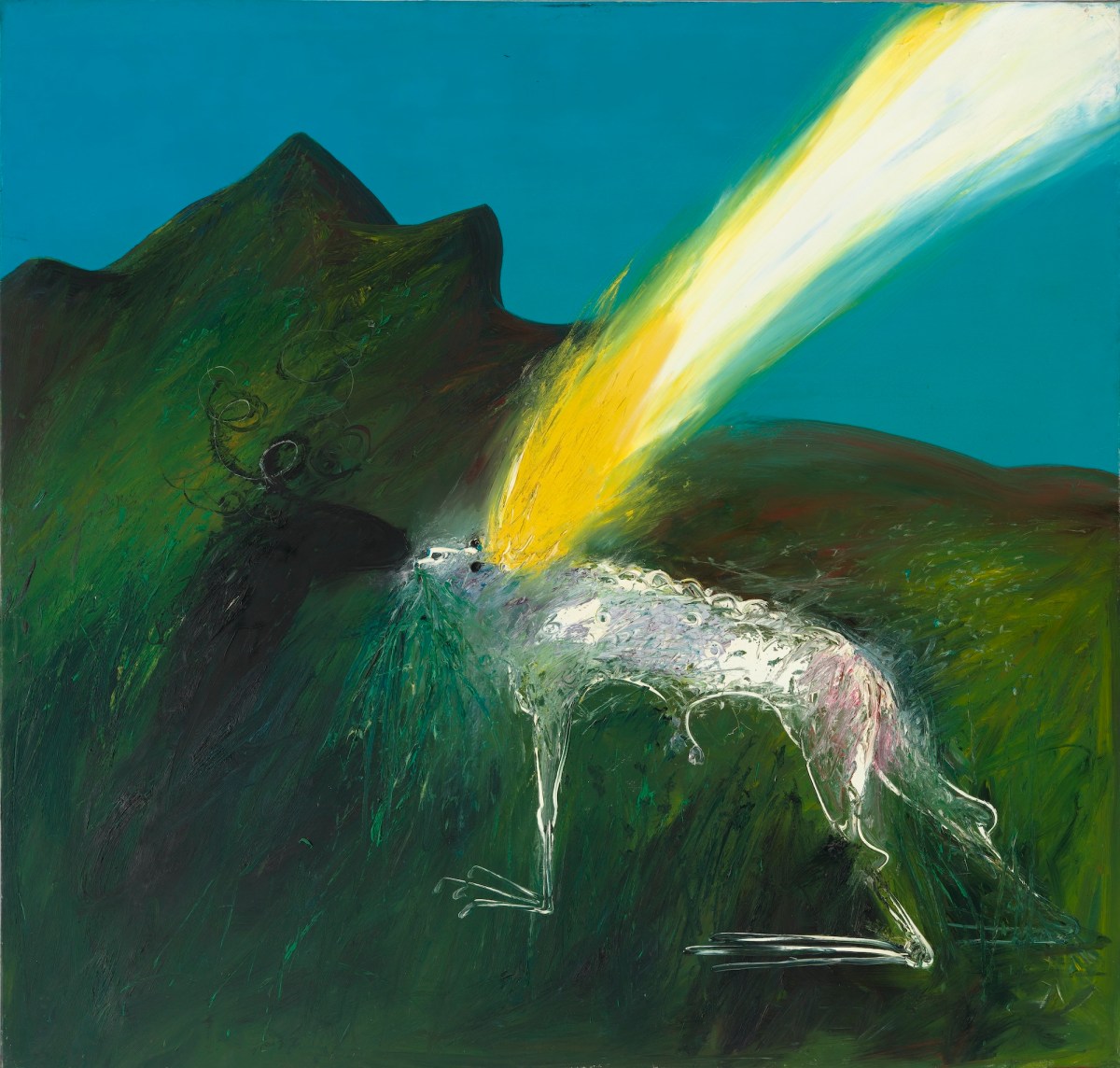
What distinguishes the exhibition is its refusal to reduce these works to anti-war paintings alone. Nature, for Boyd, is never merely backdrop but an active force through which ego dissolves and transformation becomes possible.
Confronting vulnerability
Equally compelling is the exhibition’s attention to Boyd’s personal mythology. O’Brien draws subtle connections between the biblical king and Boyd’s father, Merric Boyd, whose epilepsy profoundly shaped Arthur’s understanding of physical vulnerability. Recurring green-topped trees associated with Merric quietly thread through the exhibition, suggesting that these paintings are as much about compassion and inheritance as they are about political protest.
Boyd’s treatment of the male body remains startling. Figures crawl and howl, their anatomy exposed, distorted or burning upwards into the body. Pride is rendered not as strength but as something combustible, unstable and ultimately self-destructive.
It is this physicality that multidisciplinary artist Shaun Gladwell mines in his major new commission. With longstanding ties to the Shoalhaven, and a deep engagement with Boyd’s work, Gladwell shares the older artist’s interest in masculinity and endurance, yet approaches them through the lived body rather than the painted image.
It’s only after Boyd’s world has been fully established in the first gallery that the exhibition shifts into Gladwell’s response. The transition is striking. Visitors leave the luminous gallery for an almost entirely darkened space dominated by Gladwell’s hour-long moving image, filmed over two weeks on Bundanon’s landscape.
Shaun Gladwell’s A Nebuchadnezzar Cycle
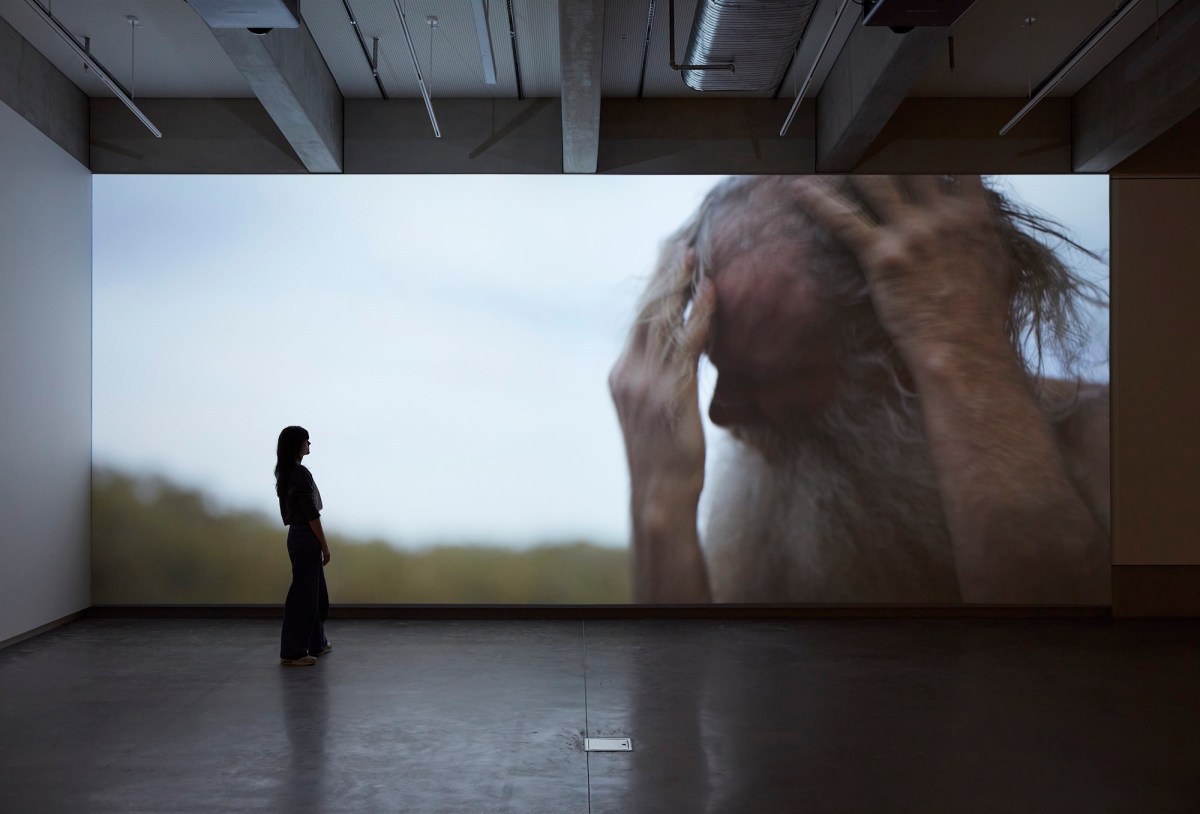
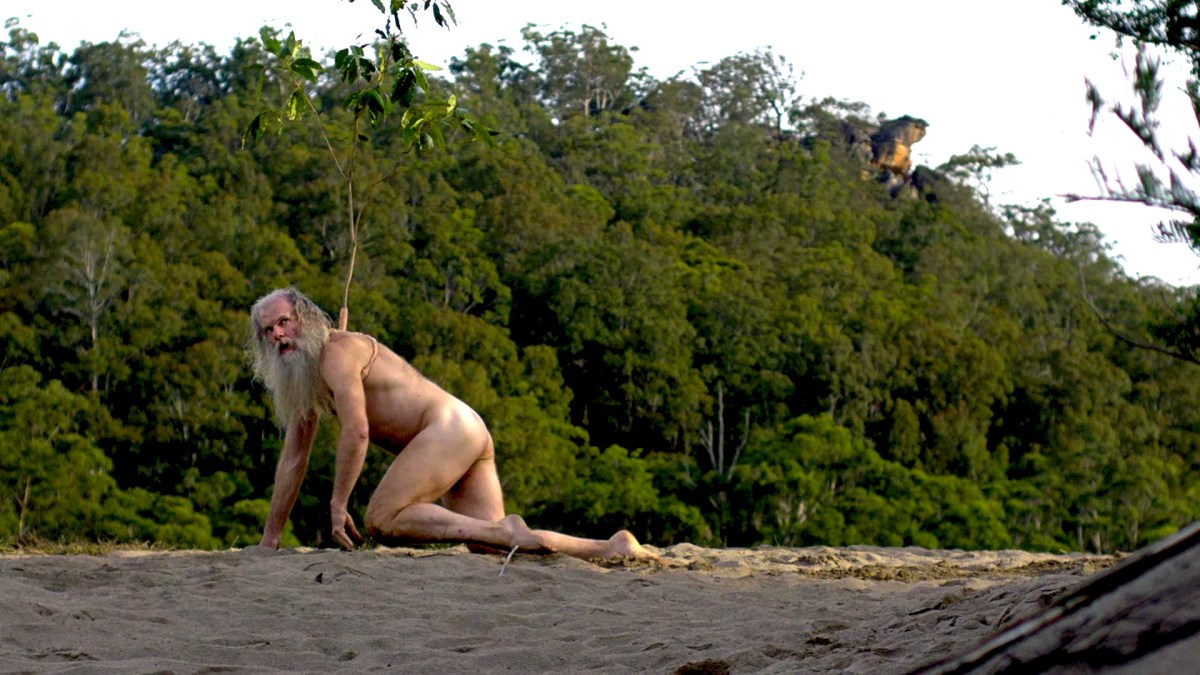
Structured across nine chapters, drawn from Boyd’s painting titles, a naked Gladwell crawls through bushland, immerses himself in the Shoalhaven River and, in one unforgettable sequence, enters the water engulfed in controlled flames. Boyd’s imagined body becomes Gladwell’s enduring one.
The darkness of the gallery heightens the work’s meditative rhythm. The film inhabits Boyd’s ethical concerns through contemporary performance, asking what transformation might mean when experienced physically rather than symbolically. And, because the film loops continuously, redemption remains perpetually deferred.
While the film is deeply performative, it is less about feats of strength – the hallmark of Gladwell’s earlier practice – than it is surrender. It becomes an acceptance of vulnerability, of an ageing body and human limitation.
Clearly this is not just role playing for Gladwell. Like the shadow of Merric in Boyd’s work, Gladwell has lived his own shadow of the Vietnam war – its banishment and violence – with his father a veteran. And, also like Boyd, he spent a pivotal period in London after art school, describing it as a time that ‘saved him’ as an artist.
We see these raw emotions not only in the film, but especially in a small group of photographs (destined to become a future body of work), where Gladwell’s own pain is exorcised like Nebuchadnezzar in this kind of purgatorial landscape.
A dialogue across generations
The final gallery completes the conversation across generations. At its centre sits a custom crash mat beneath the suspended handlebars of a BMX bike, remnants of a durational performance staged just days before the exhibition opened. They retain the memory of physical depletion – that point where endurance gives way – and become a quiet metaphor for the futility of clinging to power.
These objects are paired with Boyd’s expressive black-and-white drawings, works whose loose, experimental lines reveal drawing as a process of renewal within his own practice.
Interestingly, in the museum foyer, a small selection of Gladwell’s daily drawings extends that idea of making as ritual rather than product.
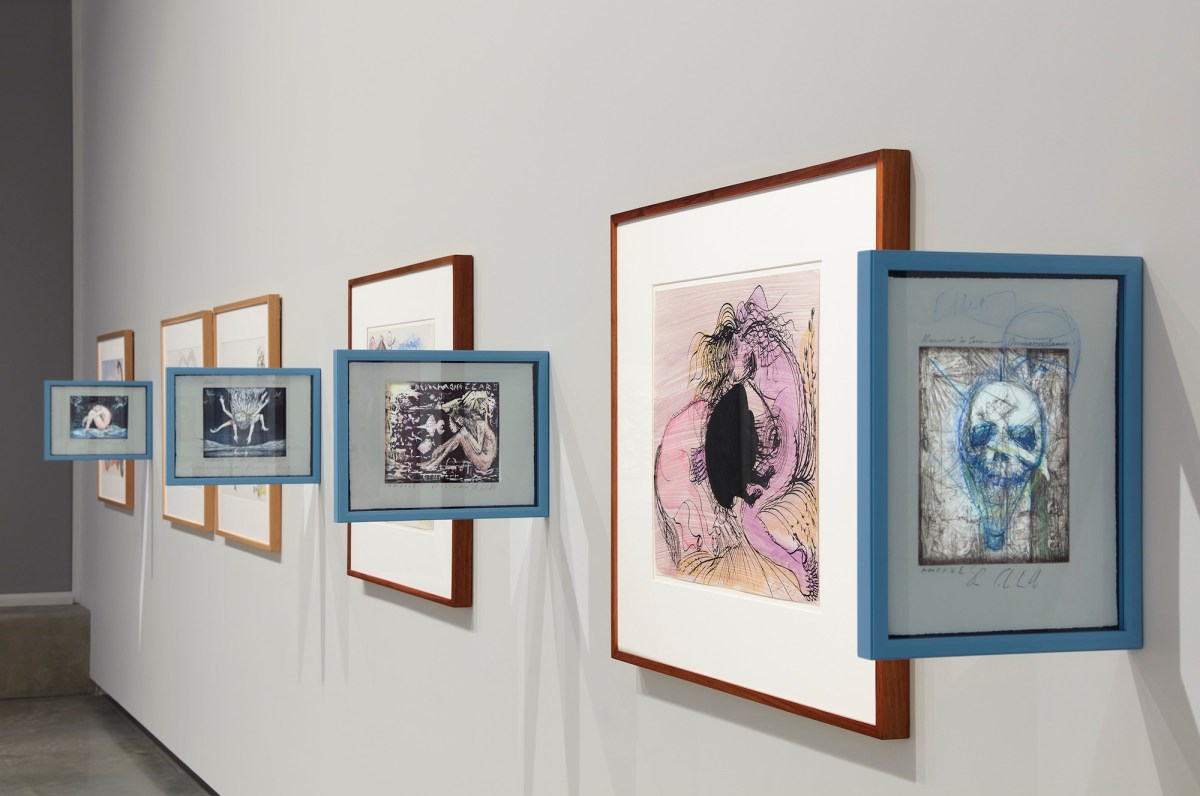
On the final wall, Gladwell’s hand-coloured prints are mounted perpendicular to the wall so both surfaces are visible, and these are interspersed with prints by Boyd. The unusual installation creates a literal dialogue between artists across generations, allowing visitors to move around each work as if circling an ongoing conversation rather than comparing historical and contemporary practice.
Throughout, Bundanon emerges as an active collaborator rather than simply a venue. Gladwell’s commission grew from months spent in residence on the property, while Boyd’s paintings return to the landscape that would later become central to his life and legacy.
O’Brien’s exhibition understands that connection instinctively. Landscape is never backdrop here; it is the place where identity dissolves, time compresses across deep long histories, and transformation becomes possible.
The achievement of Man on Fire lies in resisting easy historical reverence. Instead, it reveals Boyd’s Nebuchadnezzar cycle as an unfinished conversation about violence, humility and the dangerous seductions of power. Gladwell does not modernise Boyd so much as demonstrate that the questions Boyd posed have never stopped demanding answers.
At a moment when conflict, conquest and masculine authority once again dominate public life, Bundanon has produced an exhibition that feels less like a survey than a reckoning. Boyd understood that the story of Nebuchadnezzar was never really about divine punishment. It was about the dangerous belief that power exempts us from our own humanity. More than 50 years later, that lesson has lost none of its force.