
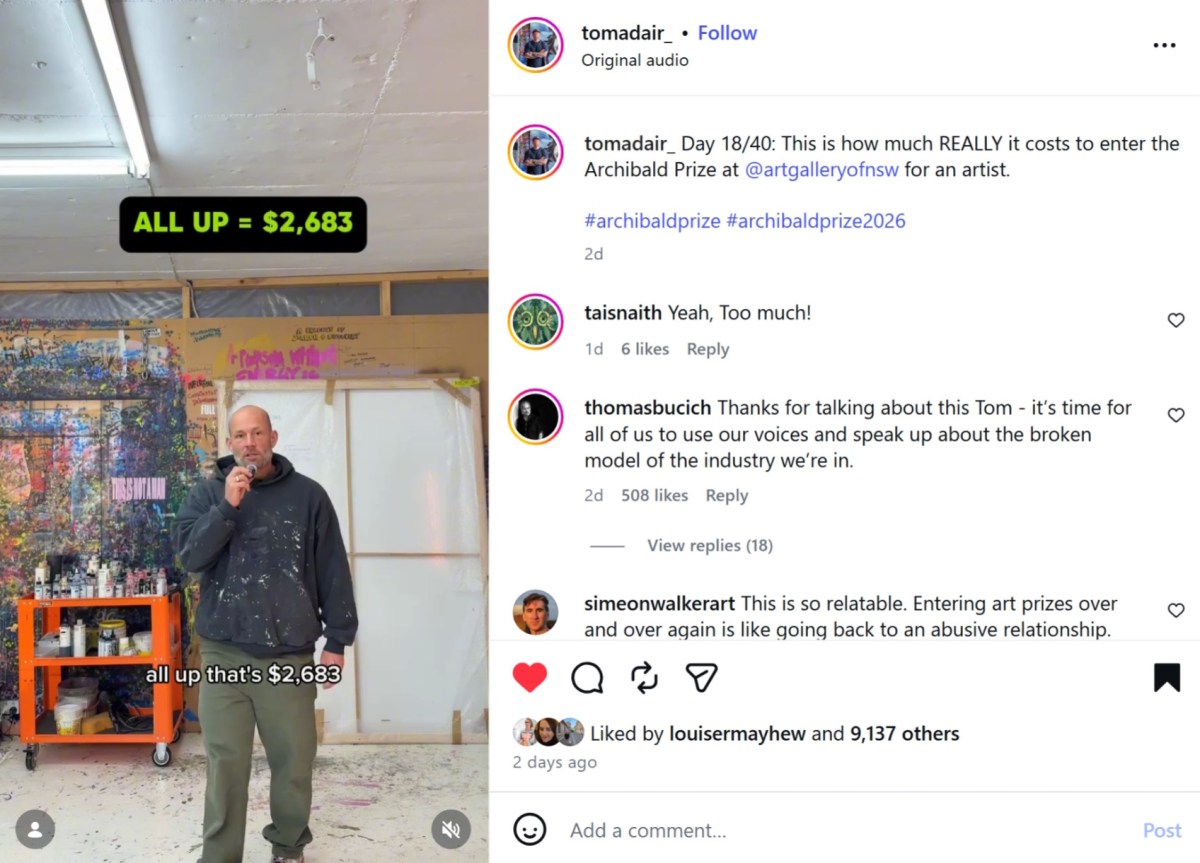
Recently, artist Tom Adair took to Instagram to list his full costs entering the Archibald Prize. Alongside the $50 entry fee, he went through materials and framing – not cheap – but also his travel expenses to meet with his sitter, and the hundreds of dollars he spent on specialty art couriers to get his work to the Art Gallery of New South Wales, and then back again. All up, his shot cost him $2683.
This is all a choice, or at least that was what some commenters jumped online to tell him. Others said they gave themselves restrictions on size and material to help manage the expense, or simply didn’t bother entering at all.
Yet for many artists, it doesn’t feel like much of a choice. Art prizes are now such a critical career pathway that they’re almost impossible to ignore. To give up on them entirely means stepping back from one of the most visible ways of attracting curatorial and critical attention, not to mention getting work in front of new audiences via well-attended institutional exhibitions.
The Archibald, of course, is one of the most popular of all. When the American superstar critic Jerry Saltz stopped in at AGNSW during his recent visit to Australia, he said it was ‘one of the most crowded shows I have ever seen’. There remain very good reasons why getting into this prize exhibition can feel like an Olympic-level achievement for artists.
But when Adair catalogued the cost of his unsuccessful entry, he hit on a very uncomfortable question: should it cost this much to have a go?
The debates around art prizes – quick links
The cost of entering
There are already serious inequalities in the visual arts, particularly around access to education and opportunities. The financial precarity of the work itself is another major factor in the lack of diversity. One reason Australian culture is so fixated on prizes is precisely because of that: they’re meant to be even playing fields.
In the visual arts, entry fees are typically a little higher than for writing prizes. The Archibald’s $50 is fairly standard here. Most prize organisers are trying to balance artists’ need to budget these things while also, in many cases, using the entry fees to beef up the prize purse. (Not everyone has AGNSW’s operating budget.)
The logistics are changing. Transport has long been an issue, particularly for regionally based artists, but many prizes are now judged on the basis of images, at least in the first round.
It’s a welcome shift that removes the need for couriers or delivering the work in person, and makes entering much more feasible for those based outside of the cities, but it can sometimes leave artists with the cost of professional documentation instead. (When ArtsHub looked inside the judging of the hugely competitive Loewe Craft Prize, it was made explicit just how important clear images can be.)
Judging based on images is not going to work in all cases. This year, for instance, the Archibald received over 1000 entries and it’s not hard to imagine the flood that would arrive if the prize rules were relaxed to accept digital submissions. (For his part, Adair seemed more concerned with transport costs, suggesting in the comments to his reel that AGNSW might use its standing to potentially organise an artist discount with one of the art courier services.)
Paying for a platform
Many of the hundreds of comments on Adair’s reel shared his frustration, or just voiced relief at hearing the issue being talked about. One artist, Simeon Walker, said, ‘This is so relatable. Entering art prizes over and over again is like going back to an abusive relationship.’
Another compared the art world to big-business sport. ‘Imagine a footy game that only paid for one player, the top player, and all the other players not only got nothing but they actually had to PAY an entry fee,’ said Naomi Crow.
What comes through here is a sense of the changing expectations around art prizes, which, while not exactly the big money spinners of footy games, can still be major draws for their organisers. In what felt like a plea for respect, one commenter suggested that at the least, organisers could provide entrants with a free ticket to see the prize exhibition.
There’s obviously an emotional dimension to many of these conversations. Rejection stings at the best of times. All artists, whether they choose to enter art prizes or not, are constantly assessing if, when and where to put their work out there, and what’s worth their time, money and effort. Unfortunately, that often comes down to trial and error, and there are no simple answers.
But running underneath all this, Adair also tapped into a deep vein of discontent about the difficulty forging a career at a time when traditional pathways, like gallery representation and institutional exhibitions, are so difficult to secure, and art prizes appear as largely pay-to-play opportunities.
The changing place of art prizes
For audiences, on the other hand, the appeal of art prizes is fairly straightforward. Give or take the odd grumble about injustices, oversights and scandals, it usually feels pretty good to see artists raised up and lauded for their work. Prizes obviously range in scale and purpose, but they remain a stage that captures attention.
There’s no question they deserve their place. The deeper impact and legacy often comes with time, when prizes are able to earn a name with audiences and artists alike. (Or at least, when corporate backers don’t pull the pin after three years.) Acquisitive art prizes, particularly for regional galleries, can also help local communities build rich collections that might not be possible otherwise. All of this is valuable.
ArtsHub: In the limelight – latest arts prize winners and career milestones
But in today’s landscape, prizes are no longer a nice little extra, or a back pat that arrives at the end of a long and successful career. They’re a serious part of the machinery. Prizes are a source of potential income – right now, ArtsHub’s opportunities round up includes prizes worth $50,000 and beyond – and that’s money that can go towards creating new work, publishing a monograph, undertaking research or travel, or just buying some time back from paid work commitments.
Prizes also offer a host of intangibles, from the chance to add exhibitions or acquisitions to the CV, to receiving a boost of confidence, being part of a community of other artists, and simply getting work in front of curators and being seen to be active.
And arguably none of this would matter quite so much if there were more alternatives and more opportunities, beyond social media, to begin and build a sustainable career as an artist. In the end, Adair might be asking us to acknowledge the cumulative costs of entering prizes, but perhaps we should also be keeping a close eye on the imbalances that have made them so important.