On 9 December 2025, London-based artist Nnena Kalu made history when she was the first artist with a learning disability to win the £25,000 Turner prize, the UK’s most prestigious and publicly recognised award for visual artists.
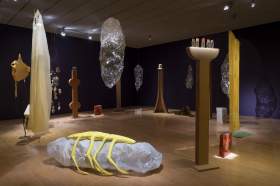
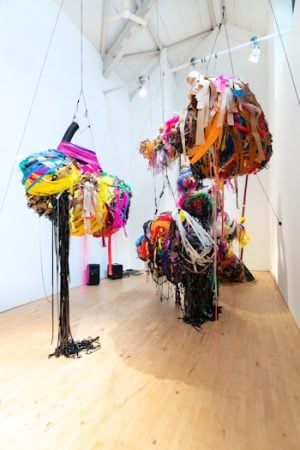
In the publicity surrounding the award, Kalu is pictured in between two large works on paper that overflow with black, red and golden clusters of rhythmically twisting lines. In Kalu’s installation practice, these hand-drawn, sensory gestures are transformed into vibrant three-dimensional forms. The result is a series of sculptural assemblages where VHS tape and coloured strips of fabric are twisted and bound around each other. These joyful, abstract arrangements can be sensed as much as they are seen.
Disabled artists breaking glass ceilings – quick links
Nnena Kalu and her work with supported studio ActionSpace
Kalu was born in Glasgow in 1966 to Nigerian parents. Now based in London, she has been developing her practice with the support of ActionSpace studio since 1999. ActionSpace is a London-based visual arts organisation and charity with dedicated supported studios in Central, South and West London.
Supported studios like ActionSpace, as well as Arts Project Australia in Naarm/Melbourne and We Are Studios in Dharug Country in Sydney, are important cultural infrastructure in the arts and disability ecosystem, serving as creative hubs where facilitators and peers work alongside disabled artists.
Through long-term relationship building and creative exchange, studio residents are supported with technical support, mentoring and career-building opportunities.
After the Turner Prize announcement, Charlotte Hollinshead, who has supported Nnena in her studio for over 25 years, reflected on her role as an astute observer and listener of Kalu’s practice. Careful not to lead Kalu in any particular direction, her role is to make sure the artist has the materials she needs to do what she wants to do.
More than just removing barriers for artists, supported studios also provide access to connections, networks and professional development opportunities that challenge institutional ideas of what art is and who can do it.
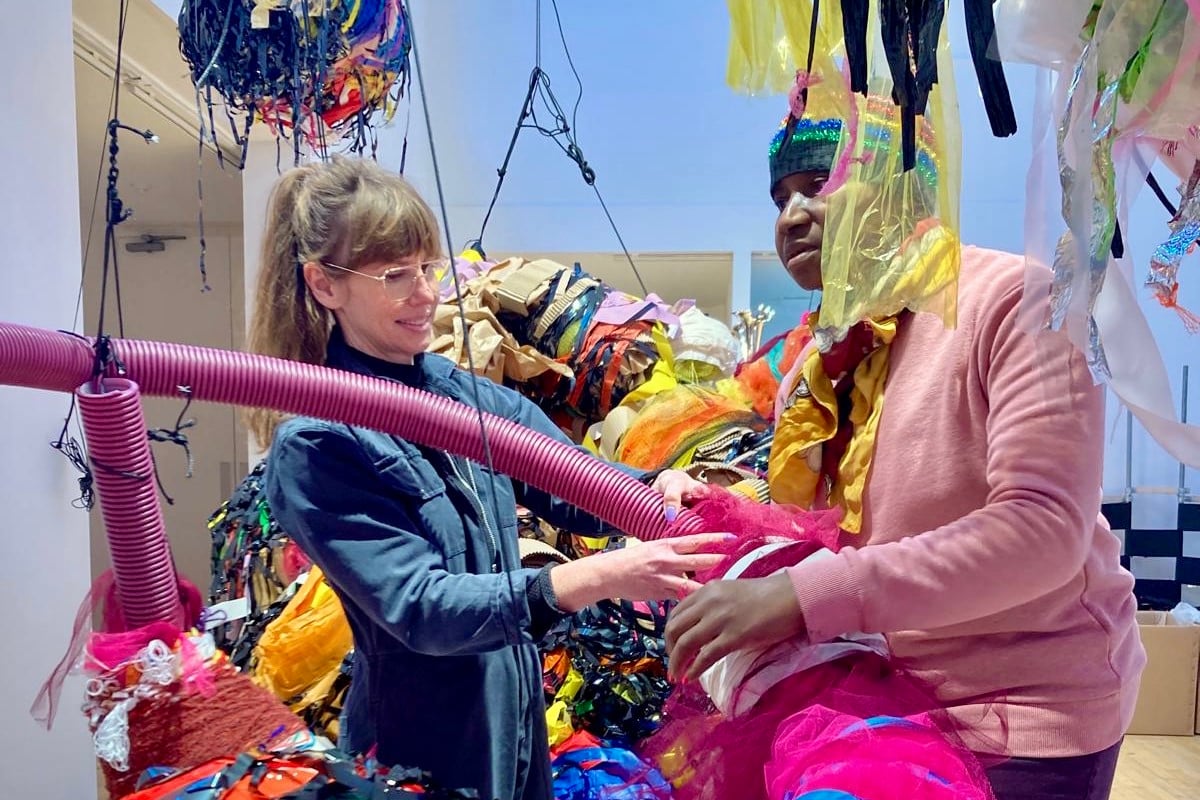
London-based writer, curator and researcher Lisa Slominski has had a long-term engagement with Nnena Kalu and ActionSpace. She has seen how the creative environment provided by the studio, along with the decades of facilitation, advocacy and support provided by Hollinstead, alongside many others, have allowed the artist’s work to be recognised by wider audiences.
‘For me, the significance of the Turner Prize is that it demonstrates how artistic excellence and support structures are not opposing ideas. Great artists deserve recognition for their work, but artists also need the time, resources, relationships and opportunities that enable that work to be made and encountered in the first place,’ Slominski said.
ArtsHub: An intimate exploration of artists from Arts Project Australia
Building networks for artists
Slominski has been researching how artistic agency is fostered and mediated within supported studio contexts for years. She has noticed that alongside the artist and the continued development of their work, what is important to any creative career is networks – of support, relationships, institutions, peers, family members, facilitators and audiences.
‘My research has reinforced the importance of thinking about these processes collectively rather than individually,’ she says.
‘The most meaningful changes I’ve witnessed have emerged through coalitions of artists, facilitators, curators and institutions working together to challenge barriers and expand how artistic value is recognised.’
Collective thinking and international networking is central to Art et al., an international platform founded by Lisa Slominski (Slominski projects), Australian curator Sim Luttin (formerly of Arts Project Australia and now Jump Left) and Jennifer Gilbert (Jennifer Lauren Gallery in Manchester, UK). Together, they facilitate collaborations between artists from supported studios, contemporary art professionals and international peers.
Established in 2020 in response to the limited visibility of neurodivergent, learning disabled and intellectually disabled artists within the contemporary art sector, Art et al. commissions new work, critical writing, exhibitions and digital projects that connect artists across borders.
According to Luttin, the impact of Art et al. has been extensive. ‘Projects have been supported by Creative Australia, DFAT [Department of Foreign Affairs and Trade], the British Council and the Aesop Foundation, amongst others, opening doors for Australian artists to build new experiences, gain real visibility, and establish professional standing on a global stage,’ Luttin said.
‘It has also given artists (and supported studios) opportunities to learn about other artists and arts professionals working in different cultural contexts.’
Creating international opportunities
Australia’s thriving arts and disability ecosystem has no shortage of artists working together to create meaningful change. In Kaurna country in Adelaide, artists Dave Court and Hari Koutlakis have spent years creating spaces where disabled artists can develop their creative voices alongside their peers.
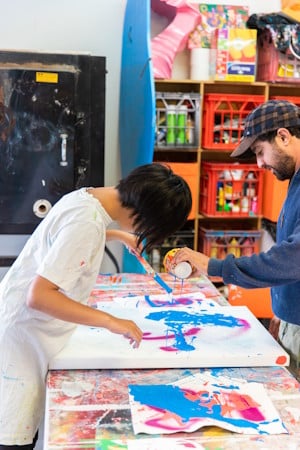
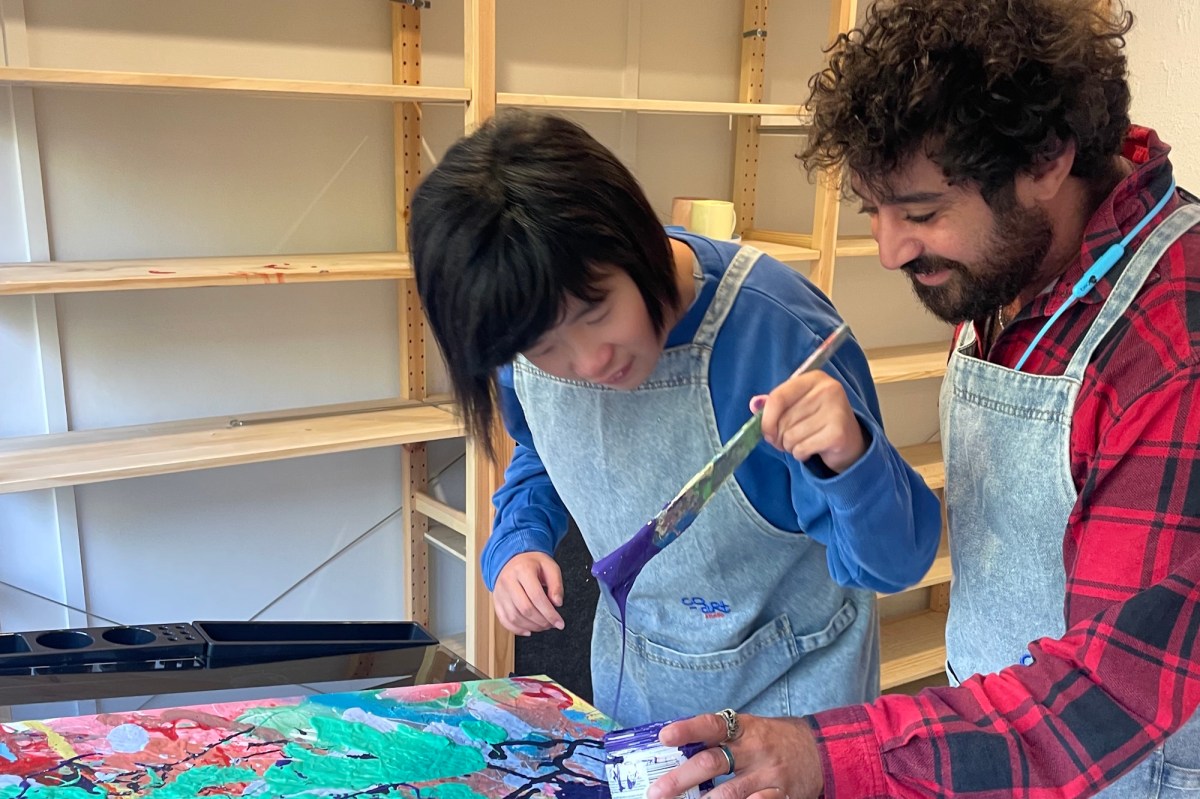
One of those artists is Joanne Lee, who began making work with Court and Koutlakis in their backyard shed. Lee lives with daily challenges. Jung Yoon, Lee’s mother, felt that therapeutic input was not working for her and was looking for other solutions. That’s when her friend Dave Court suggested that Lee come and hang out in his backyard studio. It was a place where she could play with things and didn’t have to worry about getting dirty.
Watching Lee grow through these informal studio relationships, firstly with Court and then Koutlakis, led Lee’s mother to imagine something bigger. Inspired by the generosity and community networks that are central to Adelaide’s arts and disability community, she established co-art Studio.
Built around the concept of creating together, the studio is an inclusive space where artists with and without disability can work together, build professional practices and develop sustainable creative careers. Today, co-art supports artists with intellectual disability, autism, psychosocial disability and acquired brain injury through ongoing studio access, mentorship and career development.
Through Jung Yoon’s relationships with artists and universities in South Korea, the studio has also opened international opportunities, including artist residencies, exhibitions and cross-cultural exchanges.
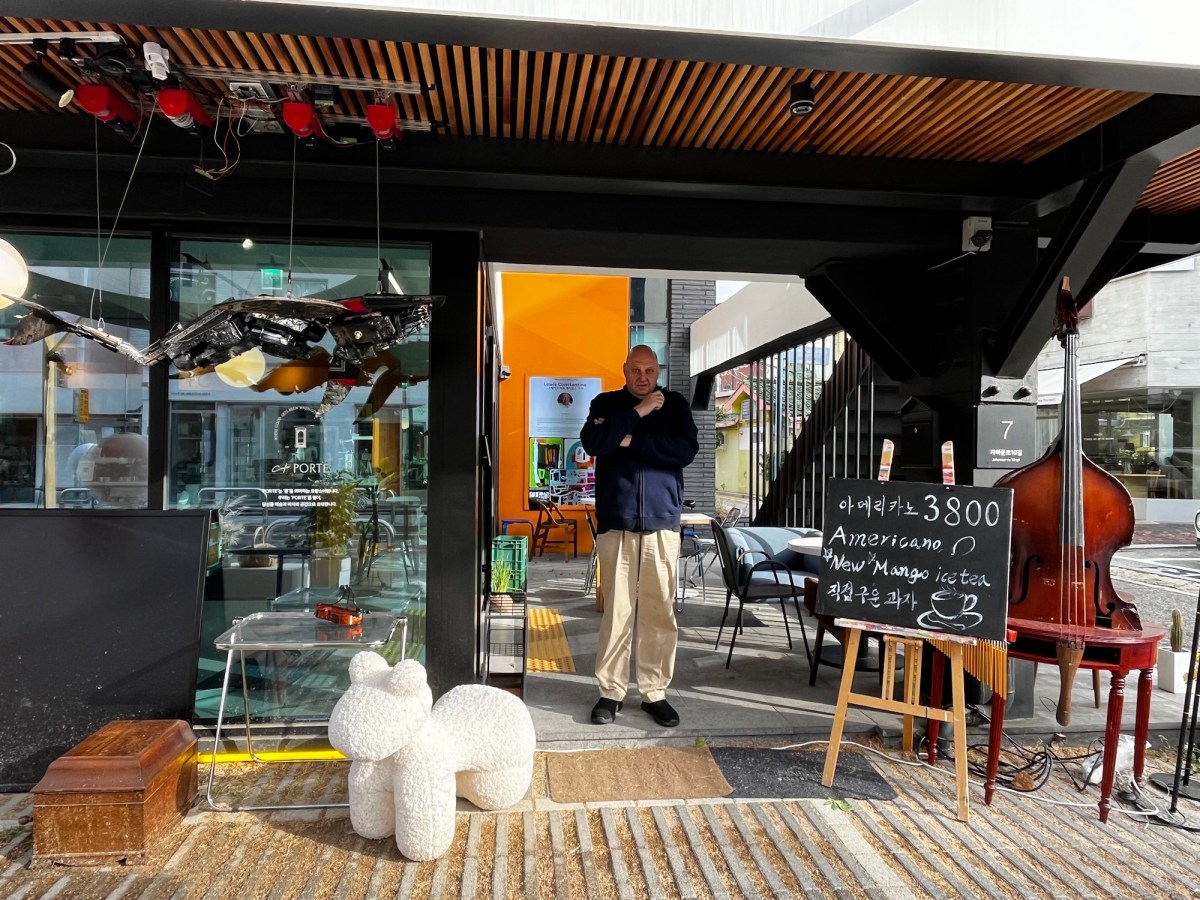
For painter Lewis Constantine, who had previously never been outside of Adelaide, meeting Korean students at a workshop organised by Yoon was a life changing experience, sparking his own desire to travel. He visited Korea and was supported on the trip by his brothers and sister-in-law, who Yoon accompanied.
‘We stayed there for 10 days and Lewis really enjoyed listening to Korean music and painting there. And then we did a small exhibition at the end of the residency,’ she said.
Supporting First Nations artists to thrive
In Central Australia, Bindi Mwerre Anthurre Artists occupies the intersection between supported studios and Aboriginal art centres, the first in Australia to do so.
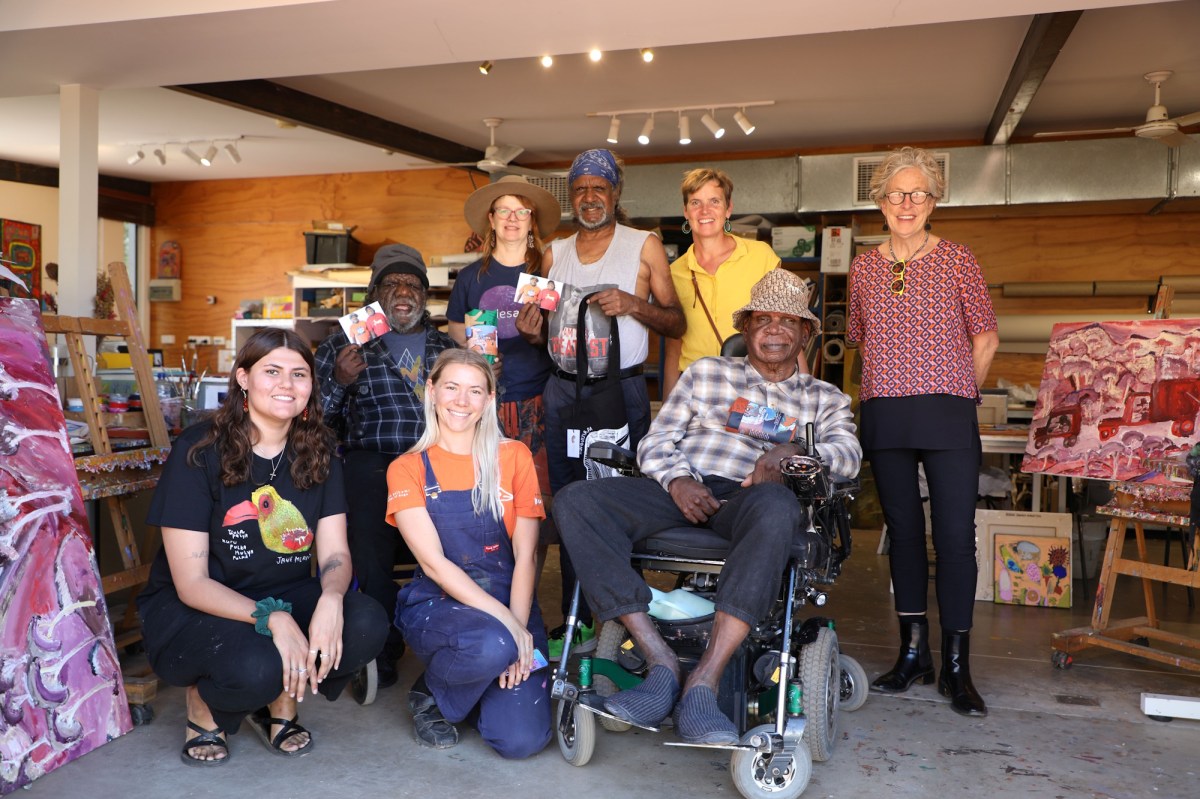
Based in Mparntwe/Alice Springs, the studio works with First Nations artists living with disability, combining the advocacy and career development approaches common to supported studios with the cultural protocols and artist-centred practices of the Aboriginal art sector.
For Operations Manager Liesl Rockchild, the role of the studio is not to speak for artists, but to help them achieve their own ambitions. ‘We act as an agent to support the artist’s voice in their goals and aspirations,’ she explains. Whether an artist wants to exhibit internationally, develop new skills or build a professional practice, the studio works behind the scenes to create opportunities and remove barriers.
Those opportunities can have a profound impact. Warlpiri artist Adrian Jangala Robertson, who Rockchild says paints his country ‘magically from his mind’, has become one of Australia’s most celebrated contemporary painters. As well as winning the Alice Prize and the general painting prize in the Telstra National Aboriginal & Torres Strait Islander Art Award, he also achieved the rare distinction of being selected as a finalist in the Archibald, Wynne and Sulman Prizes in the same year.
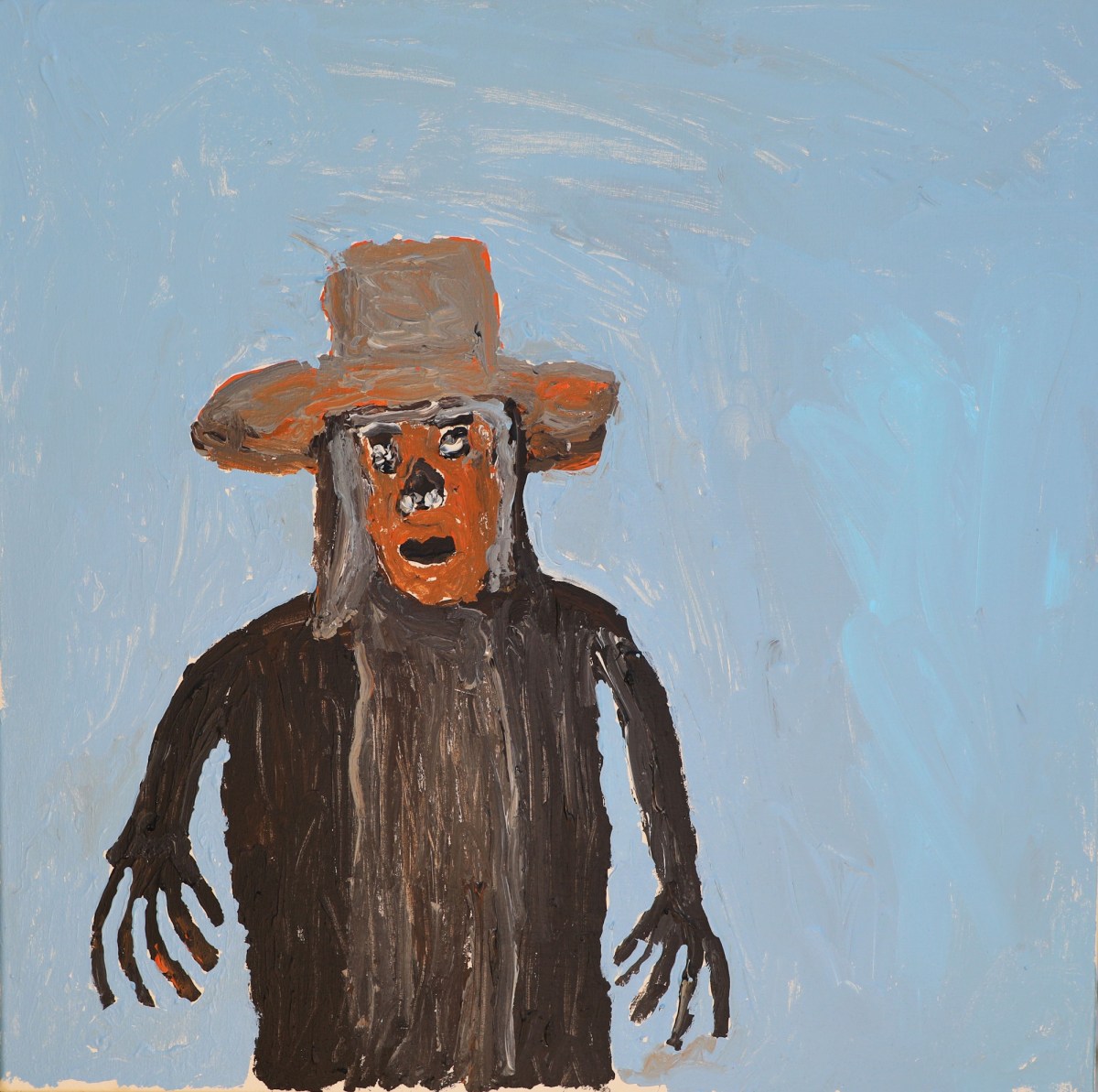
Yet Rockchild is quick to point out that success is never achieved in isolation. Behind every exhibition, award and residency is a network of family members, studio staff, advocates and cultural communities working together to ensure artists can participate on their own terms.
‘We travelled him to London two to three years ago for a solo exhibition with the Rebecca Hossack Gallery there. That took about 12 stakeholders around a table for six months, including allied health specialists, NDIS staff, accommodation, medical and art specialists to bring that together. And that was quite remarkable,’ Rockchild said.
The challenges facing disabled artists in Central Australia are also unique. Many live away from family and Country, with limited opportunities to travel home or maintain cultural connections. For Bindi Mwerre Anthurre Artists, supporting artists means recognising that creative development cannot be separated from culture, community and belonging.
The future of the art world is accessible when we work together
Taken together, these stories reveal arts and disability sector that is increasingly ambitious, interconnected and visible. As Luttin said, ‘For many artists, being shown in professional contexts shifts how they see themselves – and how the sector sees them. It builds confidence, market presence, and opens doors that simply weren’t available before.’
Perhaps the greatest lesson from these stories is that artistic careers are rarely built in isolation. They emerge through relationships, trust and collective effort: a curator who opens a door, a facilitator who sees potential, a family member who advocates, or a creative community willing to make space for someone to belong.
From Alice Springs to Adelaide, Australia’s arts and disability sector demonstrates what becomes possible when artists are supported not only to participate, but to lead. In doing so, it is helping to build a richer, more accessible and more imaginative cultural landscape for everyone.