The annual Primavera exhibition of artists under 35 is a Sydney institution. Since its inception in 1992, the Museum of Contemporary Art Australia has played host to well over 200 young artists, including many who went on to become well-known names, such as Mikala Dwyer, Shaun Gladwell, Michael Zavros and Nell.
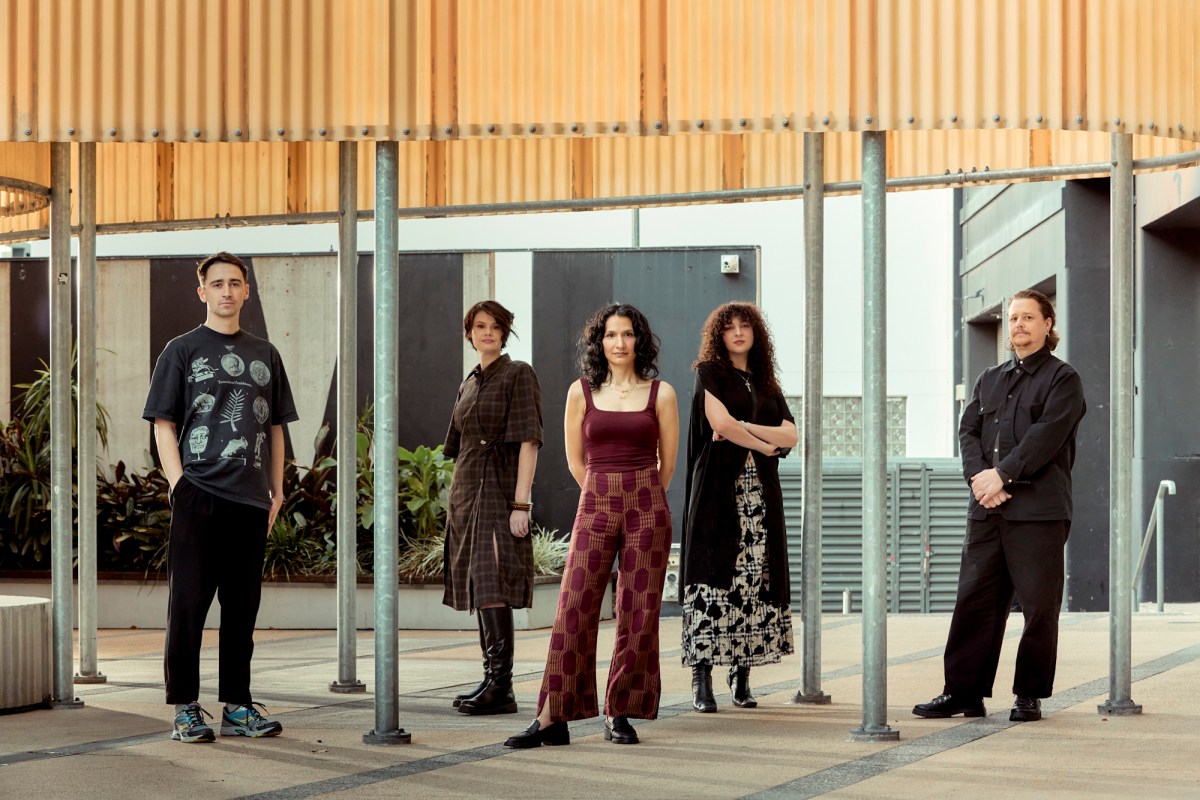
With a different curator each year, Primavera is all about fresh perspectives. This year, the baton’s been handed to MCA Assistant Curator Antares Wells, who has brought together a small group of artists interested in the archives and traces of history – always a provocative topic to think about inside a museum.

Now open at the MCA, the exhibition lands at a time when many young artists are broadly questioning institutions and how their colonial foundations shape their purpose, while also having to negotiate the challenging realities of professional practice today. And institutional exhibitions can still be very important for early-career artists, especially when it comes to introducing work to new and larger audiences.
Art prizes are the tried and tested route, alongside programs like Create NSW’s Visual Art Fellowship (Emerging), which opens this week at Artspace in Sydney. Graduate shows like Hatched at PICA in Perth are another. But beyond that, there are relatively few opportunities for emerging and early-career artists to exhibit in institutional spaces, especially since the departure of pulse-check exhibitions like Melbourne Now and The National, which both faded out in 2023.
That’s one reason why Brisbane’s Institute of Modern Art has been developing something similar to Primavera in recent years, though not pegged to an artist’s age. The aptly-named Platform series began in 2024 and has just been expanded from three the five artists, with the new commissions for 2027 set to be exhibited at the gallery early next year.
As for the artists coming through these initiatives, some already have extensive exhibition histories and gallery representation, while others are rapidly earning their name in other ways.
5 early-career artists – quick links
Jahkarli Felicitas Romanis
Jahkarli Felicitas Romanis is one of the eight artists in this year’s Primavera, exhibiting alongside Mark Maurangi Carrol, Linda Sok, Stanton Cornish-Ward & Trent Crawford, Callum McGrath, Jack Wansbrough and Rudi Williams.
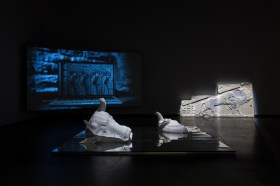
A Pitta Pitta woman living on Kulin Land in Melbourne, her works ranges across photography, the moving image and spoken word. In her poetic two-channel video work for Primavera, she speaks to her great-grandmother Dolly, who she describes as an ‘anchor point’ for much of her practice.

‘It’s filmed out the front of the South Australian Museum on Kaurna country in Adelaide,’ she tells ArtsHub. ‘And I wanted to film there because Dolly, in 1938, was photographed and documented by Australian anthropologist Norman Tindale on Palm Island.’
Tindale’s photographs are now held in Adelaide and with Skin to Skin (2026), Romanis is feeling out personal and family connections – Dolly was part of the Stolen Generations – but also asking deeper questions about First Nations collections and who has control.
‘After death, [Dolly] is still being moved around so much, in photographic and documentation form,’ she says.
‘I’m having a conversation with my great-grandmother and acknowledging her lived experience, but also her experience after death, I suppose – how she lives on in these photographs and where they end up and how they move through the world.’

Right now, Romanis’ work is also being shown at the National Gallery of Victoria in Melbourne as part of Future Country, a First Nations commissioning and exhibition project that saw her selected and mentored by artist Brook Andrew.
‘This was the first time that I’d worked with a really large major institution, and also the first time that my work was being acquired,’ she says. ‘That really shifted the way that I was thinking about images because often, I’m critiquing or responding to these archives, these institutional archives, but [here] … I’m directly benefiting from being acquired.’
Her large-scale photograph of Pitta Pitta country runs from the wall onto the floor. ‘The idea is that people walk on the work and that is a kind of metaphor for understanding that wherever we’re walking within Australia, we’re walking on country,’ she says.
The way she talks about this NGV commission, it’s clear she learned a lot, not just from the support of a veteran artist like Andrew, but also about how large institutions work, and how to explain and defend her ideas to different teams. Coming from a strong academic background, it’s been both a new way of working as well as a chance to think at a different scale.
‘My work and my practice is only made possible because of my family, firstly,’ she says. ‘But also, secondly, these works in these institutions [for Future Country and Primavera] are also only made possible through a team of really incredible people.’
Mark Maurangi Carrol

Also featured in Primavera is the Sydney-based painter Mark Maurangi Carrol, who shows a suite of four paintings about a horse race that used to be held on the island of Rarotonga.
‘It’s always been something my family talked about and had photographs of,’ he tells ArtsHub. It was only after the last horse on the island died about three years ago that he found himself drawn to horses as a subject, turning over their arrival on the island and their disappearance.
‘The horse was a very vital part of the economy at one point,’ he says. ‘They were used to transport goods and people around, and for farming. And then obviously with machinery like cars and trucks and tractors and so on, they became redundant as a tool.’
Carrol has already built a strong reputation for his hazy painting style and confident handling of colour. Influenced by pareu textile printing, he frequently paints on the reverse, allowing the paint to seep through to the front of the work.
‘That’s the way I paint, pushing from the back forward,’ he explains. ‘And then in doing that, you lose a lot of information.’
He describes this as almost like a physical enactment of losing memory. ‘Memory of a place may not be as accurate as it actually was,’ he says. ‘And when it’s told by successive generations, little bits get forgotten or lost, or get made up and filled, and the spaces that are lost get invented in some way.’

Since graduating from art school in 2017, Carrol has won the Mosman Art Prize and the Brett Whiteley Travelling Art Scholarship, with the work produced during this Paris residency going on to be shown at the Lismore Regional Gallery.
He has also been a finalist in major national awards including the Sulman Prize, Wynne Prize and the Arthur Guy Memorial Art Prize and, more recently, his work was also curated into the 2026 Adelaide Biennial, Yield Strength.
While this is a remarkable CV for an artist not even a decade out of art school, he’s still excited by the chance to take part in Primavera. ‘In a similar way with the Adelaide Biennial,’ he says, ‘these have been the first two opportunities where I’ve actually been able to show work at an institution.’
Primavera has also been a chance to continue developing a new technique involving dislodging paint with boiling water, something he raised in the early studio visits with Antares Wells. ‘She was really supportive of doing anything experimental. She said, that’s what these things are for – to perhaps not play it safe just because it’s an institutional show, but actually push and really do something you haven’t necessarily done before.’
Linda Sok

It’s a message echoed by Linda Sok, who has made the largest work so far in her ongoing Deities in Temples series for Primavera. This is the 21st work in the series, which also saw earlier works featured in a 2025 solo exhibition at Sydney’s Campbelltown Arts Centre.
‘It actually goes all the way back to when my parents would bring silk scarves back from Cambodia,’ Sok says.
‘That began my investigation into silk as this strong and resilient material representative of the strength of the Cambodian people. From there I then began to learn how to weave with silk and looked further into the practice of pidan.’
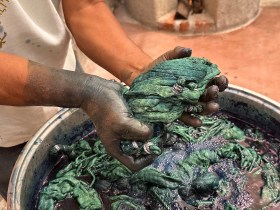
The technique involves tying and dyeing threads, similar to ikat, to create ornate imagery, frequently drawing on Buddhism. As Sok explains, these textiles would often be found in sacred spaces, like the tops of temples. Many were collected by the national museum in Cambodia and recorded on collection cards but later went missing, due to lack of care, theft or some other unrecorded reason.
‘The cards were the only things that verified that they existed,’ Sok says. ‘So I took those cards and shared the descriptions that were on it with my family, and they drew what they thought might have been on the original weaving.’
Those responses have then informed the different iterations in her Deities in Temples series. ‘So all of the [works in the] series that I have, up to 21 at the moment, they’re all inspired by just the one registration card,’ she says.

Sok’s richly coloured and beautiful weavings suggest a certain ambivalence. As she says, there’s no real way to tell if it was a good thing the textiles were originally collected, or how accurate her weavings might be. At the same time, the cards have also given her a rich way to reinterpret and reengage with a lost cultural practice.
For Sok, Primavera has been a chance to work on a bigger scale, and also expand her use of sculptural elements, including air-dry clay and other elements that relate to how palanquins were once used to transport important people and sacred objects.

After completing her MFA at the Rhode Island School of Design, Sok now works between Sydney and Providence, Rhode Island, and that international experience has given her different perspective on the question of opportunities for early career artists.
She describes Australia as having more institutionally-backed and government-backed opportunities than the US, where initiatives are more likely to be supported by private philanthropists or one-off fundraising campaigns. But she adds that there are more residencies in the US, providing space to work and the chance to forge those valuable and lasting connections with other artists.
‘Those same opportunities I don’t think are as widely available in Australia,’ she says. ‘Which is part of the reason why I’m in the US too, to take advantage of the fact that I can do the residencies and then travel back to Australia and then do the institutional shows and also have that experience … navigating institutions and learning how that side of things operates.’
Daniel Sherington
Brisbane-based artist Daniel Sherington has just been named one of the Institute of Modern Art’s five Platform artists for 2027 alongside Amanda Bennetts, Adam Cole, Savannah Jarvis and Prita Tina Yeganeh. The newly commissioned works and projects will be shown at IMA from January to March next year.

Sherington only graduated from art school in 2021 and has shown mainly in artist-run spaces to date, but has already been catching the art world’s attention for, well, talking about the art world, often with an edge of humour.
Many of his works are about the ‘professional dynamics and systems and structures of the art world and how they play out,’ he says. One recent work involved printing an image every 28 seconds, which he’d read was the average time people spend looking at art.
Another work, originally shown at 1WORKROOM9 in Brisbane and now at Firstdraft in Sydney, took on heavyweights of the local art world – the directors of leading state and national institutions.
‘I’d become interested in graphology, which is … [deciding] someone’s personality or character via their handwriting and pseudoscience,’ he says.
He found the directors’ signatures (freely accessible in annual reports) and fed these handwriting samples into an AI program, asking if it could infer how the directors might draw. Sherington then used these descriptions to render a sequence of portraits, as though ‘making them draw each other or themselves’.

Maud Page, done in the supposed style of her Art Gallery of New South Wales predecessor Michael Brand, is peppy and cartoony, while the faux-portrait of the NGV’s Tony Ellwood is much more serious. But the really interesting part was how audiences reacted, Sherington says, and the assumptions brought to these portraits of art world figures.
‘It comes down to people’s relationships with [these professionals] and their own interaction with the work,’ he says, noting that portraiture is already a loaded topic in Australia.
While it’s early days yet, Sherington says the IMA commission is ‘a great vote of confidence and something I’m really looking forward to embracing over the next six months’.
He adds, ‘There’s that developmental aspect. There’s a long, decent-sized lead time for the exhibition, to resolve something really substantial.’
That time is rare for early-career artists, he suggests. ‘You’re often reactionary, or you’re looking for the next opportunity. But to know that there’s something on the horizon to really give your attention to, something across six, seven, eight months … [that’s] an opportunity that I don’t think was taken for granted across the Platform cohort.’
Savannah Jenkins

Another Platform artist for 2027 is Savannah Jenkins. Known primarily as a painter, her work deals with the experience of chronic pain. ‘I’m interested in how that is culturally represented and the tendency to rely on catastrophic imagery like knives, flames or these kind of broken bodies,’ she says.
‘I think pain has a lot more to say. It doesn’t really behave like visible damage. It’s kind of neurological and repetitive and difficult to locate. So with painting, I’m working on developing these alternative representations that draw from domestic spaces and still life and architecture.’
As she explains, architecture gives her a way to explore pain as a system that has to be inhabited. ‘I’m asking whether … painting can make pain visible without intensifying or reenacting the fear around it,’ she adds.
Jarvis is hoping to use Platform to develop an installation-based project. ‘I really want to create something at scale,’ she tells ArtsHub. ‘I’m planning on building quite a large-scale domestic tableau with all these kinds of corrupted objects. So, something that … you can walk around, and you can participate in and literally inhabit, to more directly emphasise the idea of existing within this system.’
For Jarvis, opportunities like Platform are valuable because they provide space to test and develop approaches and interests. ‘I feel like the institution allows you to really explore an idea without the concern of commercial viability, or where is this going to go,’ she says.
‘It’s already had an impact,’ she says, pointing to the experience of developing her proposal for Platform. ‘I wasn’t thinking about storage or cost … The questions that normally plague my practice just sort of melted away and it really freed up the space to have ideas.’