Khaled Sabsabi is one of the most talked about artists in Australia today. However his artworks – much like the man himself – often reveal quieter journeys that are refined and restrained in their power.
In many ways, the artist’s latest solo show fits that bill perfectly through its graceful presence and elegant (though sparsely organised) energies.
Interestingly, the development of this exhibition started during one of the artist’s most tumultuous times – in early 2025, when Sabsabi’s invitation to represent Australia at this year’s Venice Biennale had been rescinded, only to be reinstated six months later after an outpouring of dissent from the local arts sector and an external review of Creative Australia’s decision.
In light of this outcome, Between Suns, curated by Milaka Tai, presented at Vessel Contemporary in Fremantle/Walyalup is somewhat of a coup for this new contemporary arts space, which currently has programming ties to one of the world’s most prominent art events.
But while art world devotees take in Sabsabi’s latest work at the Venice Biennale, local WA audiences can experience what is arguably a richer viewing of his practice in this survey show, which includes pieces from Sabsabi’s past three decades as an artist.
Khaled Sabsabi’s Between Suns review – quick links
Centrepiece work reveals deep spiritual inquiry
Comprising five works made between 1998 and 2025, the exhibition foregrounds Sabsabi’s deep connections with tasawwuf (Sufism) – a mystical dimension of Islam that the artist has practiced for many years.
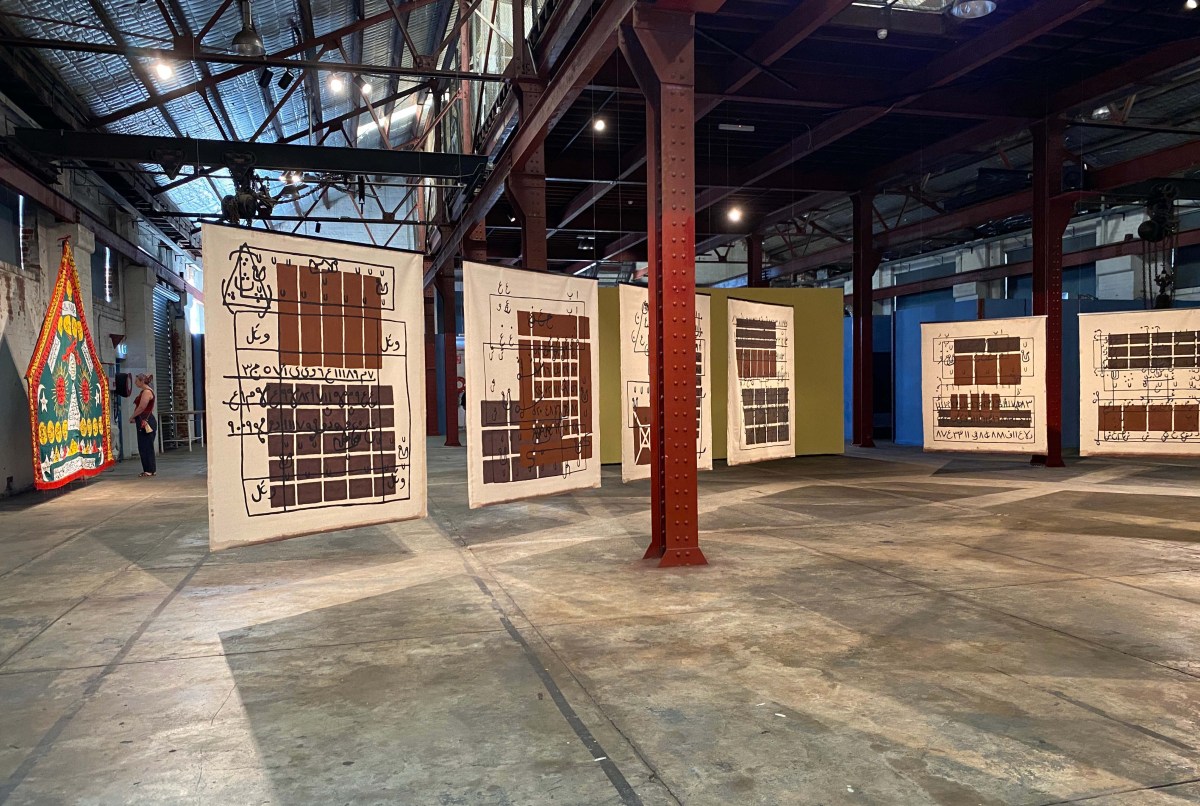
In particular, Sabsabi’s interest in the text Shams al-Ma’arif (The Sun of Knowledge), written by the Sufi mathematician and philosopher Ahmad idn Ali al-Buni in the 13th century, is a prominent feature – especially in the show’s centrepiece installation work, titled Knowing Beyond, which presents 10 large double-sided free-hanging canvases that are positioned around an even larger projection of a 20 minute video work.
ArtsHub: Monet to Matisse review – AGSA blockbuster is simply unmissable
The placement of the 10 large canvases, which operate as an expanded frame around the work’s projected video element, allows for an immersive, contemplative consideration of the many beautiful and complex connections between the human and the divine. Its audio component is another strong feature, especially in Vessel’s industrial warehouse space, where it hums overhead and reverberates through the gallery in deep, constant tones.
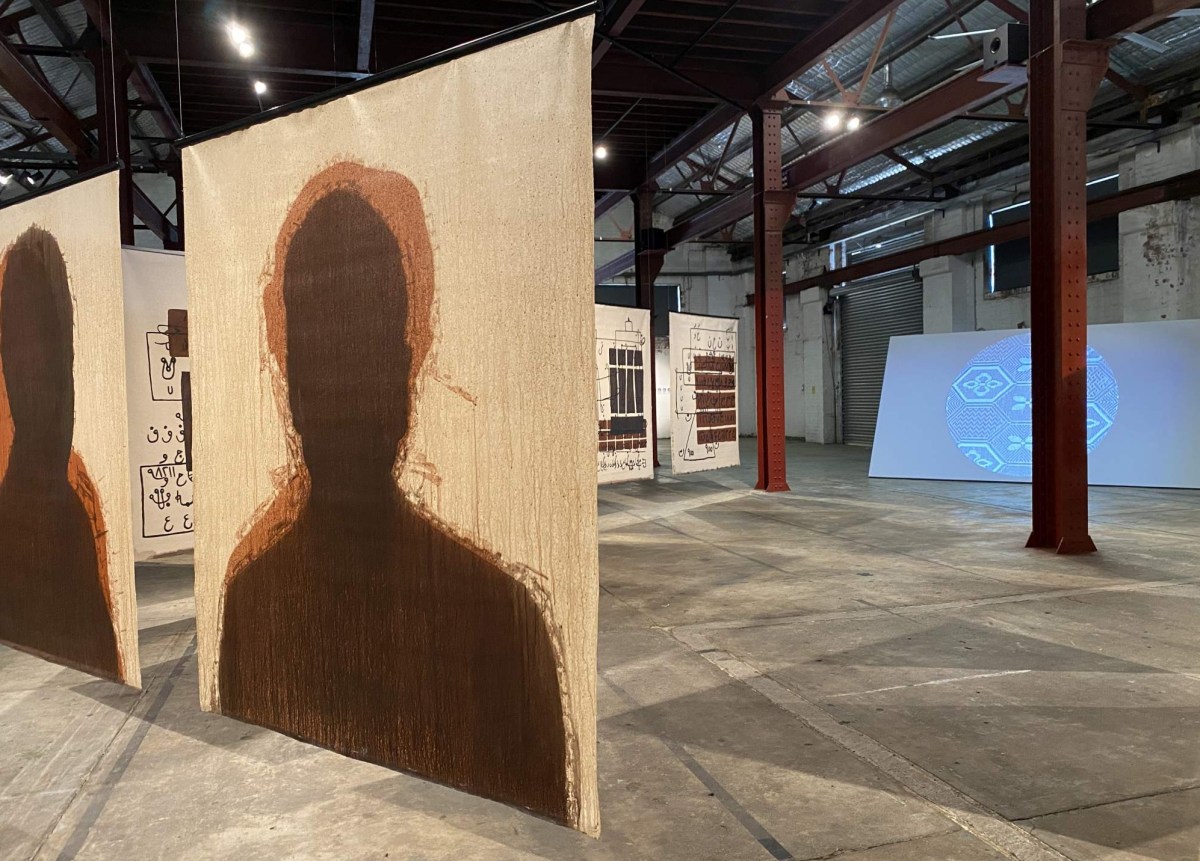
Some of the canvases sway gently when a breeze blows in through a gallery back door. Standing in the gallery encircled by these works, while reflecting on their arrangements of numbers and Arabic script and watching the work’s video projection of a man slowing wiping his hands clean, the depth of Sabsabi’s years of spiritual inquiry and his fascination with esoteric phenomena is made clear.
Artist’s earliest work revived to great effect
While over the years, some of Sabsabi’s conceptual interests have drawn him beyond the spiritual to explore numerous political themes too (he has made many multimedia works exploring ideas of displacement and migration, especially as to how those experiences have affected Arab and Muslim people), this show feels intimate and personal to Sabsabi’s own life journey, as someone who fled the civil war in Lebanon as a child and whose experiences of living in Australia since then have been guided by his Muslim and Sufi beliefs.
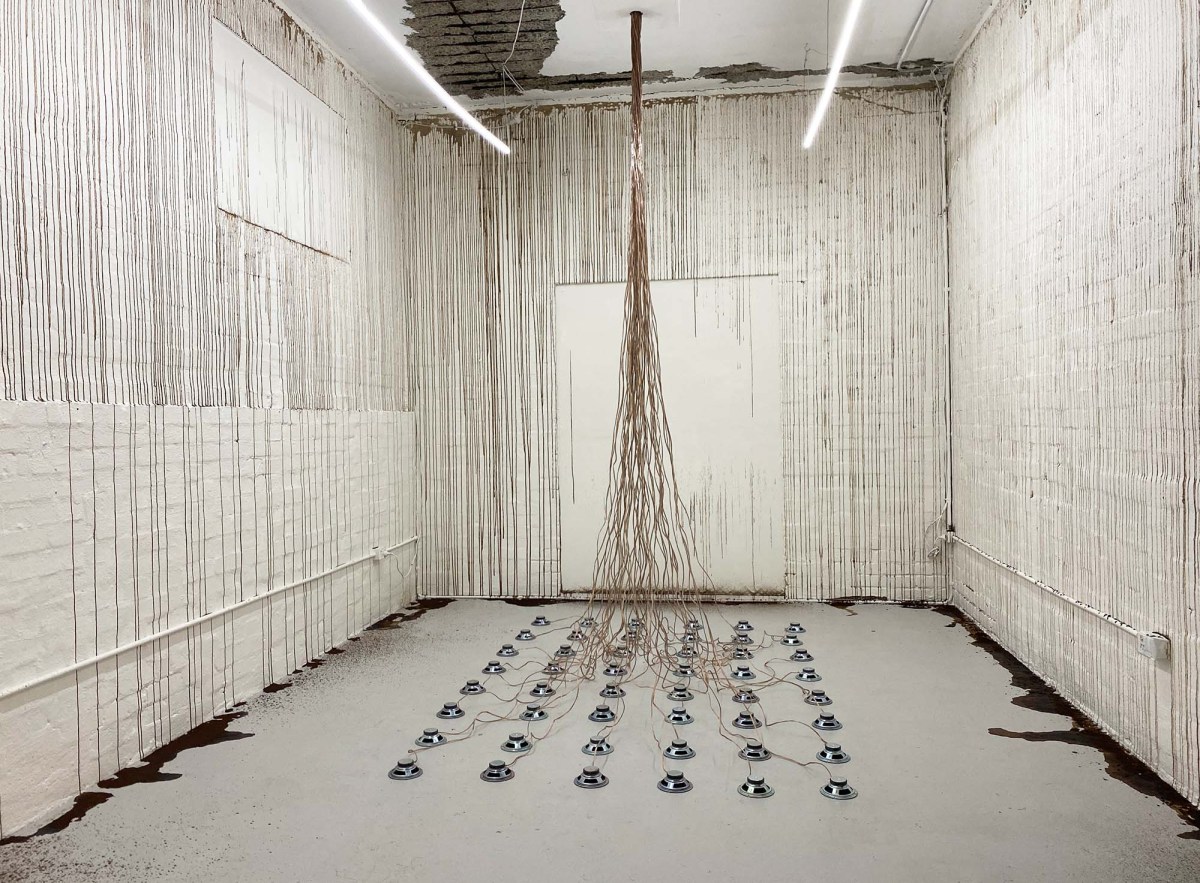
On this note, the inclusion of his earliest major work, Aajyna (1998), plays an important role. Meaning ‘dough’, this title references the artist’s childhood memories of being confined to damp shelter spaces underneath buildings for days as his family took shelter from the civil war related conflict happening on the streets above. Sabsabi recalls seeing these buildings’ interior walls dripping with moisture, and remembers family members pressing flour into them as a way to make dough while sharing cups of Lebanese coffee.
ArtsHub: Margaret Olley: Australian Intimiste offers a new way to see a beloved artist
Here, Sabsabi has recreated Aajyna in one of Vessel Contemporary’s smallest spaces (a space that also operates as CURRENT Gallery), where viewers look in on the work through a partially destroyed brick wall. What they see is a small room where the the white walls are covered with delicate vertical lines of dark brown (coffee-stained) drips.
This multi-sensory work also features a grid of 48 small speakers on the floor, which emit subtle humming vibrations through the space, while strong aromas of Lebanese coffee circulate in the air. It’s especially effective in this tiny space, and offers clear impressions of the artists’ formative concerns around familial and community connection, especially in times of conflict and distress.
Generous invitation into artist’s inner world
Similarly quiet and poignant is a series of small, painted-over photographs displayed in Vessel’s main gallery space. Titled UnVanished (2020), they show a repeated image of a teenage boy (Sabsabi’s cousin Mohamed) who was killed in 1977 aged 15 in South Lebanon. As with Sabsabi’s early installation work Aajyna (1998), these photographic works read as reflections on (and perhaps reawakenings of) past memories in gentle acts of remembrance and memorial.
With its focus on these kinds of moments from Sabsabi’s own life, Between Suns reads as a generous invitation into the inner world of the artist himself – from his early childhood memories, to his ongoing commitment to spiritual awakening through Sufism and his study of some of its mystical texts.
Overall, it’s a quietly moving show that allows for rich understanding of one of Australia’s most prominent contemporary visual artists, and includes several major works that are definitely worth seeing.