Few would question that Margaret Olley AC is one of Australia’s most beloved painters. Indeed, she has always known success with her painting, having exhibited consistently since 1948, when she had her first sell-out show just out of art school.
She studied at East Sydney Technical College, now the National Art School, in Darlinghurst (Sydney). It is a fitting venue, then, on the occasion of the gallery’s 20th anniversary year, to look at that pivotal relationship of one of its most celebrated alumni.
But let’s be frank. While Olley is loved, it is near impossible to come up with a fresh angle for exhibiting her work.
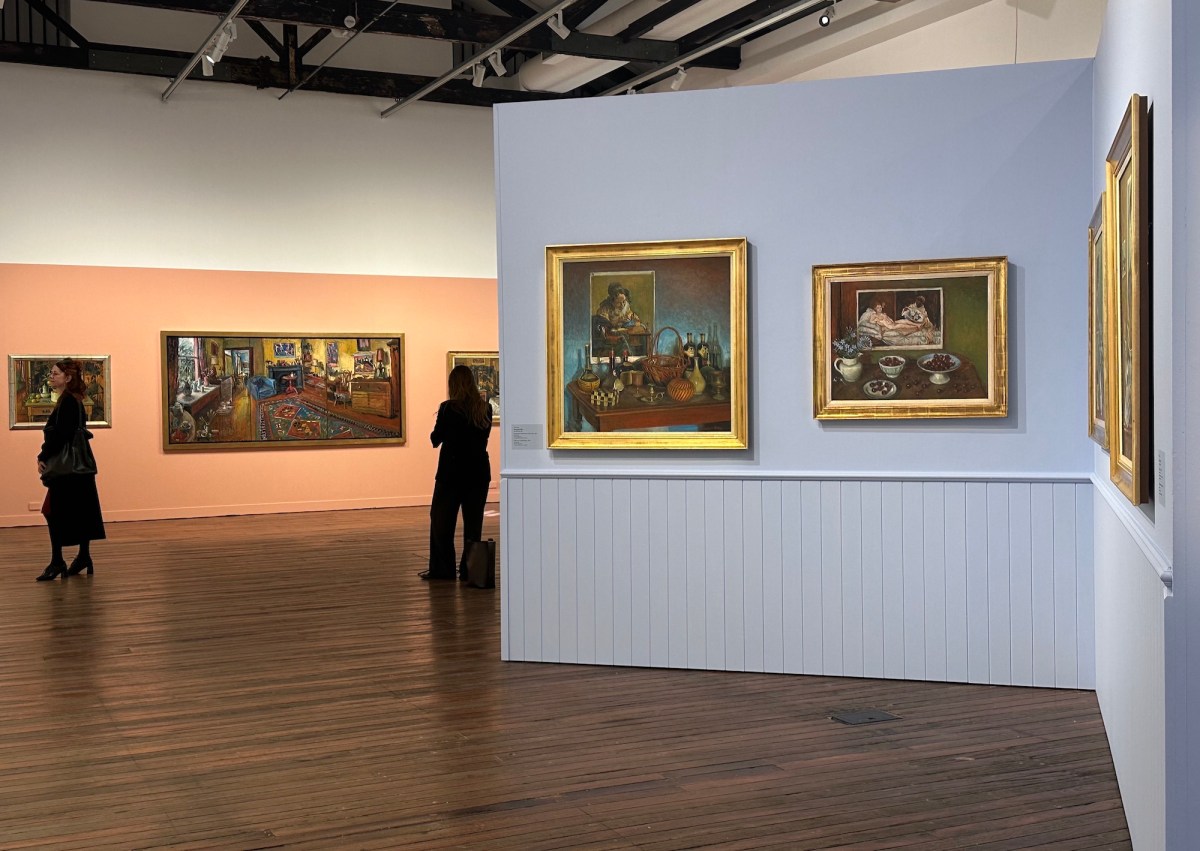
Curator of Margaret Olley: Australian Intimiste, NAS Gallery Manager Katrina Cashman, has come close. By narrowing the scope to her intimate lived spaces and circle of friends, this exhibition offers a more psychological lens into her world, than mere pretty still lifes and arranged rooms.
Margaret Olley – quick links
Celebrating Olley’s days as an emerging artist
Cashman’s passion, and clearly deep knowledge for her subject, is felt across this exhibition. Visitors step into the space to be faced by a wall of timber VJs, typical of the Queenslander home in which Olley grew up.
It is a subtle, repeated anchor across the spaces, where doorway fretwork and Victorian arches also point to the domestic space. But it is a light touch – like a lot of the threads that connect paintings across a near 60-year period on show.
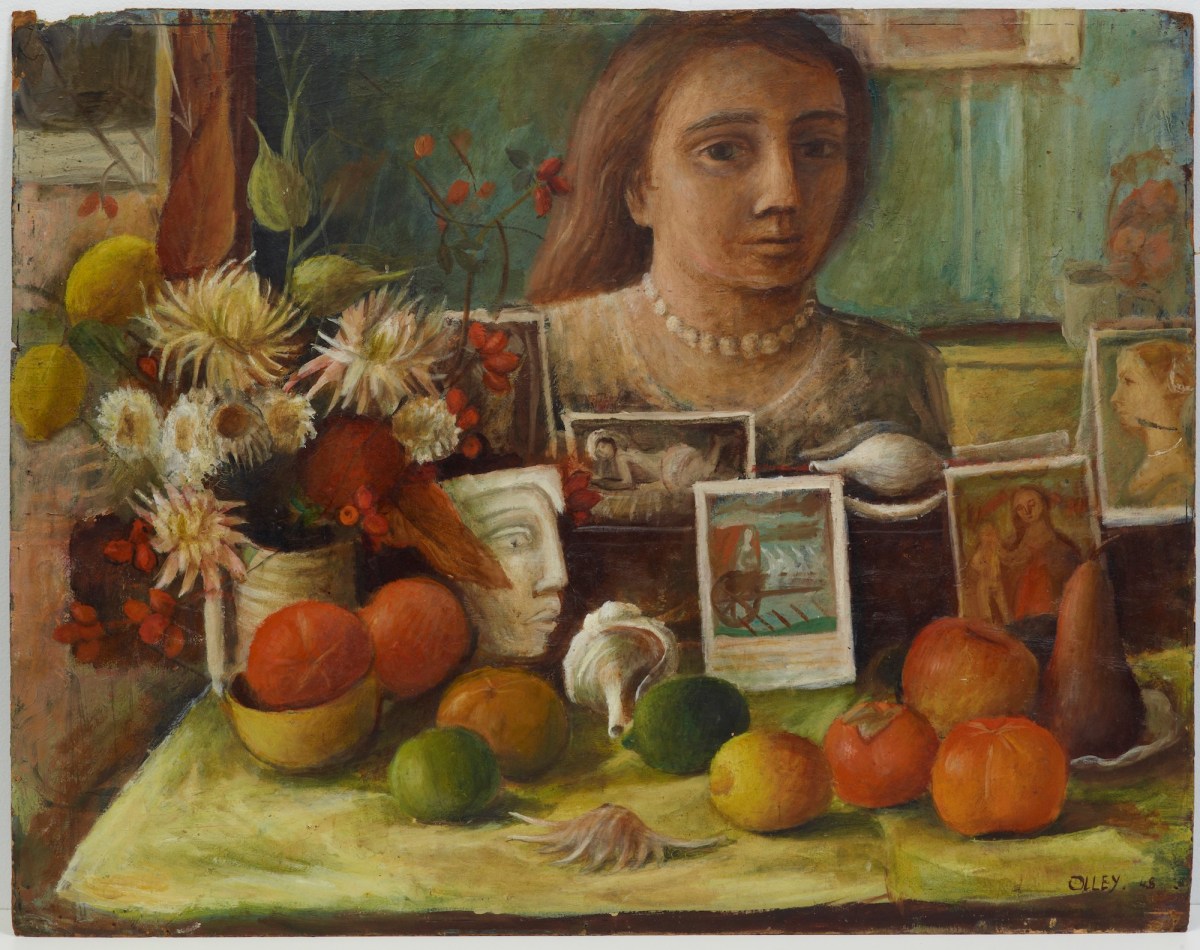
The exhibition is presented loosely chronologically, starting with those early art school days with works of by Olley and her teachers, revealing how those foundations and learning seeped into her work.
‘You could say she had an obsession, and it absolutely flowed out of her,’ Cashman tells gathered media. ‘And you can see the type of training she had – the focus on the figure and drawing, and this beautiful sensitivity starting to come through in her early works.’
Olley was just 19 when she arrived at art school in Sydney, and Cashman clusters works from this period on a salmon-coloured wall – a palette that stuck with Olley right across her career. Among her teachers – on display beside her works – were Jean Bellette, Douglas Dundas, Dorothy Thornhill and Frank Medworth.
The exhibition moves through the circle of artists Olley was a part as a young painter finding her expression. It is nice to see here a suite of atypical paintings of landscapes and rural scenes, painted on weekend excursions. It becomes clear just how significant this period of development was.
A standout work that celebrates that painterly confidence – despite her shy demeanour at the time – is Portrait in the mirror, 1948, painted after getting her first studio space. It sits alongside a suite of major still life paintings – all major works for someone so young.
A rupture with Australia
Finishing the lower galleries is that famed portrait of Olley by William Dobell, which won the 1948 Archibald Prize. Olley struggled terribly with the media storm around the win. Cashman relays: ‘She said for many years she couldn’t even look at this painting – it was too painful for her.’
Despite her own success winning the Inaugural Mosman Art Prize a year earlier (1947), judged by her mentor Lloyd Rees – a landscape painting displayed adjacent to the Dobell portrait – the Archibald spotlight offered a welcome moment for Olley to take her exit to Europe and escape.
Olley: from the spotlight to the intimacy of home
Just as Olley had drawn a line through time, so too does Cashman offer that punctuation in this exhibition, with the upper galleries taking on very different headspace and energy. Here, the viewer plays witness to the assured sense of place which came with Olley’s arrival back in Australia in 1953.
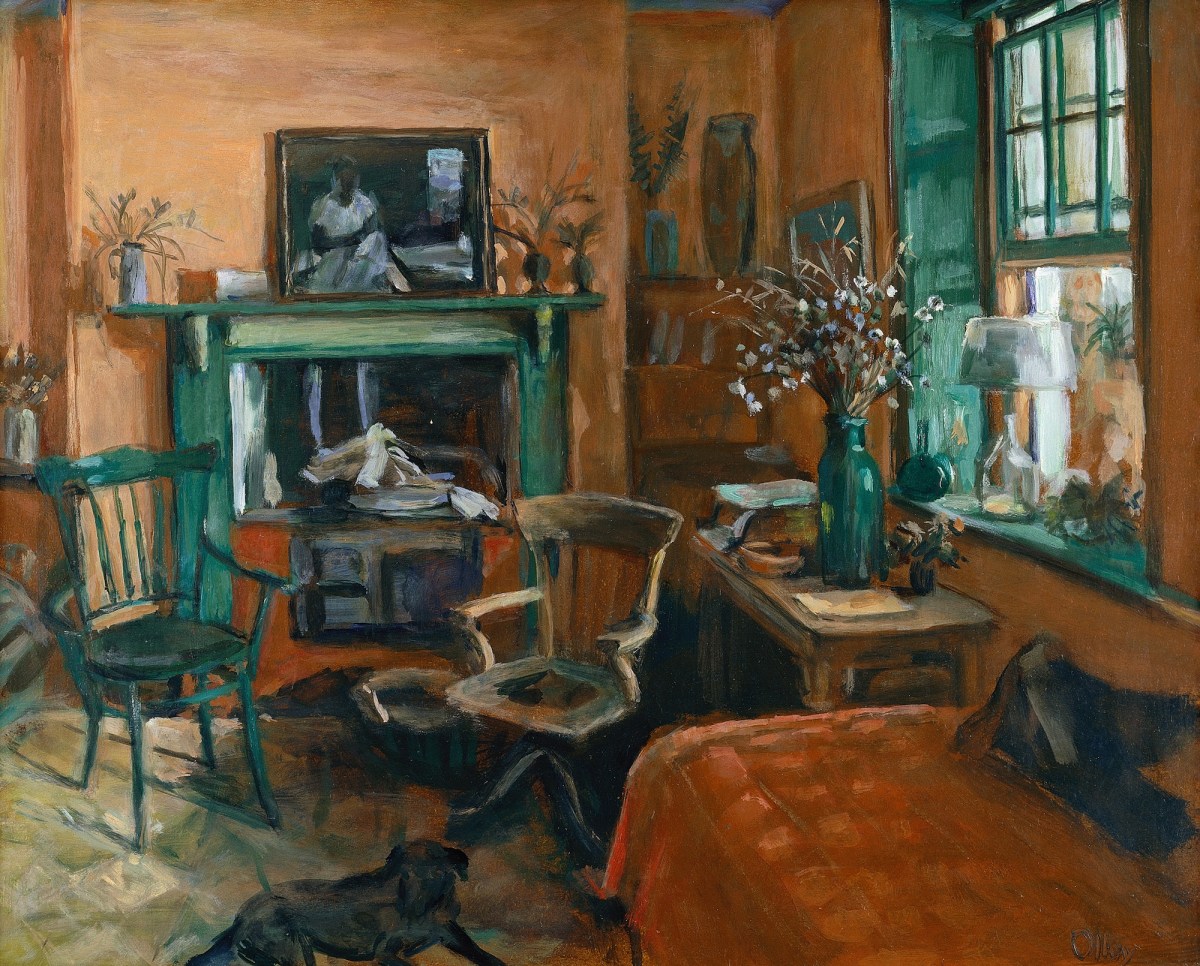
‘She turned inwards on herself – to that European idea of intimism – maybe a reaction to this storm of publicity or maybe just finding her metier, how she wanted to work as an artist, but the focus was on the studio,’ Cashman explains.
Cashman has clustered paintings on this level into intimate relationships – her family home, Farndon, in Brisbane, which was almost a repository for things important to Olley; the interiors of dear friends, artist David Strachan (she continued to paint there several years after his death) and Paddington neighbour and gallerist Brian Moore, whose homes she repeatedly painted with a similar deep connection and passion as her own properties; and, of course, the famed former hat factory, her Duxton Street home studio that was cluttered and curated on a daily-basis by Olley.
Olley did not have a studio at home. Her home was her studio – painting on her lap at a dining table which had effectively become her palette.
Overshadowed by bold gestures late in life
In the 1960s Olley’s painting took off and she was doing incredibly well, but she was also renovating various houses and doing all the work herself.
Cashman says the painting that triggered the focus for the show was Interior (1974), a modest piece where two chairs, bathed in light, sit in conversation and stand in for human presence.
She says: ‘It gave me that feeling of Bonnard, in terms of light not colour, plus her classic inclusion of works by other artists – here Ray Cook on mantle. It made me think this is where we want to take this exhibition.’ It was a good call, and it has given us a bit of an open door to look at Olley work in a renewed way.
The exhibition’s conclusion is a suite of three works of her beloved yellow room at Duxton Street – the centrepiece, The Yellow Room Triptych (2007), is expansive in scale for Olley and has all the hallmarks of her oeuvre. It was painted at 84, just four years before she died. There is so much energy in these pieces – an almost fever capturing her beloved objects with a brushiness. Centralised, is a blue chair inviting us to pause and to join her world, which is the very sentiment that Cashman has created with this exhibition.
Yes, many of these works have been exhibited before in conversation, but Cashman has successfully steered the exhibition back to her paintings and their warm intimacy, rather than being overshadowed by the larger-than-life character and patron Olley was in her later years.
The exhibition has been four years in the making, and is a true delight to view. There are more 80 works, more than 20 of them by her friends and peers. Given the exhibition is presented mere steps from where Olley’s career started, and the school’s garden where she would pull out a chair to draw, the spirit of the late artist feels almost palpable.
Margaret Olley: Australian Intimiste is showing at the National Art School Gallery in Darlinghurst (Sydney) from 31 July to 24 October 2026. Entry is free. Exhibition Catalogue.
Curated by NAS Gallery Manager and Senior Curator Katrina Cashman in consultation with Margaret Olley biographer and curator Christine France OAM.