On the eve of The Green Bus, a sweeping retrospective of his astonishing career at Melbourne Town Hall’s City Gallery, gifted photographer Andrew Chapman recalls the book that started it all.
‘There was a copy of [Armenian-Canadian photographer] Yousuf Karsh’s Portraits of Greatness that sat in my grandfather’s den,’ Chapman recalls. ‘I used to love looking through this very heavy photographic book, through portraits of probably a lot of people who have faded from memory now.’
One indelibly stuck. Karsh faced the full force of then-British Prime Minister Winston Churchill’s notorious ire when he snapped a photograph of him at a Canadian event.
‘That great shot, where [he] reputedly pulled the cigar out of his mouth, and Churchill sneered at him,’ Chapman says. ‘That’s the first book that I really noticed, and I grew up on National Geographic too.’
Chapman was one of seven siblings who grew up in a Catholic family in Elsternwick, cared for by his mum, with his dad working for the Australian Wheat Board.
‘Life was good,’ Chapman says. ‘We weren’t poor, we weren’t rich. We didn’t have TV until 67, so we rode that 60s boom where the economic times were getting better. Dad got an office car in 1965, our first motor vehicle. Until then, we of course relied on that green bus to take us into the city.’
Hence the retrospective’s name.
Andrew Chapman’s The Green Bus – quick links
If, at first, you don’t succeed

Chapman first handled a camera at school, borrowed from a friend, the now-painter Brian Peeper. ‘He was a year ahead of me, and he had a Pentax Praktica IV camera.’
Academically lazy, to use Chapman’s own term, and hardly sporty, photography opened the shutter to possibility. ‘It increasingly became more important to me as I went along.’
Enrolling at Prahran College, the first institution to offer a major in photography, Chapman studied under John Cato, with Athol Shmith and Paul Cox also major influences.
‘I thought I was pretty good, but they failed me,’ Chapman chuckles.
‘A couple of years went by, driving trucks for Australia Post, and then I got married and thought, “Oh, I need a career. I better get that piece of paper.” So I went back to Prahran.’
The piece of paper was secured. Cutting his teeth as a photographer for the Melbourne Times opened the door to Time magazine, which commissioned a portrait of Bob Hawke.
Soon, Chapman was working diligently across the city, from the halls of power to the streets.
‘I was that little fly on the wall, just observing life,’ he says. ‘I just used to turn up and do it.’
Prime Ministers aplenty
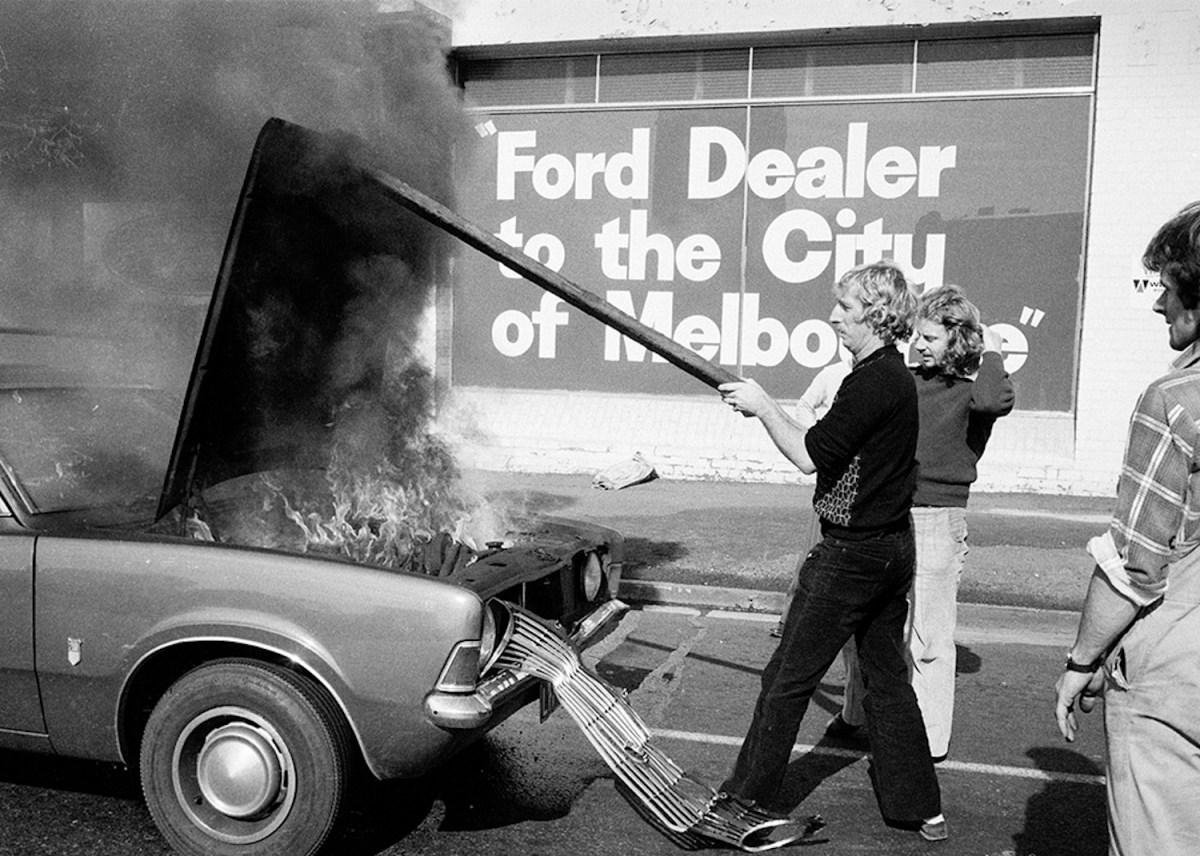
How lucky we are that Chapman did. The Green Bus covers everything from Vietnam War protests at Spring Street in 1971 to the last horse-drawn milk cart in 1979, Queen Elizabeth II’s royal visit in 1980, hot air balloons over the city in 2014 and on. For every monarch, there are many more ordinary people of every background who make up the marvel that is Melbourne.
‘I’m a real everyman, but there were strands of interest,’ Chapman says of his oeuvre. ‘Politics was one of the big ones. I’m a child of the early 70s when Whitlam was elected, when the world changed for young people, and then it was savagely taken away by [John] Kerr and the bloody brats.’
Chapman snapped the protests against Whitlam’s successor, Malcolm Fraser, too. ‘But it was also about what people were wearing. And I also loved photographing sheep shearing.’
As a result, The Green Bus is a truly remarkable snapshot of the city and surrounds, capturing the true heart of Melbourne. And she has changed across the 55 years that Chapman has been capturing her and those who dwell within her city limits.
‘Hardly anyone was walking about with a camera in the 70s and 80s, and there was a real naivete about being photographed,’ Chapman says. ‘These days everyone’s got their phone out.’
He’s worried that the art of photography has forever been warped by the insidious omnipresence of AI. ‘The truth was always a slippery little bastard, but now you can’t trust anything you see on your social media feed,’ he says.
‘We’re being desensitised, numbed. It’s like [Aldous Huxley’s novel] Brave New World, where they give them the drug soma to keep the population sedate.’
The existential threat AI poses to true photography, copyright, the environment and more worries Chapman. ‘The advancement of civilisation should be exactly that,’ he says. ‘It should be advancing civilisation so that all people can climb out of the pit, and I mean everyone from every corner of the earth.’
Take a shot
With 55 years under his belt, Chapman’s advice to all would-be photographers is that perseverance is key.
‘It’s not like I bounced out of the box a fully made photographer,’ he insists. ‘I always like saying that to young people, particularly, because you look at someone who’s really, really good, and you go, “Oh, I can never be like that”. And of course you can. It’s just too hard to see right at the beginning.’
The journey to get there is the real story, Chapman says. Looking at the photos in place, the artist says he’s happy at how they are in conversation with one another and can’t thank the team at City Gallery enough for their staging of The Green Bus.
‘They’ve done a really lovely job in looking after me,’ he says. ‘They’re just a beautiful, beautiful crew of people down there.’
This writer humbly suggests that Chapman and his work deserve the love.