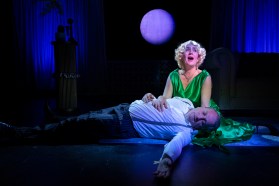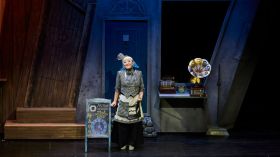
In 2023, La Mama, the pocket-sized Melbourne theatre with an extraordinary record of past achievement, was rejected for multi-year operational funding from Creative Australia for a second time and decided it needed to reflect and reconnect. Accordingly, at the beginning of 2025, it suspended public activities (although it still managed to host 80-plus developments and showings this year, despite its theatres officially being dark), to consult with its Committee of Management, community, staff and artists.
La Mama: quick links
La Mama: relaunched and refocused
On 27 October, La Mama relaunched. Its annual seasons now have three main components. The first part, from February to May, showcases the company’s curated program, LA MAMA PRESENTS: 8 works across its two venues – Faraday Street (HQ) and the Courthouse – for a month each (you can find the 2026 program here).
The middle of the year, from June through August, LA MAMA PLAY, is about development and experiment. There are extensions of its Explorations program, staging works in development for three nights with 100% of the box office going to the artists, and activities focused on professional development for mid-career playwrights, Immerse and Regional Immerse.
LA MAMA PARTNERSHIPS, in the last third of the year, from September through to December, is about festivals and relationships. It includes collaborations with First Nations artists and companies, the Puppetry Festival, Melbourne Fringe, and the Hope Punk Festival, focussed on issues of climate change.
Read: Which Australian Fringe festival is achieving the greatest growth?
The company’s year-long pause has also been about securing new sources of support. Like every performing arts company, “sustainability” – financial, environmental, health and well-being – is crucial. All La Mama’s programs have either found an external sponsor or are in the process of getting one. Such partners include the Cybec Foundation (a regular champion of new Australian drama), the Robert Salzer Foundation (a new name), and Griffith University (my own employer).
Artistic Director Caitlin Dullard has said the three-part structure ‘is a holistic response to the needs of artists now and how they’ve changed, and the needs of audiences’ (Dullard’s full interview on Three Triple R FM can be heard here). Over the year, the company has consulted widely in both metropolitan Melbourne and the Victorian regions. The result is an emphasis on slower development, stronger networks, and more diverse pathways to production.
La Mama: doubling down on ‘complete artistic freedom’
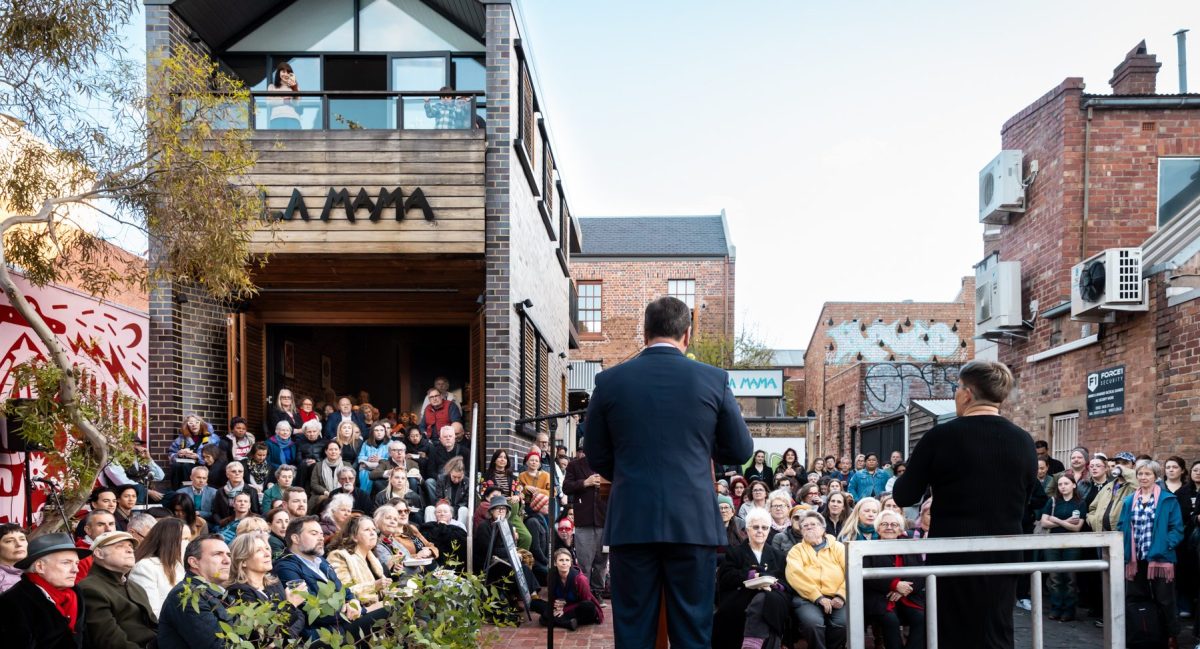
There is something deeply symbolic about La Mama’s reappearance on our theatre scene. The company was established in 1967, back when uncertainty still meant possibility. At the relaunch outside its iconic Carlton venue late last month – the evening sky a perfect blue, the mixed audience in offensively good cheer, because that’s the La Mama vibe – Dullard announced a number of key commitments that in her words, ‘made sense of values that are fundamental, and re-energised some areas that needed love’. Two jumped out at me. The first, to support exclusively new Australian work (of a diverse kind), the second to ‘double down on complete artistic freedom’.
They are values that La Mama’s founder, Betty Burstall, would proudly uphold. When the big picture goes awry, it’s the small one that offers opportunity for repair. In the twaddle tropes of marketing-speak the company has been “reinventing itself” to “refresh its brand”. Better to say it took quality time out to consider how to fulfil its artistic mission in the dysregulated global village we are now forced to live in.
La Mama: joining past to present
In a recent Boyer Lecture, Justin Wolfers, visiting Professor of Economics at UNSW, suggested it is ‘our democratic institutions’ that make Australia ‘not just world class, [but] the world’s best’. Leaving aside the question ‘best at what?’ the fact is that the country was late establishing its national cultural institutions, supports them patchily and cuts them back at the slightest opportunity. Australia ranks 26th out of 33 OECD countries for government investment in culture (latest data), a position it has held since 2017. For the second wealthiest country in the world that is, to put it technically, a shit number.
Wolfers is right about the importance of ‘inclusive institutions’ but wrong to focus on political and economic ones as the only ballast we need in choppy waters. The global order has been warping under the predations of reckless leadership for some time. The bill for that is gutter populism, and it’s a heavy price to pay. So far Australia has been immune, but it would be foolish to imagine it will always be.
The US is a caution, not a contrast. It was founded with an eye to “checks and balances”, weighted towards compromise and inertia. Yet this has proved no protection against a charismatic chancer with a 39% approval rating and an ethical bypass. Were Australia to be challenged in the same way it would have less, not more recourse to constitutional barriers –especially when 51% of Australians don’t know how our constitution works.
The history of La Mama is part of the New Wave that swept over Australian theatre in the late 1960s. It involved companies in every state and territory, and dozens of artists now synonymous with the artform. They did not see their role as Australian theatre-makers separately from their role as Australian citizens. The domains of politics, economics and culture were fused in their minds, as they were in their actions. The Whitlam “moment” sprang from that fusion. It took its character from it, the sense that change can be more than a few policy tweaks but can be principled and mission-focused.
Read: The little theatre that could: 50 years of La Mama
Does our worth as a nation really need constantly “demonstrating” in the spavined language of productivity and innovation? If we value our way of life, it is the quality and texture of that life we should look to nurture. As a digital picture is composed of countless tiny squares of light, so the quiddity of our commons is made up of myriad interactions from which arise our sense of self, individually and collectively. Culture is a major part of the Australian picture. Its key squares are our cultural organisations
The implications of La Mama’s relaunch are therefore profound. It joins our present to our past at a time when we need to reconnect with our common values and straighten our backs when these are dismissed or treated with disdain.
If I’ve heard it once, I’ve heard it a hundred times: why should we care? If you’re asking that question, you’ve already lost what you shouldn’t. You can’t be talked into caring for something. You have to actually get off your arse and care about it. It’s not reasons for caring we lack right now, it’s practical expressions of it. La Mama is one of those expressions.
Applications are currently open for La Mama 2026 (June – November), closing 30 November 2025.
Julian Meyrick is a member of Griffith University’s Performance+Ecology Research Lab; Griffith University is one of La Mama’s new sponsors.