
In 2025, Queensland Theatre Company opened its season with a sparkling new adaptation of Pride & Prejudice. The performance took place not in Brisbane but in the regional town of Toowoomba, two hours away.
Operating on a shared-risk model, it was an unusual move for a state theatre company but one that proved a huge success, with Toowoomba’s Empire Theatre selling over 2000 tickets across the two performances.
As the lights dimmed on opening night, director Daniel Evans turned to Empire CEO Giuliana Bonel and whispered, ‘What do you think about The Great Gatsby for 2026?’
One year on, and a new adaptation of F Scott Fitzgerald’s 1925 masterpiece – a co-production between the Queensland Theatre Company and Shake & Stir Theatre Co – is set to open at The Empire this week.
Toowoomba’s The Great Gatsby – quick links
Bringing The Great Gatsby to The Empire
This won’t be the first time the heritage-listed theatre has put up the greatest host in American literature.
Built in 1911, The Empire was renovated in 1924 to cater for its growing popularity as a picture house. Among subsequent screenings was the 1926 silent film adaptation of The Great Gatsby.
At the time, the Toowoomba Chronicle and Darling Downs Gazette described it as ‘a picture with [an] ultra modern outlook’ and a ‘story of to-day, tensely human and throbbing with life’. Like the Broadway adaptation of the same year, the film (now lost, except for its trailer) helped boost sluggish sales of Fitzgerald’s third novel.
This time around, Gatsby arrives as a much-loved classic. Shake & Stir’s Nelle Lee, who co-adapted the text with Evans and who plays Myrtle on stage, is excited to bring the production to The Empire. ‘It’s one of the most beautiful theatres in the country and we knew that Gatsby’s world would sit perfectly here.’
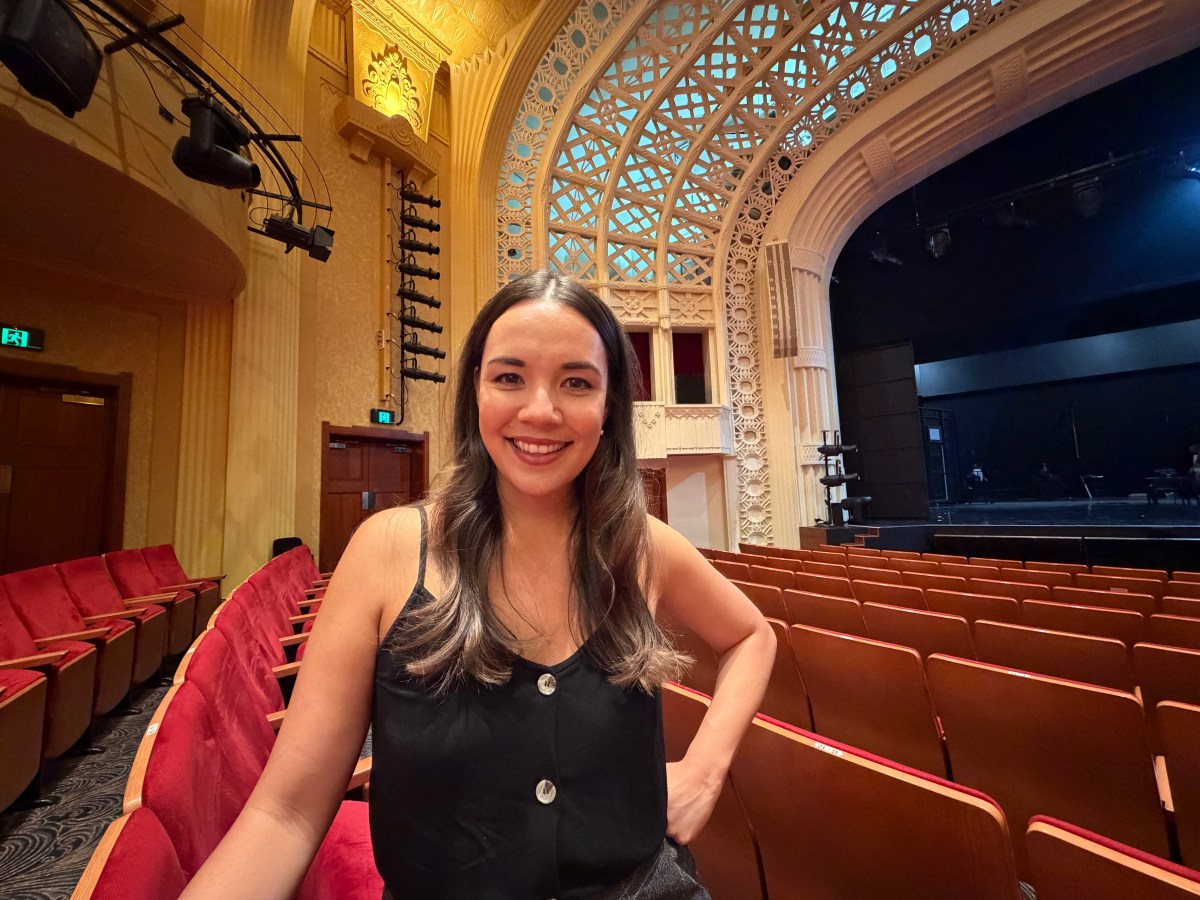
The reason? The Empire was in fact destroyed by fire in early 1933, but was rebuilt – astonishingly, within 10 months – to an Art Deco design of Gatsby-esque proportions. As one breathless reviewer reported, ‘the atmosphere of a king’s palace prevails’.
Most striking was the theatre’s new grand proscenium arch. Its ornate plasterwork concealed an intricate lighting system that allowed the arch to change colour, a feature that fittingly echoes Fitzgerald’s symbolic use of lights and technological innovation throughout the novel.
Today, it’s still a drawcard, with the theatre’s historical tours regularly oversubscribed.
Lee, herself a graduate of Toowoomba’s University of Southern Queensland, believes audiences are nostalgic for the world of the past that The Empire evokes.
Such nostalgia makes an interesting confluence with The Great Gatsby’s own themes of memory and longing.
The American dream
The Great Gatsby is narrated by Nick Carraway, a recent Yale graduate placed at the moral centre between the United States’ east and west coasts and all they represent, who becomes witness to the precarious foundations of the American dream.
While today we tend to associate The Great Gatsby with the glamour and excesses of the Jazz Age, part of Fitzgerald’s craft lies in the novel’s silences and ellipses, which point to a society finding its way after a norm-shattering global conflict.
If the book’s set pieces seem destined for theatrical and cinematic adaptation, their subtleties can be all too easily lost – as seen in Baz Luhrmann’s raucous 2013 adaptation.
But the medium of theatre, as Lee notes, is well placed to explore the novel’s gaps and ambiguities, including Nick Carraway’s reliability as a narrator. ‘There’s a certain back-and-forth between what Nick hears or knows and what the reader or audience sees. We can unpack things on stage that are passed over in the novel.’
The work’s language can also pose a challenge. Fitzgerald’s writing is often dense and is patterned in a way that signals, in its very effortlessness, a youth steeped in poetry. How difficult was it to translate Fitzgerald’s distinct style for the stage?
‘It was really important to us to strike a balance,’ Lee explains. ‘We had to make sure the script was accessible for modern audiences while respecting the original text. A lot of the lines in this work are beloved by so many people. There’s a reason why the novel has stood the test of time.’
Putting the ‘Queensland’ in QTC
As The Empire’s CEO suggests, partnerships like this put the ‘Queensland’ in Queensland Theatre Company, with attendees, including school groups, coming from across the Darling Downs and beyond.
‘Regional and rural audiences really cherish this opportunity, and they’re keen to be the first to see it, which is exciting,’ Bonel says.
So how does it all work in practice? ‘It’s a great partnership,’ confirms Co-Director Nick Skubij, who appreciates the breathing space it provides. Once in Toowoomba, the team has time to take a step back and watch and reflect, something not always possible in major city theatres.
There are also opportunities for professional development, exchange and upskilling. Marketing teams have been working together closely, and some Empire staff have been on placement with QTC.
Grace Sankey, Youth Arts Lead at The Empire, has enjoyed her time as rehearsal observer. ‘It’s been an incredible experience, and has helped me develop my craft as a director and facilitator,’ she says. ‘One of my greatest takeaways is that starting [a production] is hard at every level. It was fascinating – and reassuring – to see how uncertainties and anxieties around early choices exist in professional theatre just as much as in youth theatre.’
Read: Regional training program tackles technical theatre jobs
As with any touring production, moving a show of this size can be challenging, but Lee stresses the determination of all involved to ensure that Toowoomba audiences experience the same high quality of production as those at QPAC.
Bonel, who grew up on a farm in Far North Queensland, is similarly passionate about bringing the arts to regional centres. ‘As it currently stands, we have the space and time to be able to allow this relationship to come about. If we can accommodate productions of scale to open here at The Empire, we will do exactly that.’
It’s a boon for the city in other ways, too. Toowoomba’s central hotels are booked out and local bars and restaurants benefit, with Queensland Theatre even bringing donors to Toowoomba for opening night.
Toowoomba’s Friends of the Empire, numbering over 200 volunteers, are also taking part, pitching in to ensure cast and crew have home-cooked food (in addition to the homemade biscuits routinely provided in dressing rooms) available for the duration of the run.
The Empire was rescued from demolition in 1994 – the tale of small-minded developers versus small-town arts lovers is itself worthy of the stage – and reopened its doors in 1997 following a major renovation.
With preparations under way for the 30th anniversary of this most recent rebirth, and the precinct ready to reimagine its place in the town and region, theatre companies everywhere should be watching.