
While it’s true that fringe festivals everywhere share obvious things in common, when it comes to Australia’s big four – in Adelaide, Melbourne, Perth and Sydney – it’s their notable differences rather than their similarities that explains their strengths.
The nation’s largest and highest grossing festival, Adelaide Fringe, has been running since 1960. Its long-held place as a stalwart cultural event on South Australia’s calendar undoubtedly plays a role in its standout success and its strong audience recognition across multiple generations.
At the other end of the scale is Perth Fringe World, which launched in 2012. Yet from the earliest years of this festival’s trajectory it has undergone meteoric growth due to its summertime, carnivalesque atmosphere and its capacity to quench Perth audiences’ thirst for diverse live performances that don’t break the bank.
Conversely, the Melbourne Fringe festival, which launched in 1983, is characterised by its more bespoke outlook, supporting artists to use its platform as their playground for experimentation and creative risk-taking. While there may be sprinklings of burlesque and popular drag shows in its annual program, the festival is driven by artists trialling bold, new, avant-garde creations.
Finally, Sydney Fringe, which launched in 2008, is officially the smallest of the four, and is arguably the one with the most local competition, with the huge volume of year-round cultural events happening in its thriving arts metropolis. But the next few years might prove a turning point for this small but mighty festival, because of all the Australian fringe festivals, Sydney Fringe’s ticket sales and box office results are arguably showing the strongest signs of growth.
Australian fringe festivals – quick links:
Australian fringe festivals: big picture numbers
The most obvious takeaway of a comparative survey of the recent results of the ‘big four’ shows how far ahead Adelaide Fringe is in size and scale. Its number of events continue to grow, while overall attendance is also up.
Melbourne Fringe also presented more events in 2025 even though Creative Director & CEO Simon Abrahams says, ‘this was not the festival’s intention because growth [of events] is not one of our aims’.
Abrahams adds that while Melbourne Fringe final sales and attendance figures are still being finalised, the feeling around this year’s program (which wrapped up late last month) is that it has been ‘broadly hugely successful’.
Meanwhile, Perth Fringe World’s overall attendance in 2025 dipped somewhat due to its reduced number of free events. As Perth Fringe World & ARTRAGE Creative Director & CEO Jo Thomas told ArtsHub, this decision to cut down on its free events this year was made in light of increased infrastructure costs, such as stage builds and hire costs, which limited the festival’s capacity to present these open-access events.
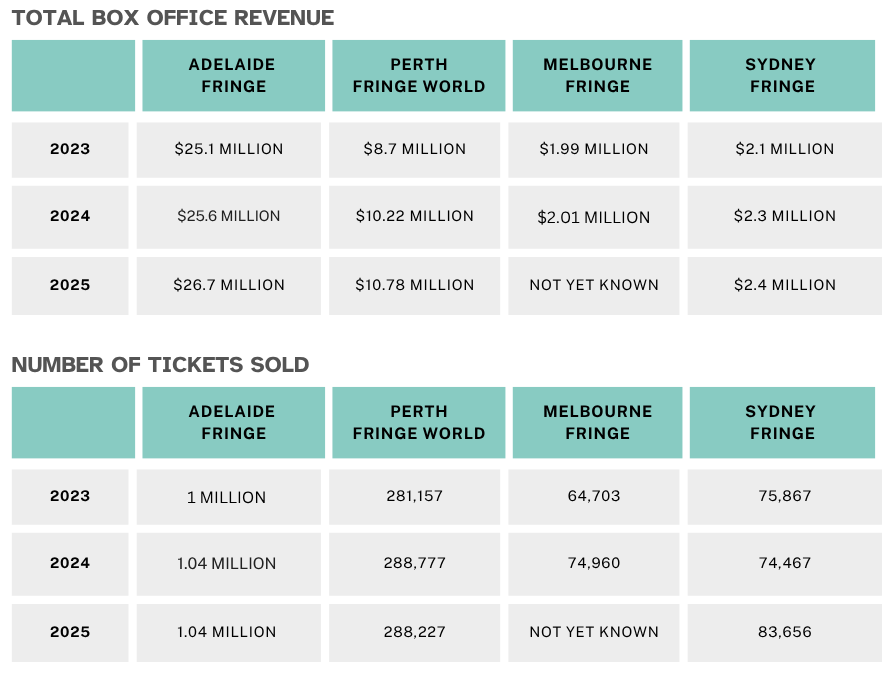
But the good news for Perth Fringe World – particularly for its participating artists – is that its overall box office takings were up in 2025 (as shown later in this article), which indicates that appetite for ticketed Perth Fringe World shows is still strong.

Australian fringe festivals: box office results
Looking at sales figures and total ticket sold across each festival also reveals some interesting trends.
While overall box office takings have risen for all four festivals over the past three years, with some recording fractional growth and others steadier increases, this dollar figure growth does not necessarily equate to increased numbers of tickets sold.
In some cases, fewer tickets have been sold overall but takings have increased, suggesting higher-priced festival tickets were strong sellers.
Yet it’s also widely understood that, especially since Covid-19, fringe audiences are highly price sensitive and festivals must continue to work hard to keep their ticket prices as low as possible.
What’s behind this fringe festival’s recent growth?
While each of the four big fringe festivals are holding their own at the box office, the festival recording the strongest signs of growth, particularly in 2025, is Sydney Fringe.
Of particular note is its increase in numbers of tickets sold this year, which rose around 12% from its previous year.
As Sydney Fringe Festival CEO Patrick Kennedy explains, these record-breaking results are a sign that audiences are welcoming recently implemented strategies, such as presenting more shows across a larger number of local government areas, in an effort to bring more work to the people, rather than the other way around.
As Kennedy tells ArtsHub: ‘It’s common parlance here in Sydney that we are a “city of villages”. Since Covid especially, there is more of a propensity for people to stay within their local LGA [local government area] for their entertainment and nights out.’
For Sydney Fringe, this has meant greater investment in localised fringe hubs and greater emphasis on ‘mini-festivals’ across a greater number of LGAs.
‘Our audience surveys show that fringe shows are often seen as opportunities to discover something new and unexpected and with that comes a sense of a taking a chance, especially because a lot of our open access program is untested, emerging new work,’ Kennedy says.
‘But our surveys also show that people are much more willing to take that chance on a show if it isn’t far from home. So we have been really responding to that feedback in the way we design and promote our festival.’
One particularly strong achievement for Sydney Fringe in this regard has been the way the festival engages with local ticket buyers who have already seen one fringe show, encouraging them to continue their Sydney Fringe experience with added incentives and friendly festival support.
Read: Are opera audiences really in decline? Big picture results reveal all
As Kennedy explains, ‘We have been partnering with more local hospitality venues to invite people who we know have already seen a [Sydney] Fringe show to attend another show in a different Fringe precinct, with percentage discounts and offers at a restaurant or bar in that area,’ he says.
‘We also provide them with public transport route options and maps to the venues to help them plan their journey.’
Kennedy says this strategy is based on recent results showing that around 30% of people who go to a local fringe show move on to see another show at the festival.
‘But in my opinion, that’s actually very difficult to achieve from a standing start. We’ve tried it, and it doesn’t actually work,’ he says.
‘So part of our strategy has been to engage in more direct communications with ticket holders and provide them with added incentives to go on to other shows and discover parts of the city they may never have visited.
‘The results of that work are now starting to show up in our numbers, which is great to see.’
Cost increases hitting fringe festivals hard
Despite the record year, Kennedy acknowledges there are also some threats to the Sydney Fringe festival’s future growth.
‘Of course we are very pleased about our blockbuster year,’ Kennedy comments. ‘But those figures actually ignore the very tight margins and rising costs we have been dealing with.’
The CEO adds that Sydney festival saw a significant drop-off in sponsors this year due to those businesses’ tough market conditions, and philanthropic donations were also down.
‘At the same time, we are in discussions with some major potential sponsors who are telling us that they are very keen to sign up, but they just need to understand why the government’s investment in us isn’t higher despite our year-on-year numbers increase, because they’d like to see firmer commitment from government before they confirm their own investment.’
‘At the moment, what’s really holding us back from greater growth is more significant government support in line with other Australian fringe festivals.’
On the other side of the country, Jo Thomas says Perth Fringe World is in a similar position in terms of battling rising costs.
As Thomas tells ArtsHub, ‘Some of our costs to build and produce the [Perth Fringe World] festival are up 96% over the last three years.
‘But with a cost-of-living crisis, we’re also focused on keeping ticket prices low and events affordable for everyone, so we need to be creative with other revenue raising,’ she adds.
The CEO also says her festival is watching every single cent to be sure it can continue to deliver for both artists and audiences.
‘As the biggest arts festival in Western Australia it’s imperative we keep bringing the summer celebration over January and February,’ she concludes.