After six years in construction and millions of taxpayer dollars spent on its development, one of the country’s most hallowed sites of remembrance has just opened the doors on some major new museum spaces dedicated to Australia’s modern-day military and peacekeeping missions, including in the Middle East, East Timor, Bougainville, Rwanda and Cambodia.
It’s a historic building project, and one that has not been without criticism for the Australian War Memorial, given its massive $550 million price tag and intention to expand its museum spaces by around 80%.
But since it opened in 1941 – which was itself a time of major international conflict – the AWM has been not only a shrine to Australia’s military servicemen and women but a powerful emblem of Australian nationhood.
Now, against the backdrop of yet more worrying conflicts playing out overseas, the institution is reflecting on Australia’s efforts in modern-day military missions, with a curatorial focus on the stories of veterans and survivors of war – many of whom are living in the Australian community today.
AWM’s new spaces – quick links
Stories of the human and the machine
For many AWM visitors, the prospect of getting close to artefacts from recent military service missions is exciting, if not emotionally confronting. However, given these new museum spaces will be frequented by Australian military personnel who have themselves been directly involved in these conflicts, the curators bear a heavy responsibility indeed.
In taking up the challenge, AWM has dedicated a sizeable team of curators to designing its new displays, which open to the public via series of staggered launches over the next few months.
The curation of the newly opened Australian Peacekeeping from 1947 display has been led by AWM Senior Historian Dr David Sutton; the Conflict in the Middle East from 1990 display, which is also now open, has been steered by AWM Curator Kerry Neale; and the soon-to-be-opened War in Afghanistan display is led by AWM Curator Michael Grant.
AWM’s Director of Gallery Development Bliss Jensen has also played a pivotal role in the design and development of these new spaces.
While these plans have not yet included coverage of Australia’s Frontier Wars, as an AWM spokesperson told ArtsHub, there are plans to build spaces dedicated to these conflicts as part of a series of pre-1914 displays, to be completed in 2028.
For now, as AWM Director Matt Anderson has repeatedly pointed out in his media appearances around the launch of the newly opened spaces, the intent of AWM’s curators has been not only to present objects of Australia’s war experiences, but to share the stories of the people behind them.
However, there is no escaping the difficult tensions that exist between the number of the massive aircraft and vehicle objects in these new spaces – including a CH-47D Chinook helicopter used in Afghanistan and a F/A-18A Hornet used in Iraq and Syria, to name just two – and the complex personal narratives that accompany these epic objects.

What AWM’s existing galleries do well is create nuanced interplays between historical objects and the myriad stories of human ingenuity, endurance and tragedy that lie behind them. (The frequent placement of art throughout the displays on the first world war, second world war and Cold War also plays a critical role in achieving this.)
Sensitive dialogues like these are less palpable in the new, modern-day warfare galleries. Yet in AWM’s defence, its curators are grappling with a range of dramatic differences in the form and shape of war armaments as they exist today, compared to days gone by, and these differences amplify the chasms between the human and the machine.

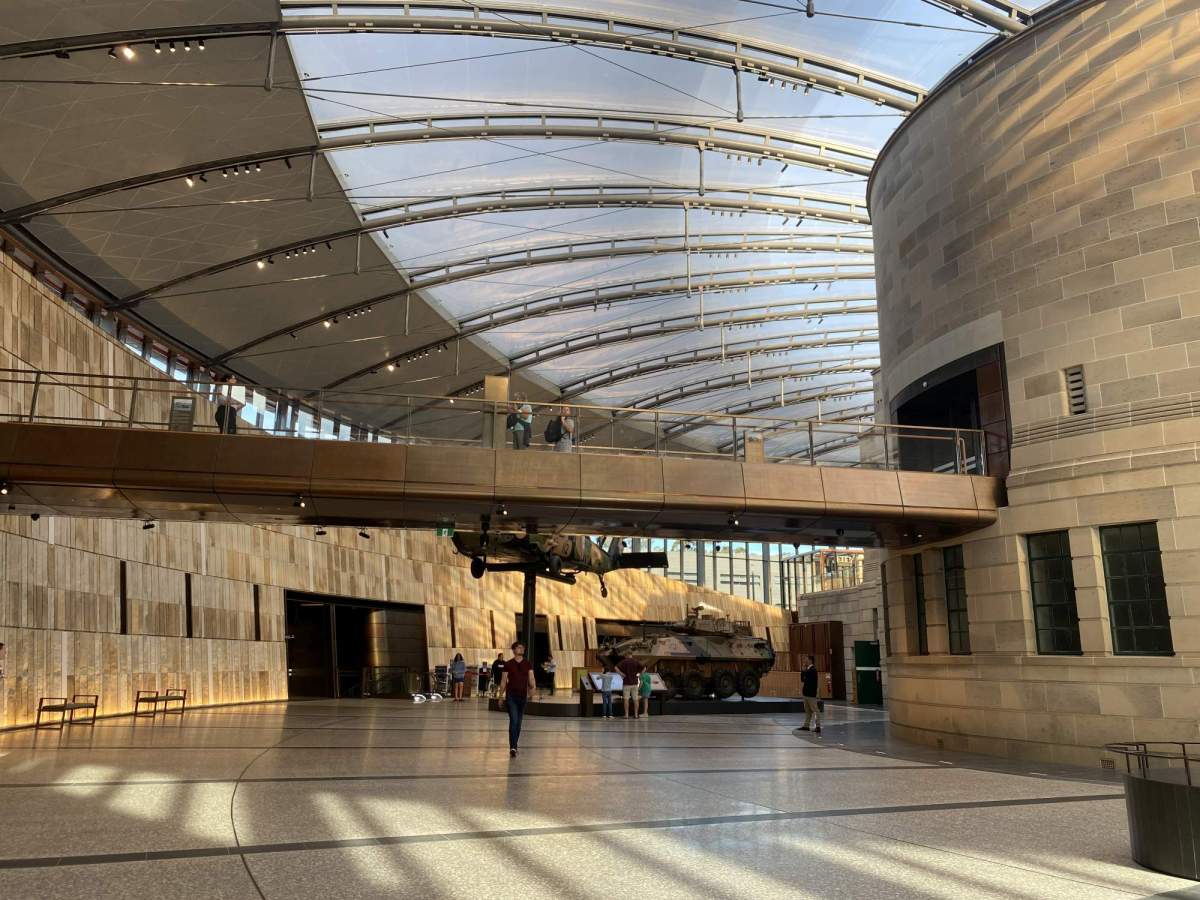
In many cases, modern-day aircraft and vehicles are far larger, sleeker and decidedly less-human than anything that has come before. This may be one reason (aside from logistical concerns) why some of the largest and most spectacular aircraft and vehicles are placed in minimalist, isolated displays in AWM’s new glass and sandstone ANZAC Atrium space, where they read as exactly what they are on the surface – stunning pieces of military technology and remarkable feats of engineering.
Modern stories told with modern technology
Where the displays become more tonally nuanced is when one enters the museum’s more enclosed gallery spaces. These span three levels and currently include the displays Australian Peacekeeping from 1947, Conflict in the Middle East from 1990, Operation Kudu: Supporting Ukraine and Tarin Kowt Wall (on Afghanistan), among others.
These spaces, particularly the Australian Peacekeeping display, are where visitors can see, hear and read numerous personal testimonies from soldiers, doctors, civilians, family members, artists and even anti-war protesters, who have been impacted by modern-day conflicts.
In keeping with modern-day focus of these new displays, recently developed screen-based technologies play a large role in presenting these stories. The most prominent of these is found in the Australian Peacekeeping gallery, where a walk-through multimedia display of 10 life-sized screens allows 34 peacekeepers from modern-day missions to share their experiences.
Playing on a loop, it’s both an informative and moving display, but its also frustrating in that it’s hard to place the individuals in the work beyond hearing snippets of their stories. The installation’s wall label (at least, the text that could be easily found) presents only a list of their names in alphabetical order with no reference to the context of their service beyond what is shown on film.

On AWM’s website, this Australian Peacekeeping display is explained as ‘showcasing the stories of over 45,000 Australian police and military personnel’. While this effort to represent the breadth of peacekeepers’ experiences in modern-day missions is admirable, from the visitors’ point of view, without adequate text-based framing, their stories become loose threads.
A more effective screen-based installation – though one that is a great deal more confronting – appears at the back of the Australian Peacekeeping display as a small, enclosed screening room. Seating only three or four people at a time, it is carefully labelled at its entrance with warnings about its strong content.
What visitors encounter here is a documentary-style piece that bears witness to the experiences of Australian peacekeepers, doctors and Rwandan refugees during the 1990s genocide in Rwanda. Each interviewee takes their time to recount their experiences, proving that sometimes the horrors and injustices of war are in fact not ‘beyond words’. In this case, their words powerfully convey what took place.
The enduring role of art
Another noteworthy element of AWM’s new displays is the way that Australian artists’ perspectives are presented in relationship with objects of wartime service, via artworks drawn from the AWM Collection.
From the very beginning of AWM’s history, artists and their work have had a valued place at this site, starting with the contributions of Australian soldier and artist Napier Waller. Waller was seriously wounded in battle in France during the first world war in 1917 and lost his painting arm from his injuries. He designed AWM’s dome mosaic and stained glass window space, artworks that continue to help tell the story of Australia’s wartime experiences.
This tradition continues in the new displays, where the frequent placement of contemporary artists’ work adds many important dimensions to the visitor experience.
At the entrance to the Conflict in the Middle East from 1990 display, there is a powerful oil painting by the late Canberra-based artist Mandy Martin. Picturing the Inconceivable No.3 was made in the early 1990s in response to seeing images of Kuwait’s burning oil fields during the Gulf War in media news reports. As its wall text describes, Martin was compelled to create the piece after realising how landscapes and the environment – as well as civilians – can become ‘unwitting players in wars’.

Also given a prominent, in this case central position in this Middle East display is a small video work by Kurdish Australian artist Rushdi Anwar. Titled Facing living past in the present (2015), it shows the artist first tearing up an image of Saddam Hussein and then trying to stick it back together with thick black tape, until the portrait is completely obscured by these attempts at repair.
A comment on the cycles of instability and violence that Anwar witnessed growing up under Hussein’s regime in Iraq – which hung on to power despite many threats to its existence, before finally collapsing at the end of 2003 – the work’s inclusion also nods to the many refugee and migrant Australians who have become part of the nation’s fabric since fleeing similarly oppressive, yet enduring political regimes.
Also interesting, but easily missed in the Middle East gallery if you are not paying attention, is a small felted assemblage work by Wollongong-based artist Anita Johnson.
Titled Weapons of Mass Deception (2012), the work resembles a kind of antique megaphone, or loudhailer, balanced on a makeshift rifle-firing apparatus. In the context of the early 2010s, when Saddam Hussein’s regime was no more but the region was still engulfed in conflict, the question of how guns and speech acts can be used as tools of mass destruction, and mass deception, is a pointed one to consider.
But these are only a small sprinkling of the contemporary artworks chosen for display among the thousands of artefacts currently showing in AWM’s new spaces. There are also pieces by Australian artists Kevin Connor, Gordon Bennett and several of Australia’s official war artists from modern-day conflicts, including Jon Cattapan, Megan Cope and artist-partners Lyndell Brown and Charles Green.