
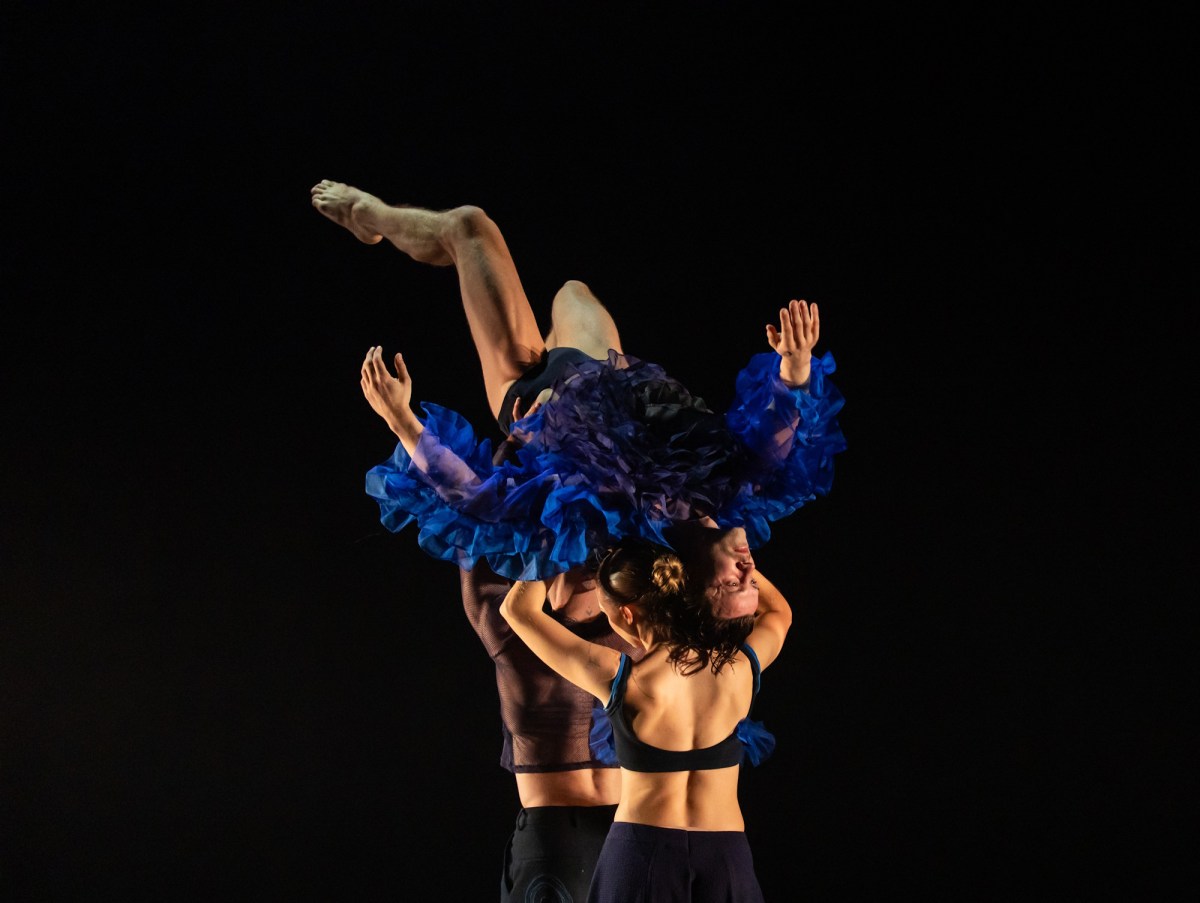
Since Australasian Dance Collective Artistic Director Amy Hollingsworth initiated Three, it has become a defining expression of her vision for the company. It champions new works by bold contemporary choreographers, working in collaboration with ADC’s dancers.
Its fourth iteration was a triple bill of one-act ballets. Maarung by Wiradjuri choreographer Joel Bray and Brog by Amber McCartney were both world premieres, while Harrison Ritchie-Jones’ Cuddle, already seen in Melbourne, was a Queensland premiere.
It was a diverse program that offered distinctly different choreographic works, with ADC’s dancers responding with imagination and technical skill to the competing demands on their bodies and skills.
Three review – quick links
Joel Bray: Maarung
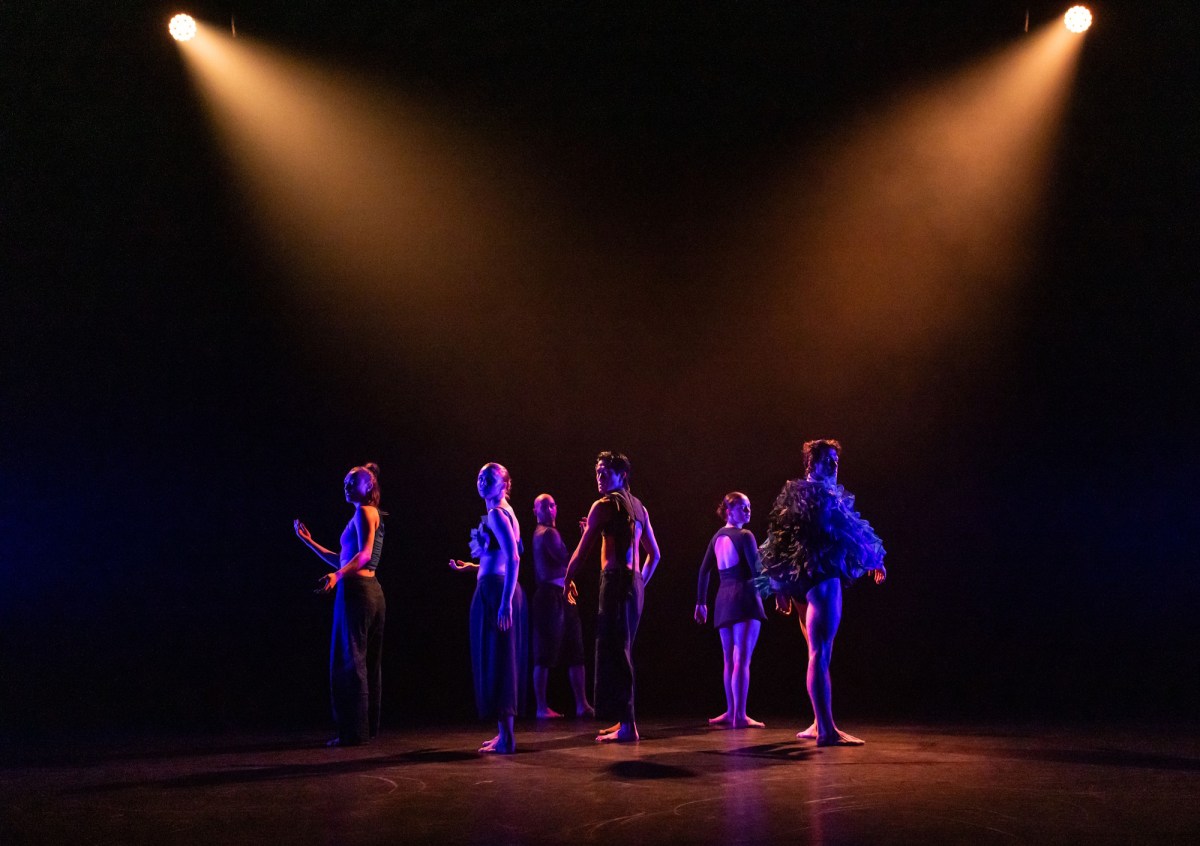
Bray’s Maarung, which means ‘circle’ in Wiradjuri, creates various images of circles, and allows the dancers free range in improvising and exploring bodily shapes, contortions and patterns, both alone and in groups.
Maarung starts gently, with the huddle of six dancers allowing one to emerge. They’re lifted slowly and ethereally above the others and this is repeated for each dancer in a series of circular movements that are entrancing and beautifully controlled. It is imagery Bray returns to throughout the work.
Choreographed mechanical yet human movements – with legs and arms flying, as dancers rise and collapse – are matched with group precision in back-and-forth swaying movements. A myriad of visually stunning contorted shapes and imagery gives the work a harmonious fluidity.
The evocative music (composed by Louis Frere-Harvey) commences and finishes with natural sounds of waves and bird song, neatly representing the circle of life. For the most part, however, this sonic picture is percussive, with resonant electronic music that suited slow dance passages and throbbing, rhythmic drum beats accompanying the stark mechanical movements.
Harrison Ritchie-Jones: Cuddle
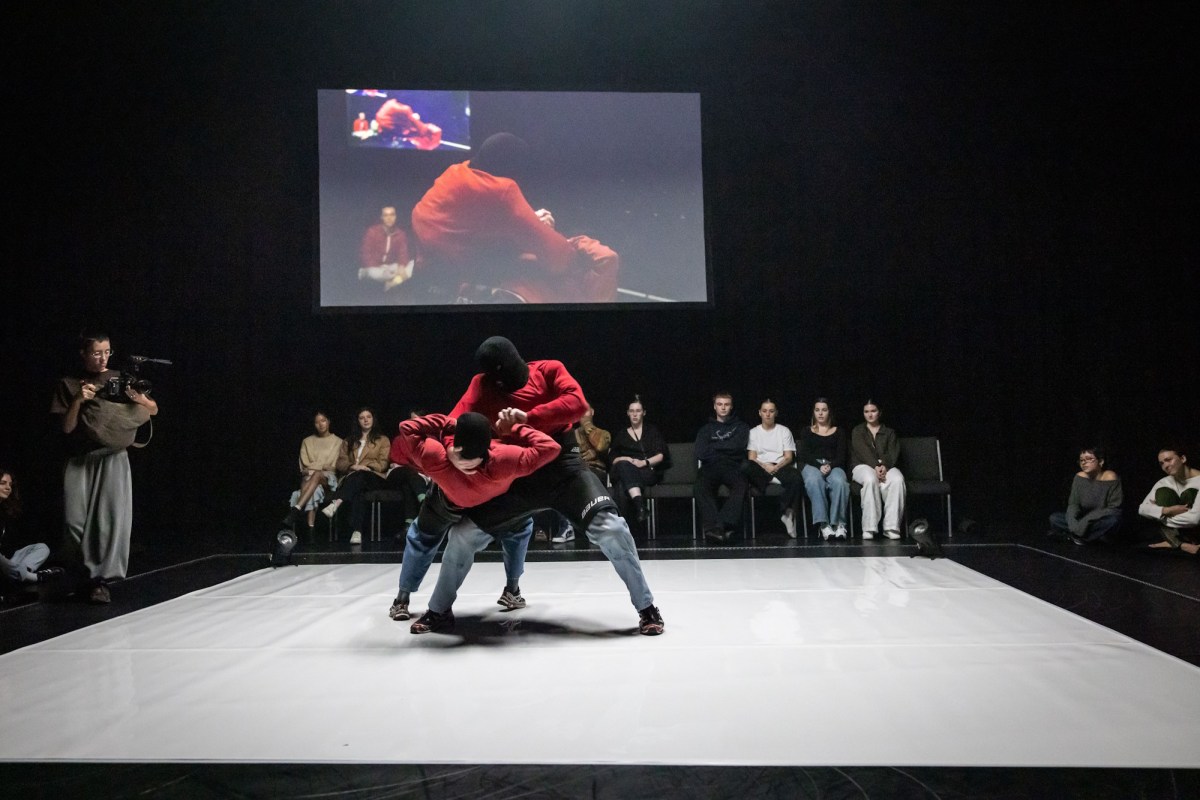
Without giving too much away, Harrison Ritchie-Jones’ Cuddle is a duet with himself and guest artist Michaela Tancheff, based on what he ironically calls ‘a dance heist’. For this work, the audience moved into a different space to watch the piece in the round, which was also filmed live by cinematographer Babi Bertoldi and projected onto large screens.
The opening is great fun as the two artists, wearing balaclavas and bodysuits, are shown on screen emerging from the Powerhouse’s ferry stop, then rolling together in a clinch on the floor as they enter the building, and then the stage. It begs the question, are we watching a heist or a couple quarrelling? Perhaps the title Cuddle gives it away.
When they arrive, they take up positions on opposite sides of the stage, similar to a boxing ring. The work then develops into a series of dance movements, akin to a judo or wrestling match, which is broken up by the back-and-forth of a verbal debate.
The dance elements are well choreographed and demonstrate tremendous physical athleticism by the dancers. However, the thin narrative and apparent lack of resolution means the initial promise ultimately disappoints, leaving Cuddle feeling repetitive and overly long. Moreover, the work does not seem to fit the initial vision of collaboration with the ADC dancers.
Amber McCartney: Brog
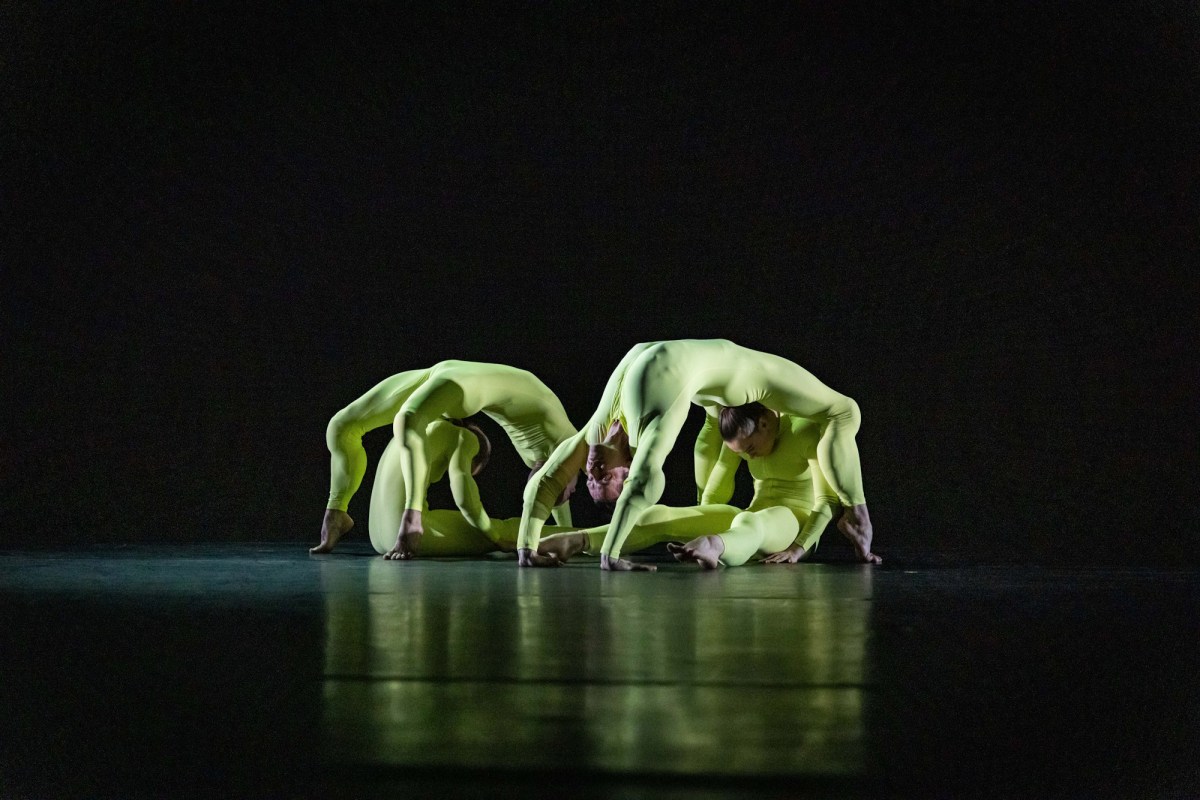
Amber McCartney created the concept for and choreographed Brog in collaboration with ADC company artists. The high-energy work is sharp, witty and thoroughly entertaining, and also full of immense technical skill.
Brog imagines a small ecosystem of bodies who evolve as they are being observed, a premise that’s evident right from the stark opening images of three dancers mechanically lined up in a row on the ground.
Impressive are the perfectly synchronised, measured robotic steps of the bodies, including a backwards walk by all six dancers moving at a snail’s pace, which is riveting. Mechanical characteristics include twisting, gyrating and rolling movements, all managed superbly. Particular praise to Taiga Kita-Leong and Lily Potger both of whom had acrobatic solos where they moulded and contorted their bodies into amazing and breathtaking shapes and images.
Three certainly presented two exciting and original works of choreography that aptly showcased the ADC’s talented dancers, demonstrating an impressive display of imaginative and technically demanding contemporary dance.


![[GAMEBOY] from choreographer Amy Zhang tours as part of ORBIT 2026. Photo: Supplied.](https://www.artshub.com.au/wp-content/uploads/sites/2/2026/08/7.-ORBIT_ARTWORK_gameboy-by-Amy-Zhang.webp?w=280)