The end that awaits us all. As certain only as taxes. However poetically or euphemistically we choose to label it, death is inescapable. The Farm’s bold new production claims another elegant description for its title – No One Gets Out of Here Alive – but the Gold Coast-based performing arts company cannot be accused of avoiding the inevitable.
Unveiling its world premiere season at the Brisbane Festival from 9 to 12 September, then playing Bleach Festival on home turf from 10 to 11 October, No One Gets Out of Here Alive positively swirls, spins, sways and skips with death, rather than skirting or shirking it. In the tradition of the memento mori, the dance-theatre piece also celebrates the reminder to live.

In order to die, we must first be alive. Also, nothing unifies humanity more than the fact that every single one of us has an expiry date. Our tendency to forget those truths is one of reasons that No One Gets Out of Here Alive embraces its topic with such relish, explains the show’s director – and also The Farm Co-Artistic Director – Gavin Webber.
‘That was super clear and important to us – that there’s something missing a lot of the time in our culture’s need to feel like we’re going to live forever, and everything about consumption and the idea of bigger and better all the time,’ he tells ArtsHub.
‘But this sense of acknowledging our mortality just brings us towards a preciousness of life, and that it’s such an incredible, fragile and beautiful thing that we all happen to be alive.
‘And this idea of waking up every morning and first thing you do is to go, “Oh, am I still alive? Yes. Okay” – and then to use that as a point of, “Well, that’s a pretty good place to start”.’
No One Gets Out of Here Alive interview – quick links
Going where death leads you
The Farm is already known for its range in terms of subject matter, looking at climate change in Tide, information overload in Hold Me Closer Tony Danza, car culture in Throttle and exploitation within the film industry in Stunt Double. Its journey with No One Gets Out of Here Alive began with Kate Harman, another of the company’s leaders and now one of the piece’s core artists, and her early suggestion of death as a topic to explore.
With four Artistic Directors, Webber says, ‘We’re always shopping around different ideas of what we’re going to be working on between us.
‘I think she had a different idea of where it might lead us than where it has actually led us, so that’s always part of collaboration.’
As with much about the process of creating and crafting No One Gets Out of Here Alive, that origin story feels apt for the work. The interplay between the individual and the collective, the reality that it isn’t just our bodies that perish: these notions pop up again and again.
That’s the nature of the subject. ‘The more that you start to look at this topic, the more of its universality just starts to echo for you,’ says Webber.

‘As soon as you start to think about it, it weighs upon you in different ways,’ he says. ‘I know for me personally, dealing with the death of myself as a dancer in a lot of capacities, as I’m getting older, there was that side of things. So what you’re going to let go of in your life, this is something that we’ve been very busy with in different ways.’
His Fellow Co-Artistic Director at The Farm, Grayson Millwood, also one of No One Gets Out of Here Alive’s core artists and performers, ‘lost his father when we were doing Stunt Double,’ Webber says – but, given that death truly does touch us all, The Farm didn’t limit the show’s development to their own direct experiences.
‘We met with a group of community members, older women, who were directly facing death in certain ways. One of them has a terminal diagnosis. And they’ve been very much our spirit guides along the way,’ Webber says.
‘As part of that, of course, they’re talking about death and saying how much they want to talk about it with their children or their grandchildren, but often they don’t want to.’
Playfully serious and seriously playful
How, then, do you tackle an immutable aspect of existence that western culture forcefully shies away from, but forever haunts our hearts and minds?
Art has always grappled with death. Webber cites Pina Bausch – who he considers part of The Farm’s story ‘from working with Meryl Tankard for so many years, and her lineage’ with the iconic German dancer and choreographer – as an influence.
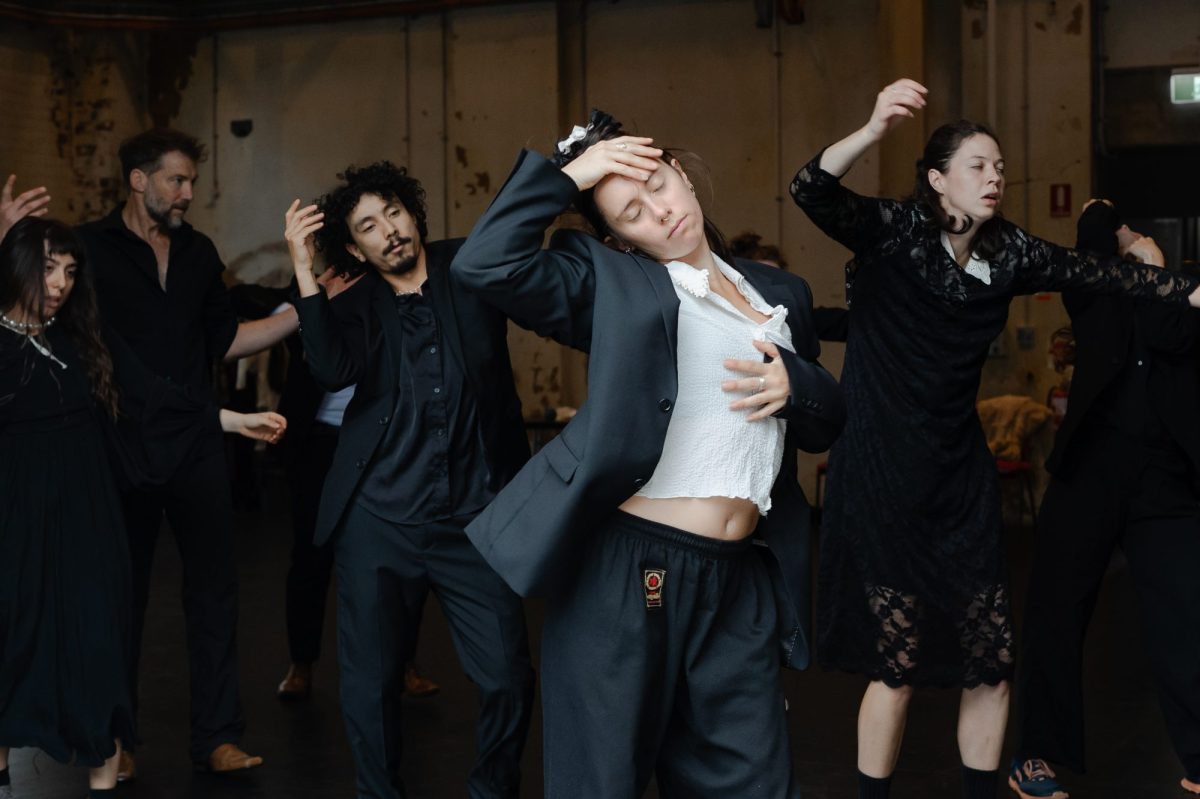
Indeed, elements of No One Gets Out of Here Alive even feel fated. ‘When you look at this funeral setting and everyone in dark black suits, there’s something that just feels so beautifully signed,’ Webber says.
‘We’re doing it very much in Farm fashion, but there is some of that beautiful history of dance theatre that it feels like it’s coming out as well. I think there is iconic imagery that is involved in that … not that you can even want to avoid it, but it just comes up.’
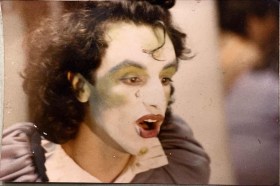
Familiar symbolism linked to mortality within the broader cultural sphere also features. The grim reaper makes an appearance, for instance, after The Farm first dressed up a seven-foot-plus German musical collaborator in the costume during a Berlin season of Social Muscle Club.

Perfecting the right tone has always been the guiding light, though. ‘We want our shows to, in some ways, be topical, but we want them to be heart-openers,’ says Webber. ‘We didn’t want to tackle death and make a funeral, even though we start with a funeral.’
He adds, ‘We want to not just grieve, but we want to celebrate life. That became very important to us. But it became also clear that in order to celebrate life, we, to some degree, we need to face death and come to terms with it, or at least put our minds onto it in some way.’
Cue ‘the playfulness of playing with that imagery in a way that you can say things without being heavy-handed,’ as Webber characterises the careful tonal balancing act of No One Gets Out of Here Alive.
‘Because it’s really important to us that we approach this topic very seriously, but also with serious playfulness at the same time,’ he says. ‘So we always say we’re playfully serious and seriously playful.’
A confrontation to share
Once you start actively reckoning with death via a piece like No One Gets Out of Here Alive, the conversation that it sparks feels like a necessity. ‘There’s definitely that sense for us that we lose something by not looking at it, and that our culture tries to bury it – and tries to also bury old people, in terms of [putting] them in a place where we don’t see them, because they remind us of something that we don’t want to contemplate,’ says Webber.
‘But that contemplation, that knowledge and that acknowledgement, is not only richer for the people who are facing death – actually, which we’re all going to face – but it’s also richer for us to share it and to be a part of that journey,’ he says.
ArtsHub: 10 must-see highlights at Brisbane Festival 2026
Sharing is among No One Gets Out of Here Alive’s key tenets. Just as communal input was valued in the production’s early development – The Farm held its first ever auditions, rather than casting from within or from performers that the company already knew – the show also underwent a feedback process to ensure that the final piece is genuinely a work that reflects humanity’s relationship with death in all of its facets.
‘This is where we felt a little bit an obligation, not just to ourselves and our own artistic desires, but to the community members we’re working with, to others – knowing that this is such a universal thing, everyone’s going to die, so everyone can have an opinion,’ says Webber.
Using those reactions to fine-tune the show’s mix of weight and levity was equally crucial. As Webber says, ‘We did very much listen to people when they’re like, “Okay, it’s too dark”, or [to help with] this sense of, “Where do we want to place that lightness?”‘
‘But we also wanted to make sure that we didn’t undercut ourselves all the time, that we did go deep, because I think it can also be a trap to always want to make the joke, to always undercut the seriousness of something. We felt like the topic deserved us to go a little bit deeper than that,’ he adds, ‘to really get underneath the skin of it in a way, or to dig down into the dirt – literally, is what we do – and to really go into those places which are very ritualistic.
‘Humour unlocks an emotional response to the subject matter, so you’re using it to open a doorway, but then you want to go through that door.’
He adds, ‘We don’t want people to leave devastated. We want them to leave uplifted. That’s really important.’
Clear eyes, open hearts
With a subject that innately evokes a visceral reaction, No One Gets Out of Here Alive’s creative team also recognised that actions, through the movement of the show’s dancers, were always was going to speak loudest. ‘We want it to go beyond words,’ says Webber.
‘My father said this to me: it’s like death is inconceivable. It’s just something you actually can’t imagine, because to imagine that you’re using your mind, and your mind is the thing that’s going to die. So your mind is unable to imagine death, because it’s the death of itself, right?
‘And a lot of people talk about that’s where the fear of death comes from, the friction between that concept of “It’s something we know will happen” … [and the fact] we can’t imagine what it means.’
He adds, ‘How do we then address death if it’s something that’s inconceivable to us?’
In No One Gets Out of Here Alive, ‘we address it through ritual, we address it through singing, through laments, through cultures who use ululation and voice,’ he says. ‘That led us very much to music and dance, because we think there is that ritual of the body that’s very important in death practices as well.
‘So it felt very much like we had to make a ritual of the show that is based in the body, and not based in language as much. It was a very clear choice for us early on to go, “Okay, we’re not going to speak on stage”.’
No One Gets Out of Here Alive doesn’t completely eschew words. ‘There are words in the music. And there’s even a poem that’s spoken from outside,’ Webber says.
But ‘the body and response to music’ is key here, alongside the desire ‘to create something that is communal,’ he says. ‘Because I think the only way we face some of these things is to be together, and by being together, you remember that you’re alive and that that is a point of celebration.’
Making the unimaginable tangible
Making No One Gets Out of Here Alive ‘definitely more of a dance show than we have made for quite a while’ also helped The Farm give the piece’s rumination upon death a physical and palpable dimension – personal rather than abstract.
Webber and his colleagues quickly realised that it can be very easy to dwell on the sadness of someone being about to die, but this still kept the subject at a remove – ‘as opposed to the contemplation of “I am going to die”,’ as he puts it.
While grief remains part of the piece, ‘we’ve dropped down into the body in a lot of ways,’ says Webber. As a result, No One Gets Out of Here Alive is also in dialogue with something else that we all face but rarely openly acknowledge: ‘this entropy, this idea of how we slow down’.

The cast ranges in age from early 20s to mid 60s. ‘You have a great range of experiences – which feels very generous in terms of the lived experience in the room, and that sharing of how that feels,’ Webber says.
It means the production spans ‘the energy and the joy and abandon of young dancers being able to really do incredible things, through to that sense of facing loss as your body gets older … the beautiful sensitivity that comes also with age and with experience as well,’ he says.
In some ways, being pulled towards finality isn’t new for The Farm – Ninth Wave was set at the end of the world – but putting death at the heart of No One Gets Out of Here Alive ‘does feel like the right topic at the right time for us,’ Webber says.
The production also feels like the natural next step, not only thematically but in The Farm’s approach. ‘In some ways, I’ve felt there’s a return from trying to push the boundaries all the time, of form, of how we’re going to stage something,’ says Webber.
‘We are back in the theatre. We’re making what is certainly a dance-theatre work, very clearly. We’re not trying to reinvent the wheel by doing everything. We are very much in service of what we’re making.
‘It does feel like a culmination, I think, in terms of a road that we’ve been on for a while, in terms of how we can deal with serious topics and how we can make.’