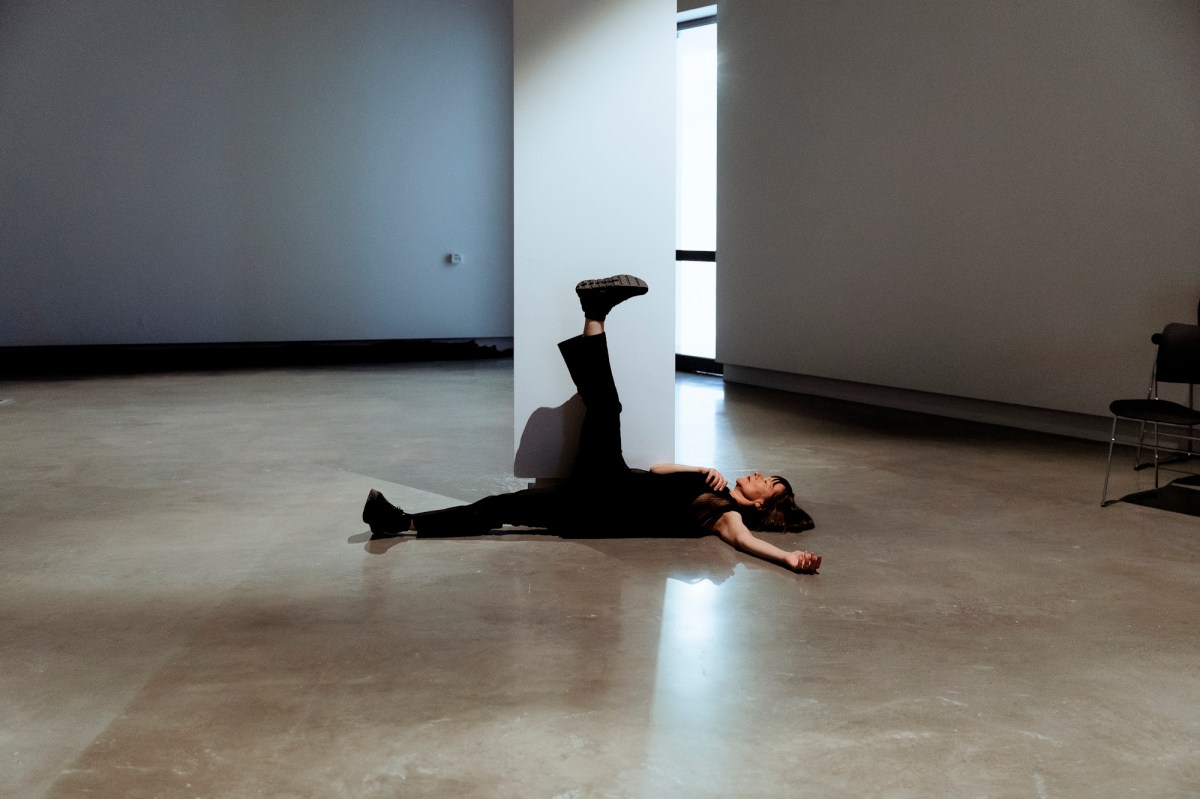
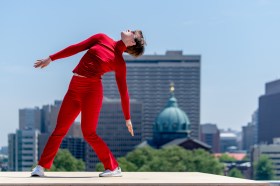
Lucy Guerin presents her solo Place Dances in Melbourne from 15 to 18 October. Photo: Gianna Rizzo.
After 25 years as Artistic Director of the contemporary dance company she founded in 2002, Lucy Guerin will retire from her leadership role at the end of this year, handing the baton to incoming Artistic Director and Co-CEO Melanie Lane, who will lead the company under a fresh name from early 2027.
Although departing Lucy Guerin Inc, Guerin’s energy won’t disappear from Melbourne’s independent dance scene, where she has been an intrinsic part of the dance-making community for over a quarter of century.
Her legacy includes supporting many of the nation’s most prolific independent dance artists, helping them maintain their practice, build their careers and get their new works off the ground.
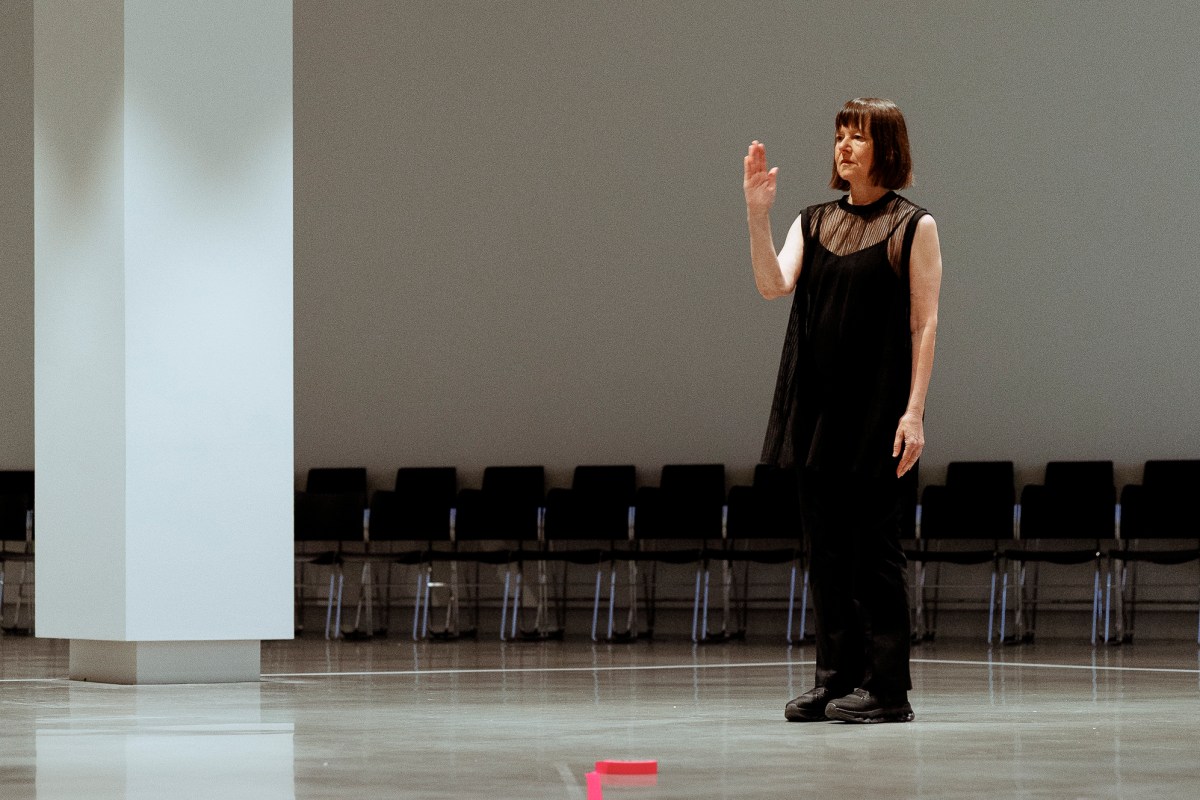
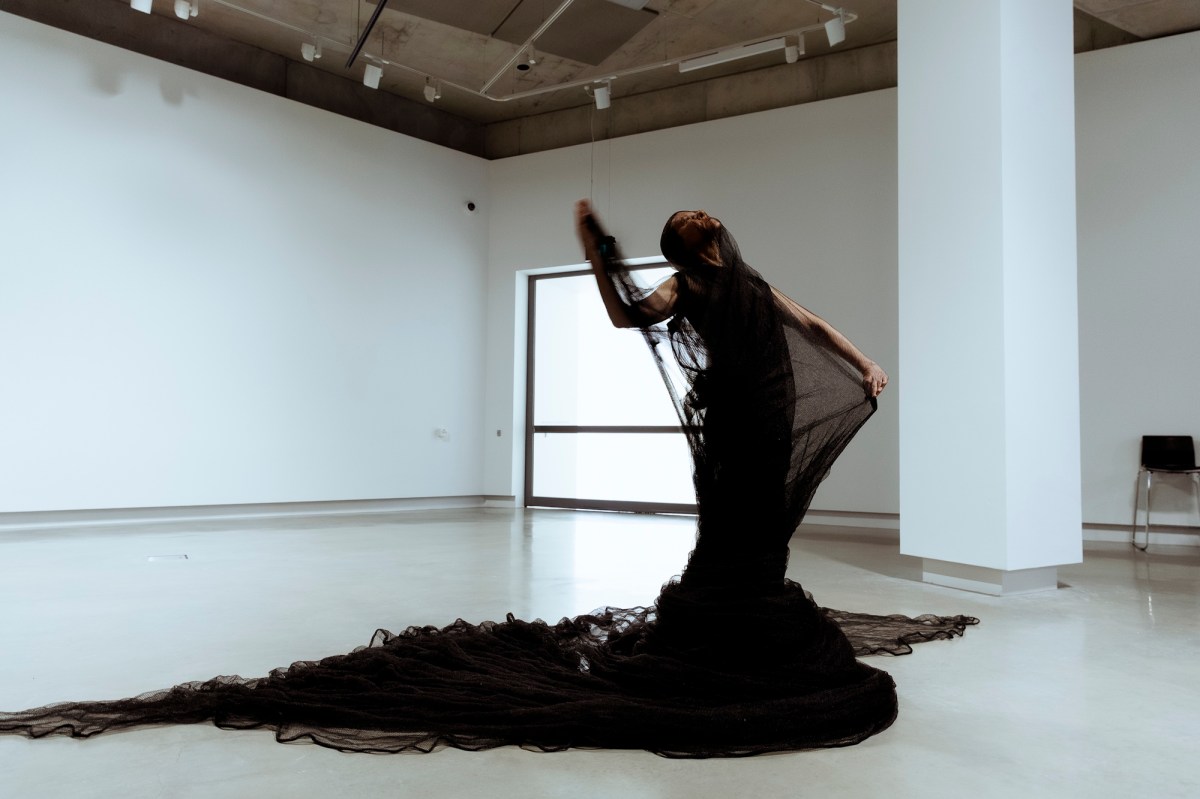
Place Dances (2026) by Lucy Guerin. Photo: Gianna Rizzo.
In the lead up to her final season with the company – where she premieres her solo work Place Dances, returning to the stage as a performer after a 13 year break – she reflects on her career so far, including how she got started, and what’s changed in the sector since then.
Lucy Guerin reflects – quick links
Guerin’s early years in Adelaide, Sydney and New York
While many dance artists will struggle to recall the national arts scene without Lucy Guerin Inc, the choreographer did in fact spend considerable time away from Australia as a young dancer, moving to New York in the late 1980s where she worked with dance artists like Tere O’Connor and Bebe Miller.
In your early years as a dancer, which experiences influenced you the most?
Lucy Guerin: I trained at the Centre for the Performing Arts in Adelaide [now AC Arts]. Prior to that I’d only done ballet, so it was the first time I was exposed to things like improvisation, and [Martha] Graham technique and [Merce] Cunningham. It was also the first time that I ever choreographed. So I think that was quite a formative experience for me, to choreograph a work, and something which I really enjoyed.
After completing that course I remember a friend of mine was going to Sydney to do a workshop with choreographer Russell Dumas. She said to me, ‘You should come, too.’ I knew I wanted to move to Sydney, so I went there and did the workshop with Russell. I ended up working with him a lot, and that was hugely formative because what he was doing was a very different style of dance than what I’d been studying.
Russell had worked with choreographers in New York like Tricia Brown and Twyla Tharp, and he had studied a lot of somatic [dance] practices. So I remember in his classes we would spend hours on the floor, just like, rolling, really really slowly, and learning how to release our weight into the floor. At first, I remember thinking, ‘What is this? This doesn’t seem like dancing.’ So, it took me a few years to realise that it was a very important part of dancing.
Did your early work with Russell Dumas inform your move to New York?
LG: Yes, well, Russell’s company was in Sydney, but he had been a ballet dancer and he’d danced extensively internationally, but he ended up being drawn to the New York dance scene [in the 1970s] .
I worked with Russell for a few years in Sydney. Then I spent a year with Nanette Hassall and Dance Works in Melbourne. Then I decided I was going to move to New York in 1989 because I had been on tour there with Russell, where we performed at the Cunningham Studios and did a lot of workshops. So I had an introduction to what was happening there, which I found really exciting.
So, working with Russell in New York and staying there for quite a while was important, because I became immersed in those [downtown New York 1990s] dance practices.
You ended up living in New York for seven years – from 1989 to 1996. How did that shape your dance practice?
LG: During that time I danced with Tere O’Connor Dance and the Bebe Miller Company, and I really enjoyed those experiences. But I think there was a certain point when I found myself second guessing the decisions of the choreographers I worked with, and thinking, ‘Perhaps I would do it another way.’
I’d always really enjoyed choreography. So, I think that’s when I thought, ‘I want to focus more on this.’ So I started presenting short works in programs in New York and that gained momentum.
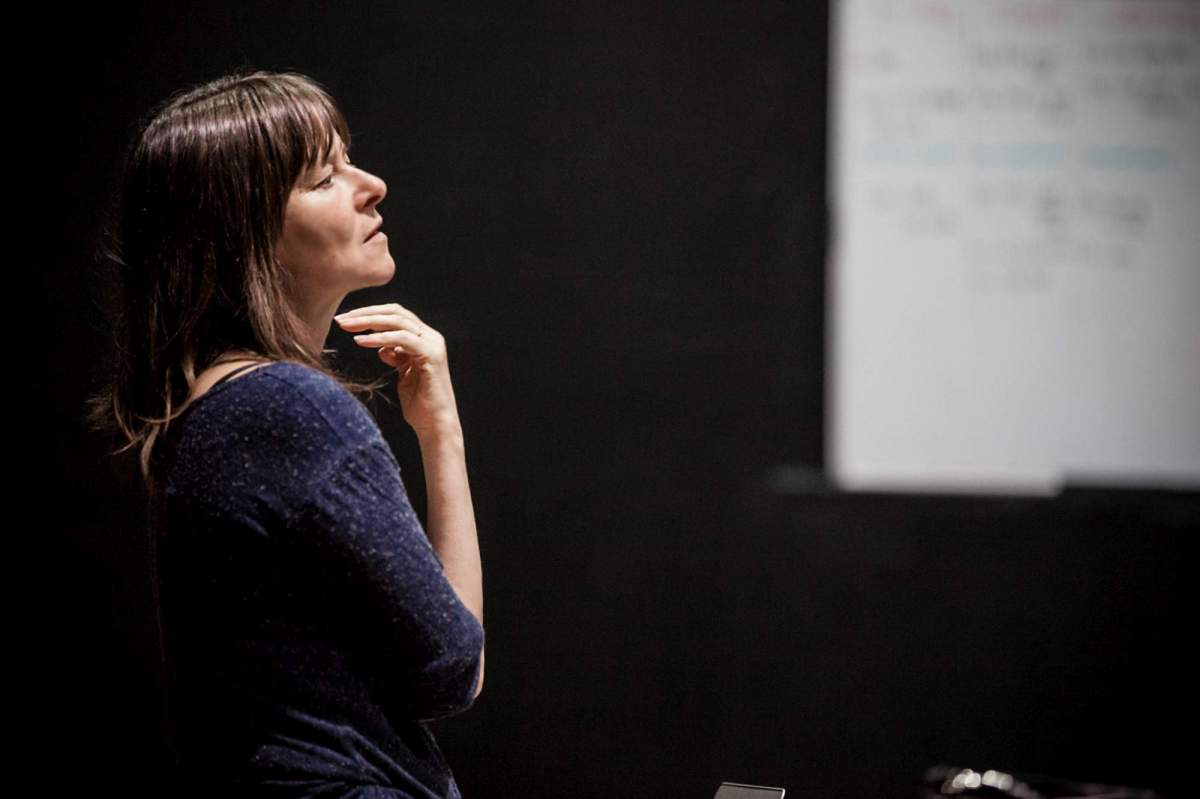
Lucy Guerin. Photo: Amber Haines.
Eventually I was presented at what was then Dance Theatre Workshop, which is now New York Live Arts, and a number of other spaces.
But dancers barely got paid at all for work on independent projects in New York. So, I was really lucky because I had fantastic group of friends, mostly women friends, who were incredible dancers in companies like Stephen Petronio Company, Tere O’Connor Dance and the Bebe Miller Company. So, from very early on I got to work with very good dancers.
We also used to go and see each other’s rehearsals and shows a lot, and always afterwards we would have very involved conversations with each other where we’d give feedback and discuss the work in detail.
There was just more of a language to speak about dance than I had experienced before, and that created this very close community among us artists. I found that support of the community was crucial for survival, especially given there was no financial support [for our independent dance projects].
Place Dances (2026) by Lucy Guerin. Photo: Gianna Rizzo.
Also, when I was living and working in New York, you could still live on Manhattan. Now it’s impossible to live there – everyone lives in Bushwick [Brooklyn] or Queens, or in the other boroughs. But [in the 1980s and early 1990s] you could get a small apartment and rent relatively affordable rehearsal space on Manhattan.
But everyone I worked with, we all had other jobs. And actually I think that helped me in a way. Because I had so little studio time I had to fit rehearsals in around my job waiting tables and other work, and around my dancers’ other jobs too. So, my development time had to be very succinct.
It wasn’t uncommon for me to have only two hours, three times a week for four weeks to make a half-hour work. So I had to be really disciplined, and I became quite quick at making work – and I think that’s why.
Returning to Australia and starting Lucy Guerin Inc
After seven years of life as an independent artist and dancer in New York, Guerin felt the pull of home. She returned to Australia in 1996 to be closer to family and set herself up as an independent dance artist in Melbourne.
How did your choreographic practice continue when you returned to Australia?
LG: I spent a couple of years doing independent projects. I did a few seasons at Gasworks [in Melbourne] and Melbourne Festival [now RISING]. And I started to get a lot of invitations to present my work internationally and more broadly locally too. But it soon become too difficult to manage all of that without a permanent producer to help me.
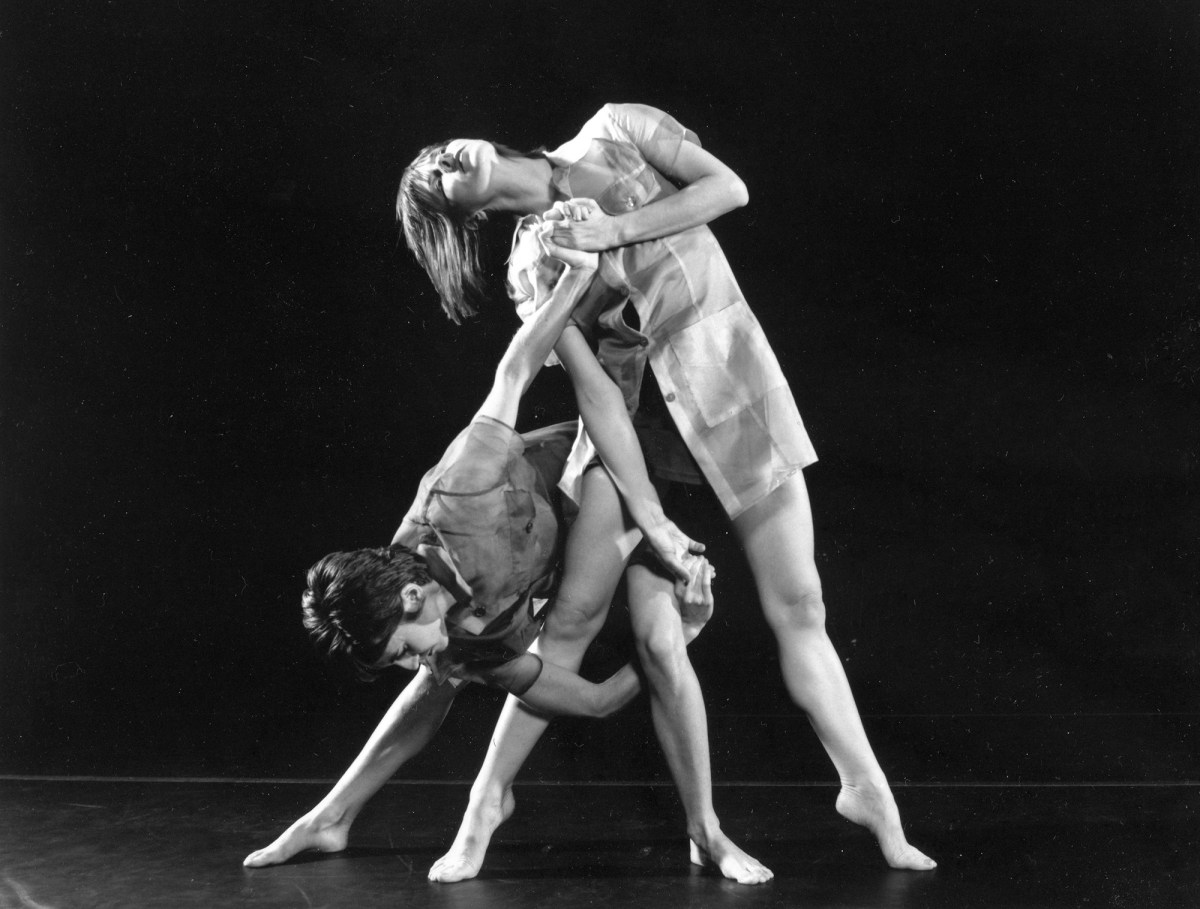
Robbery Waitress on Bail (1997) by Lucy Guerin. World premiere season, The Kitchen, New York, 1997. Photo: Johan Elbers.
That’s when I decided to form a company. I had a friend, Angharad Wynne-Jones, who was, and still is, a very good producer. She was having a baby at the time, and she was not engaged in full-time work. She helped me by working one day a week to set up the company. She also helped me apply for funding, and from there we could get some touring happening and secured a small space to work in.
Then, after a few years we got a part-time producer, which we then built up to being a full-time role. Gradually we got more funding until we managed to get multi-year funding from Australia Council [now Creative Australia], which was really the solid start of the company. We then got incorporated and got a board.
The space we had at that time was basically on top of a parking garage, and it had just a few rooms that we used as an office. There was another tiny room down the hallway that we used as our studio but it was quite small. That’s where we introduced Pieces for Small Spaces and that’s why that program we do [now called PIECES] has that name.
Initially, that season invited five choreographers to make 10-minute works and there was an audience of, like, 20 people there in the beginning.
Anyway, after some time there, we shifted to a larger studio which was a church hall type of space in Batman Street [West Melbourne], and then eventually we moved to our current location, to WXYZ Studios in North Melbourne.
Guerin reflects on then and now: what’s changed?
As an artist and artistic director, Guerin has always prioritised forums of exchange, dialogue and community for fellow independent dance artists. Here, she talks about developing those platforms and reflects on how they have evolved amid a changing arts sector.
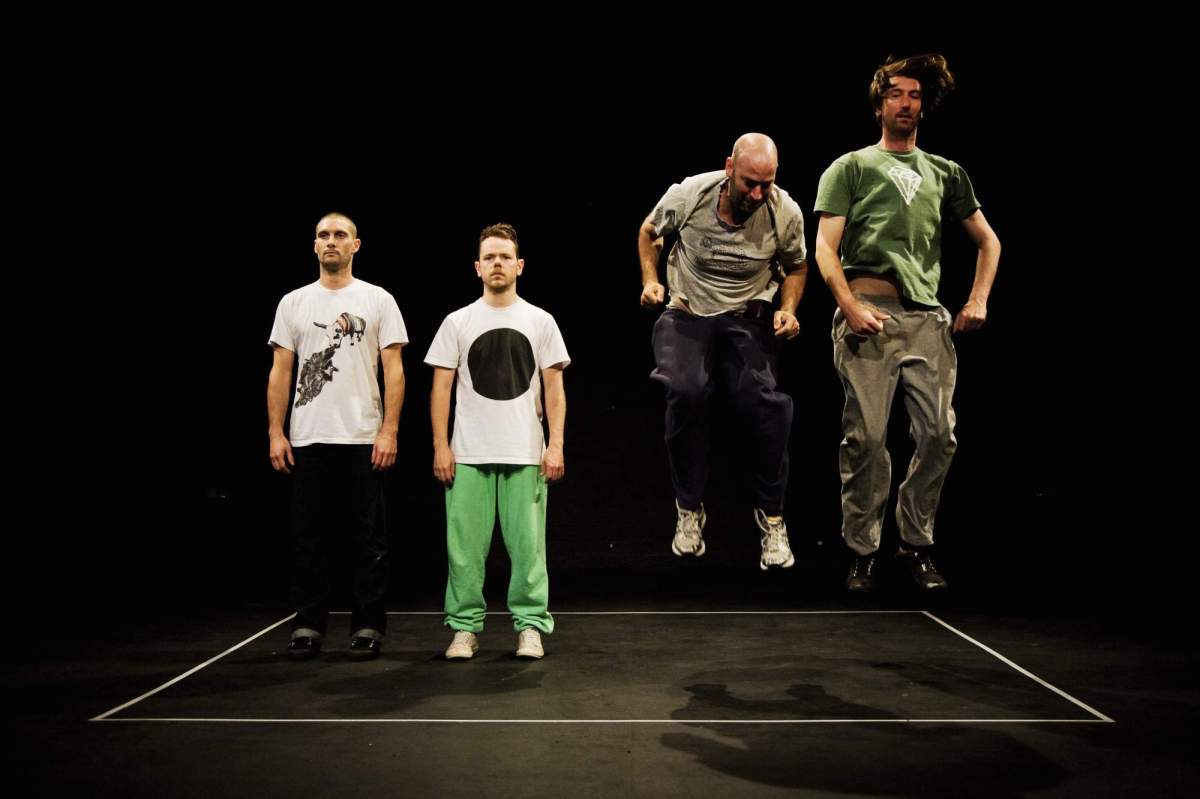
The original cast of Untrained (2009) by Lucy Guerin Inc. Photo: Lucy Guerin Inc.
Comparing your experiences of running your company in the early 2000s and 2010s to now, how have things changed?
LG: I actually think it’s a lot more difficult [for dance artists and choreographers] now. I mean, I thought that it was tough when I started 25 years ago. But I realise now, in retrospect, how supported the sector was at that time compared to now.
I remember being presented in Adelaide Festival very early on and having four or five international presenters wanting to present my work. Then we were able to get the funds to do that. I don’t think that happens now in the same way.
I don’t think there’s the money and the funding around, and also just the possibility [for presenters] to take a chance on younger artists. This is a worldwide trend and affects companies, festivals and presenters as well as independent artists.
So, in my experience and from what I can see around, now there are some young choreographers or even artists heading towards being mid-career, who’ve been doing brilliant work, but they haven’t been able to show their work internationally.
It was very different for me at that stage of my career. I think it helped that I had lived in New York for those years because I had some contacts there, and I did keep going back to New York. But I also toured my work in Europe at that time as well. So, unfortunately I think it’s harder now – partly because of Covid, partly because of the world economic situation.
Plus if you’re running a company now, there are a lot more requirements in terms of administrative load.
That being said, I do still feel that there’s still this intense excitement and enthusiasm and creativity from younger artists to just keep making work, and I think that’s incredible.
One of the very moving things that I’ve seen happening here [in Melbourne] is that independent artists are working to develop opportunities for their peers and for younger dancers. They are taking on that responsibility without being part of an organisation, because they really want things to keep happening. So, I don’t think that’s going to disappear. But I do think it is a struggle for artists at the moment.
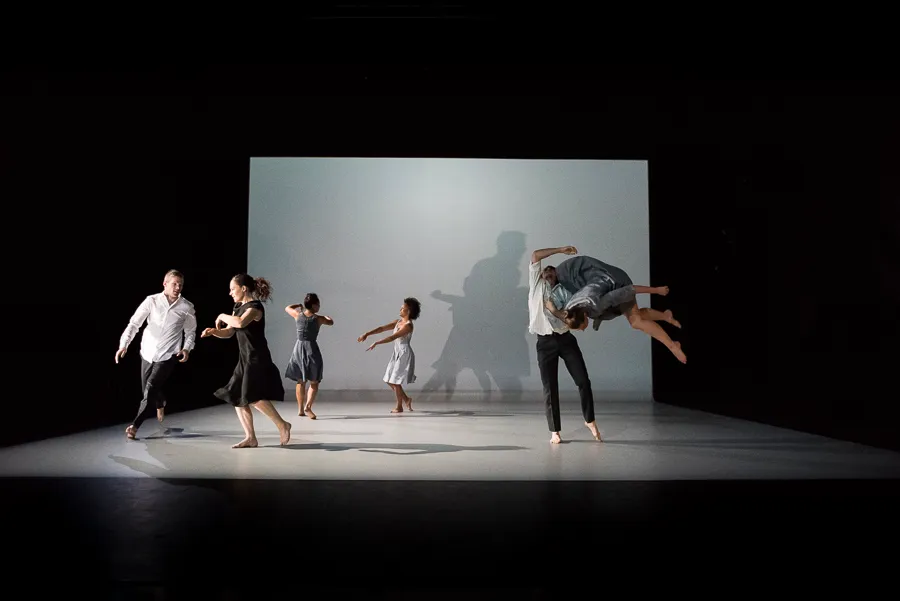
Motion Picture (2015) by Lucy Guerin Inc. Photo: Gregory Lorenzutti.
Which highlight memories from the past 25 years of work with the company stand out?
LG: It’s too difficult to choose only a few standout memories – there are so many. There have been amazing tours like to the Venice Biennale and Theatre de la Ville [in] Paris. Also, receiving the $2 million grant for Lucy Guerin Inc and the dance sector from our former Chair, Chloe Munro, and securing our permanent space WXYZ studios.
But I think being able to build support for the independent sector in Melbourne is something that I am hugely proud of.
It’s grown from that very small seed of Pieces for Small Spaces, into figuring out other ways to support artists. It’s really been an amazing thing to have a dedicated community around the work that we do.
I would also say that being able to pass on the company to a new person, particularly someone as renowned and talented as Melanie Lane, has been amazing, and I’m very excited to see where she’ll take the company next.
Also, for me personally, it’s been incredible to have had the opportunity to spend 25 years developing my choreographic skill in this medium, and to keep developing my choreographic ideas. That has been a huge privilege. Very few people get that opportunity, so that is something I am hugely grateful for.
Place Dances, a solo by Lucy Guerin, continues at Buxton Contemporary, Melbourne until 18 October.
Discover more screen, games & arts news and reviews on ScreenHub and ArtsHub. Sign up for our free ArtsHub and ScreenHub newsletters.
ArtsHub's Arts Feature Writer Jo Pickup is based in Perth. An arts writer and manager, she has worked as a journalist and broadcaster for media such as the ABC, RTRFM and The West Australian newspaper, contributing media content and commentary on art, culture and design. She has also worked for arts organisations such as Fremantle Arts Centre, STRUT dance, and the Aboriginal Arts Centre Hub of WA, as well as being a sessional arts lecturer at The Western Australian Academy of Performing Arts (WAAPA).



![[GAMEBOY] from choreographer Amy Zhang tours as part of ORBIT 2026. Photo: Supplied.](https://www.artshub.com.au/wp-content/uploads/sites/2/2026/08/7.-ORBIT_ARTWORK_gameboy-by-Amy-Zhang.webp?w=280)