Theatre of the World interview: the Chilean artists tapping into puppetry’s power

Chilean theatre company Silencio Blanco uses puppetry to create powerful, documentary-style theatre works that are now touring the world.
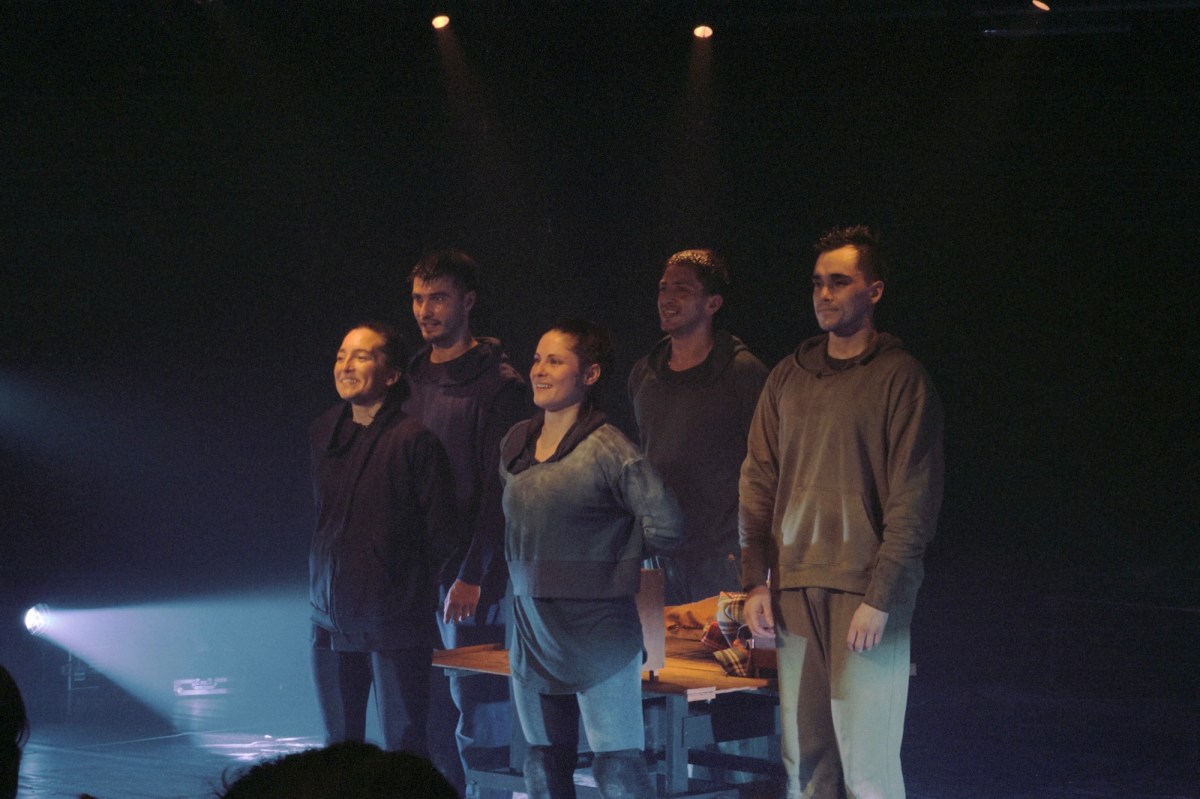
Performers from Chilean theatre company Silencio Blanco at the conclusion of Antuco at the 2026 Theater Der Welt festival in Germany, 2026. Photo: Johannes Richter / Theater Der Welt.

ArtsHub’s Jo Pickup is overseas and taking in the best performing arts from around the world at Theater der Welt in Germany.

When Chilean performing artist and creative producer Dominga Gutierrez was a university theatre student in Santiago in the late 2000s, she had little idea that puppetry would come to define her artistic career. But 16 years later, the artist and a small group of her peers are now touring the world with the company she helped found, which now has four acclaimed puppet-theatre works to its name.

Silencio Blanco has made its name for deeply-felt, meticulously-researched works where intricate puppets become a central and expressive means of telling stories about people whose lives have been touched by loss or marginalisation in some way.

Gutierrez spoke with ArtsHub about Silencio Blanco’s trajectory so far – from its beginnings as an artistic duo of theatre graduates who presented their work in the streets of South America, to what is now a tight-knit artist-led company programmed regularly in international festivals.

Early experimentation revealed puppetry’s communicative power

As Gutierrez describes it, when she was studying theatre at university in Chile in the 2000s, puppetry was not an artform high on the minds of her teachers or professors.

‘It’s different now,’ Gutierrez tells ArtsHub. ‘But when I was a student, puppetry was considered a minor theatre artform. It wasn’t taken seriously. Instead, we were studying Chekhov and Stanislavski.’

But after meeting performing artist and theatre director Santiago Tobar – an artist who was experimenting with simple everyday materials to develop his own visual language through silent theatre and puppetry – a new world opened up to Gutierrez in terms of what great theatre could be.

‘I remember the first puppets he showed me – I found them incredibly moving and deeply expressive, capable of communicating what words often cannot,’ she tells ArtsHub.

‘Santiago told me he was planning to dress them with costumes, and I remember saying, “Please don’t. They are already complete just as they are.”‘

From there, Tobar invited Gutierrez to join his research process, and the duo developed their first short puppet theatre work together, which they presented to their university (student and lecturer) audience.

‘We fully expected that our work wouldn’t be taken seriously there,’ Gutierrez admits. ‘But, people were actually like, “Wow!” They felt the same connection to the puppets as we did. So then we knew we had something to continue developing.

‘We continued developing this artistic research together, and over time that research has evolved into what is now our company Silencio Blanco.’

Performers from Chilean theatre company Silencio Blanco at the conclusion of Antuco at the 2026 Theater Der Welt festival in Germany, 2026. Photo: Johannes Richter / Theater Der Welt.

Exploring collective memories through puppet theatre

Sixteen years on, the artists have lost none of the original artistic vision they started out with as students, only now they have their own company. Silencio Blanco formed in 2010 and now operates as a collective of around eight members. Alongside around five actors, that company includes a sound designer (Ricardo Pacheco), plus Gutierrez as creative producer and Tobar as theatre director and puppet-maker.

Gutierrez explains that Silencio Blanco is essentially a project-based company within a difficult government funding landscape in Chile, where all arts companies – including major companies – have to apply for modest levels of operational or project funding every 12 months.

The small company is therefore continuing to use its resourcefulness to develop and present its work. Unlike other collectives of its size, Silencio Blanco allocates a lot of time and resources to grassroots research to fuel its creative practice.

‘In terms of how we develop our works, it’s important to say that we are artists and not journalists,’ Gutierrez explains. 

‘Yes, we talk to a lot of people about their real experiences and stories, but we can’t take on the responsibility of creating “documentary theatre”. Instead, our research, observation of reality and encounters with real people are always transformed through a poetic and theatrical language.’

So far, the company has been especially drawn to the stories of people and groups in Chile whose livelihoods and traditional trades are dying or have been subject to mass disruption or political marginalisation.

Perhaps the most striking example of this is an early work by the company, titled Chiflón (2013), which the artists developed after extensive field research conducted in the former Chilean coal mining town of Lota.

After meeting former mine workers in the town who lost their jobs after the closure of the notoriously dangerous El Chiflón del Diablo mine in the 1980s (a mine also made famous by the early 20th century Chilean social activist author Baldomero Lillo through books such as Sub Terra) the company created a piece that shed quiet light on the daily struggles of labourers and their families.

Like all of the company’s works, this piece is completely devoid of spoken text and relies on the artists’ manipulation of its small puppet characters to convey the emotional landscapes of these people and the dangers they faced daily while working in the mines.

As Gutierrez describes, ‘With this work, and with all the works we continue to make, we wanted to show the power of real people, and how in representing some small moments from their lives, we can understand larger themes about Chile.’

Chilean theatre company Silencio Blanco's work Antuco, performed at the 2026 Theater der Welt in Germany, 2026. Photo: Johannes Richter / Theater der Welt.
Chilean theatre company Silencio Blanco’s work Antuco, performed at the 2026 Theater der Welt in Germany, 2026. Photo: Johannes Richter / Theater der Welt.

Gutierrez also tells ArtsHub that presenting this work at Chile’s major performing arts festival Santiago a Mill in 2015 helped open doors for the company to pursue international touring for the first time.

‘We got a lot of invitations from international festivals after our season of Chiflón at Santiago a Mill,’ she says.

‘We then did a two-and-half-month tour across eight states in the US and our first tour to Portugal as well as to the Brighton Festival [in the UK].’

A decade on, the company is still actively touring its repertoire, with four major works to date. This includes Antuco (2005), recently presented at the international Theater der Welt festival in Germany, which tells the story of the tragic death of 44 young Chilean military recruits on a training exercise through the Antuco volcanic mountains in 2005.

The company is also premiering its latest work, Cabeza de Elefante (Elephant’s Head), which is a co-production between Silencio Blanco, Figurteatret (Nordland Visual Theatre, Norway), Het Lab Hasselt (Belgium) and GAM (Centro Cultural Gabriela Mistral, Santiago).

‘This work is a little bit different for us, because it’s the first work we have made that is about the life of just one man,’ Gutierrez explains.

‘But like all our works, it’s very much about exploring social memories. In this case, the story … of a man who is sick and losing his memory, and that’s why we have used the elephant in this story also – as the animal best known for its long memory.’

Silencio Blanco’s work Cabeza de Elefante premiered in February 2026 at Nordland Visual Theatre in Stamsund (Norway), before playing at the Gabriela Mistral Cultural Center (GAM) in Chile in April 2026.

Silencio Blanco’s work Antuco was presented at Theater Der Welt in Chemnitz, Germany on 19 and 20 June.

Discover more screen, games & arts news and reviews on ScreenHub and ArtsHub. Sign up for our free ArtsHub and ScreenHub newsletters.

ArtsHub's Arts Feature Writer Jo Pickup is based in Perth. An arts writer and manager, she has worked as a journalist and broadcaster for media such as the ABC, RTRFM and The West Australian newspaper, contributing media content and commentary on art, culture and design. She has also worked for arts organisations such as Fremantle Arts Centre, STRUT dance, and the Aboriginal Arts Centre Hub of WA, as well as being a sessional arts lecturer at The Western Australian Academy of Performing Arts (WAAPA).