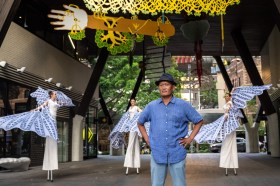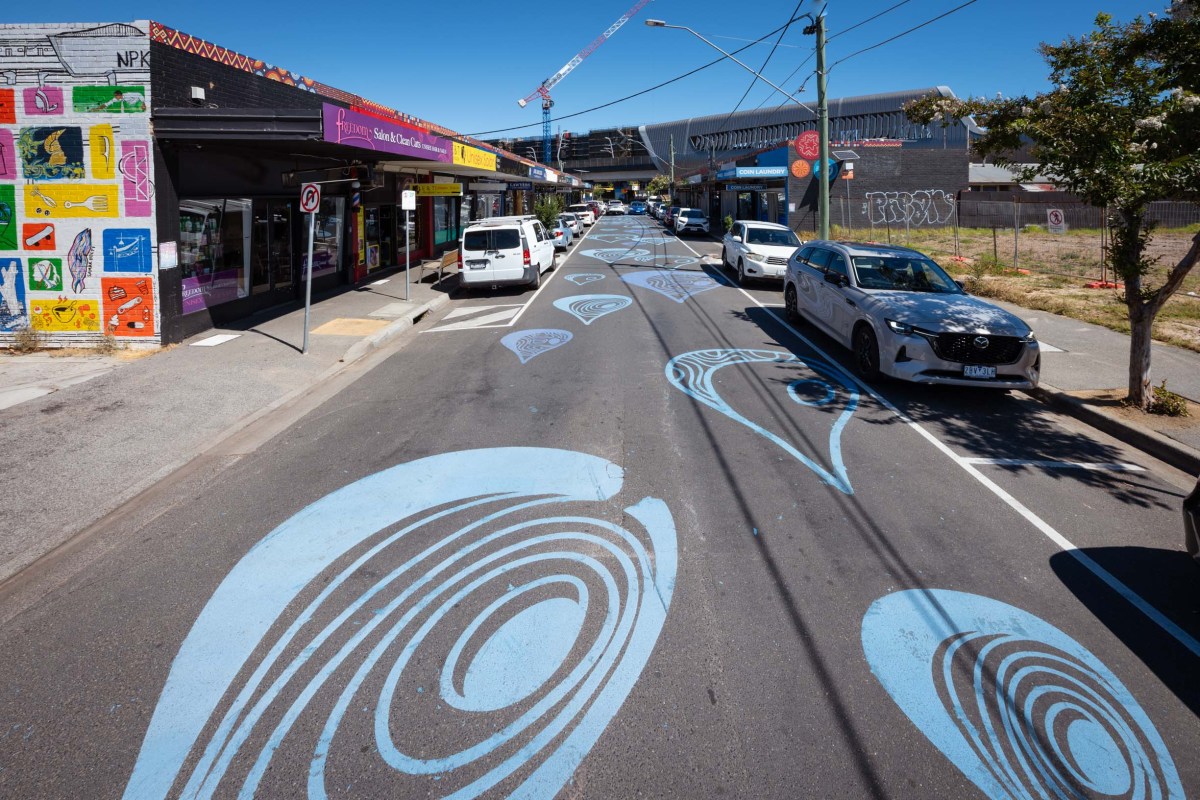
Beneath the elevated railway line in Noble Park in the outer suburbs of Melbourne, sweeping blue paint stretches across the road, the vibrant colours and bold lines drawing the eye through a landscape alive with Aboriginal and Torres Strait Islander language, stories and Culture. This is a celebration, and an acknowledgement of Country, of the Bunurong people.
Muderra Way (pronounced moo-dah-ra and meaning ‘torrential rain’ in the Bunurong/Boonwurrung language) is a striking example of public art, but its real strength lies in the way the project came to life and what it means to the local community.
It represents a shared vision for a place where Country, culture and community have shaped each creative decision. With the ongoing involvement of Uncle Shane Clarke and the Bunurong Land Council Aboriginal Corporation, Muderra Way was shaped by Bunurong culture.
Three local Aboriginal and Torres Strait Islanders artists were engaged to contribute their knowledge, skills and creativity to the project: Kobi Sainty (Bunurong and Trawlwoolway), Koorrin Edwards (Bunurong, Gunnai, Gunditjmara, Mutti Mutti and Yorta Yorta) and Robert Michael Young (Gunnai, Wiradjuri, Yorta Yorta and Gunditjmara).
Each of these artists brought a distinct voice to the collaboration. Sainty’s leadership in Bunurong language and storytelling anchored the work in Cultural knowledge and place; Edwards contributed a strong Bunurong women’s perspective; and Young brought extensive experience in large-scale public art, alongside a deep commitment to Aboriginal and Torres Strait Islander self-determination in artistic practice.
Muderra Way in Melbourne – quick links
Working together
Working together, the artists envisioned a public space where Culture is encountered every day.
As arts practitioners at different stages of their careers, the project also provided opportunities for mentorship, shared learning and creative exchange, strengthening their individual practices and expanding the field of Aboriginal and Torres Strait Islander public art.
‘It was such a big project. I hadn’t done anything on this scale before,’ said Sainty.
‘We’re all Bunurong artists, working together to tell Bunurong stories. We’re bringing some Culture and some art to Noble Park, which I think is really important.’
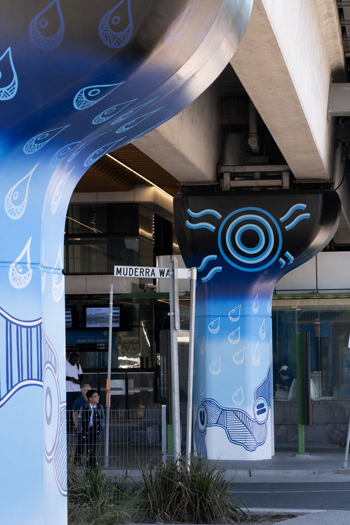
Each artist chose a different element of the ‘torrential rain’ theme. Young focused on raindrops, Edwards created visions of a meeting place by the water, and Sainty painted a river representing new life and purity.
First, the artists created the designs that cover the four massive concrete pillars holding up the railway. They then chose the design elements to be printed on vinyl and heat-pressed onto the road.
As Sainty said, ‘It’s about bringing beauty, bringing Culture, and bringing stories to life’.
He added: ‘I think Bunurong Culture, stories and art have been silent for a long time. We’re in the process of re-finding our language and our art, and all these parts that make us Bunurong. I think sharing that story with the wider community is really important. And then that educational element flows on because so many people drive and walk through this area every day.’
Making time for deep listening
Long before the artwork was painted, the process began with dialogue and listening. Back in 2022, the Greater Dandenong City Council approached the Bunurong Land Council, as Traditional Custodians, about the naming of the new roadway. This was to be the first Bunurong/Boonwurrung place-naming in the council area.
The Muderra Way project unfolded over several years, allowing ample time for the project to grow organically as the artistic concepts developed.
Earlier this year, the project was recognised internationally when Muderra Way won the Place Leaders Asia Pacific Indigenous Placemaking Award. This important award makes Muderra Way a shining example of what’s possible when Traditional Custodians and Aboriginal and Torres Strait Islander artists are given meaningful creative leadership.
Public art as a rebellious act
For Uncle Shane Clarke, a Senior Bunurong Elder and member of the Bunurong Land Council Aboriginal Corporation, the significance of the project goes beyond the art.
‘For a long time, people have been making decisions for us,’ Clarke said. ‘The City of Greater Dandenong has been very respectful all the way. It makes us proud of who we are as a First Nations people, the Bunurong people, and part of the oldest living Culture in the world.’
At a time when local authorities, designers and communities everywhere look to enhance their public spaces, Muderra Way offers an impressive model for the future. It shows that public art can become something far richer and more meaningful than its aesthetic outcome; it can be the embodiment of Culture, Country and respect.
As artist Robert Michael Young said, ‘It’s almost a rebellious act in creating something so peaceful here. The joy that you have when people just have an “awe” moment is always worth it. This will stand for years to come. I could be gone and it will still be here.’