

American playwright Arthur Miller’s 1949 Pulitzer Prize-winning tragedy Death of A Salesman, directed by Neil Armfield and starring Tony Award-winning Australian actor Anthony LaPaglia and legendary Helpmann Award-winning Australian Alison Whyte, is back in Melbourne at Her Majesty’s Theatre, following a national tour in 2023.
I missed the play first time around, and I’ve never seen it performed, so came in with zero expectations, and possibly a fair whack of scepticism about what this 20th-century American classic still might have to say to an Australian audience in 2026.
Turns out, quite a bit.
Death of a Salesman – quick links
Death of a Salesman: the American Dream
The play’s protagonist, Willy Loman (performed by LaPaglia), is the incarnation of a mediocre white man. Despite carrying himself (to paraphrase writer Sarah Hagi) with the confidence of one, beneath his puffed-up bluster he is plagued by deep dissatisfaction in not ever being able to live up to his own dreams of material success.
He’s on the road for weeks at a time, and comes home to his wife, Linda, who dutifully tallies up his sales and commission earnings against their mortgage and bills for a borrowed middle-class life with a payment-plan refrigerator that keeps breaking down.
An ageing salesman on the decline in a post-WWII America at the dawn of its superpower status, he’s bought wholesale the idea of the American Dream, and now – far from critiquing it – he’s repackaging it and selling it to the next generation.

Death of a Salesman: Biff and Happy
Loman’s two adult children, Biff and Happy, wear the scars of their father’s fetishisation of competition and capitalism. Biff (Josh Helman) is a good-looking, once-promising high school football star – the apple of his father’s eye and his great hope – who ended up not making it to college after failing a maths exam.
Happy (Ben O’Toole) is a smooth-talking corporate ladder-climbing womaniser, with a taste for conquest, for conquest’s-sake. Like his father, winning helps him hide his own unhappiness from himself.
At the outset, the two boys have returned home to their family home in Brooklyn, New York, temporarily – Biff, at 34, feels like he’s wasting his life.
As he and Happy catch up, Biff reveals his true passion for a life lived outdoors, and his dreams of working on a farm, away from the city and the rat race.
But Happy is his father’s son, and his brief flirtation with the idea of running a ranch with his brother in the country is quashed by his stronger interest in the gamified gains promised by a life as a businessman in the city.
Death of a Salesman: prescient warnings
Written in 1949 in America, at a time when the country was riding a post-war manufacturing boom and unprecedented growth in national wealth made possible by Roosevelt’s wartime Lend-Lease policy that put the largest world economies of the time into crippling debt, and spurred by a rising middle class eager to spend, Death of a Salesman feels like it was vastly ahead of its time – a prescient warning against the impossibility of endless growth and the limits of a free market capitalist system to provide real value, purpose or freedoms for ordinary people.
And to a modern audience, the play’s critique of patriarchy and its inability to serve men, women, or anyone at all, will resonate.
Loman is afflicted with Trumpian big man syndrome, his identity and sense of self-worth wrapped up in machismo ideology, and he is thwarted by personal pride.
He is lonely, aimless, and by his own measure of his value, a failure. And in the ultimate twist of grossly capitalist irony, allows himself to be convinced he is worth more to the people he loves dead than alive, due to the insurance payout.
Death of a Salesman: the view from the bleachers
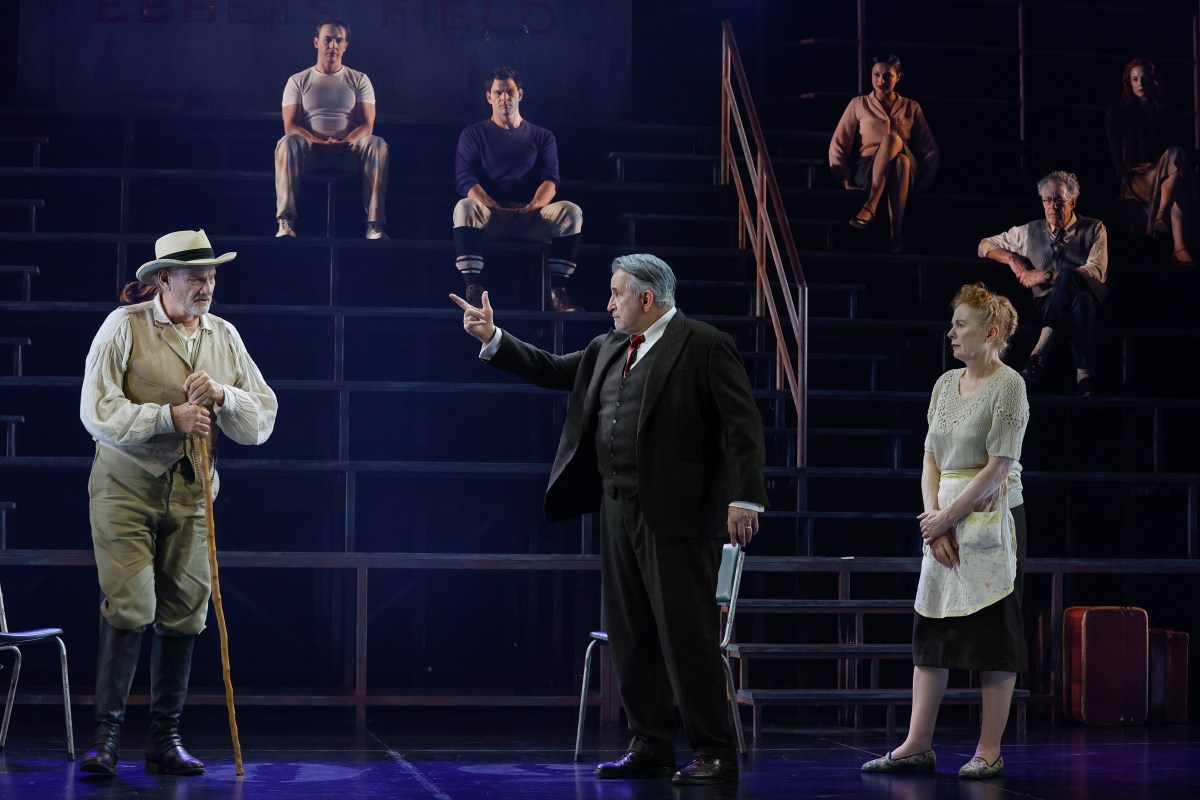
There are nods to Greek tragedy in the design and staging: dilapidated bleachers, like those seen in American college football fields, rise up towards the back of the stage, creating a spartan amphitheatre facing the audience, where the characters sit throughout the play as a silent, watchful Greek chorus tableau.

‘Ebbets Field’ – the name of the Major League Baseball stadium in Brooklyn where Biff once played a high-school football game – is emblazoned in fading red letters on the front of the press box at the back of the bleachers. The remnants of a failing cult-of-masculinity civilisation where sporting prowess and macho one-upmanship are next to godliness.
A large screen is used at points in the play to project black and white footage of train lines, of moving landscapes – the many journeys of a mid-century American salesman.
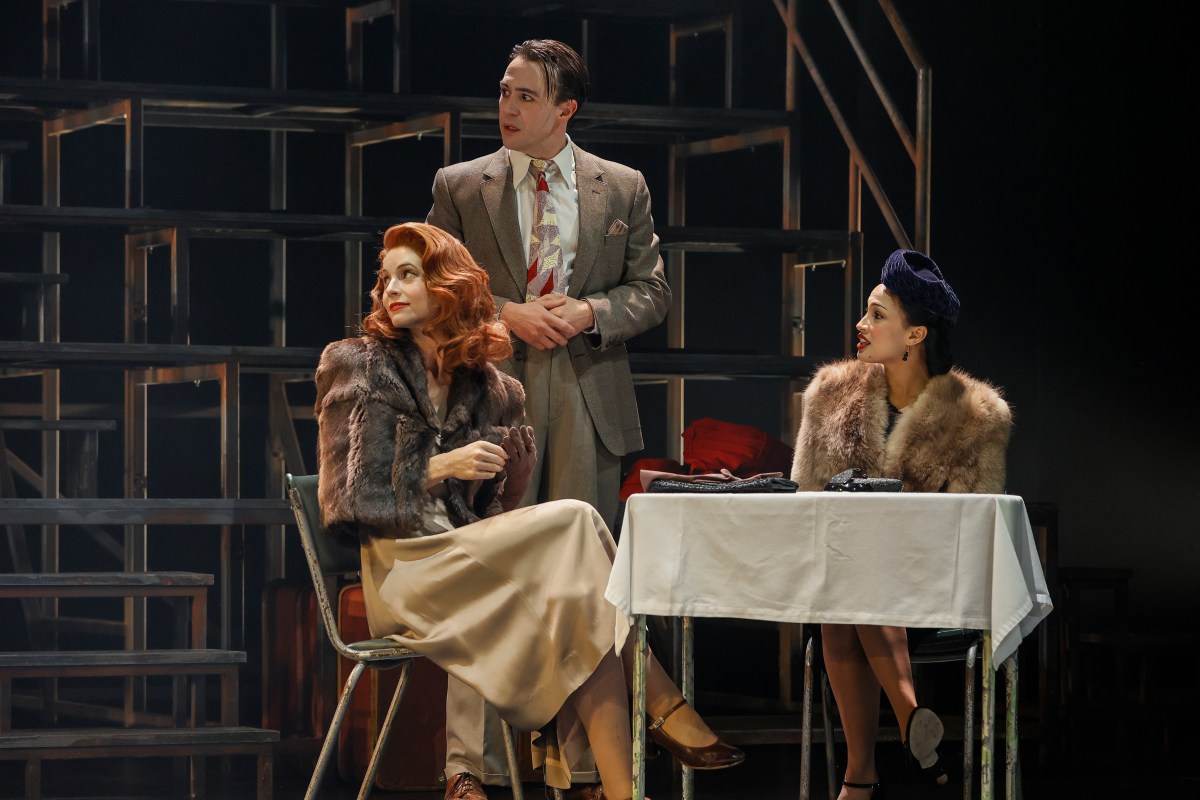
From the opening strains of a wistful clarinet rising from Gershwin-like jazz, the music (composed by Alan John), the various Brooklyn drawls, the brown-and-beige costume design with flashes of republican red, all conjure mid-century America. Brown waistcoats and white singlets, stripped pyjamas and woollen cardigans.
Different scenes – at the Loman’s house, outside in their garden, at a restaurant – are created simply at the front of the stage, with chairs and tables brought on by the actors and supported by diffuse spotlights.
Having the actors seated on the bleachers throughout the play allows for fluid transitions between scenes, or to connect time periods – a present-day restaurant scene with Loman, Biff and Happy flows into a revelatory moment from the past, when a teenage Biff accidentally discovers Loman’s marital infidelity.
It’s a blow that effectively turns him from a wide-eyed kid with fatherly hero worship to a lost young man without purpose or direction.
Death of a Salesman: LaPaglia & Whyte
LaPaglia as present-day Willy Loman walks in a shuffle, mumbling to himself as his frequent delusions blur the line between present and past. His hand frequently reaches to his side, and his shortness of breath and visible difficulty getting in and out of chairs presents a 63-year-old much older than his years, a man who values strength, masculinity and ‘being liked’ but is trapped in an ageing, vulnerable body, his eyesight fading.
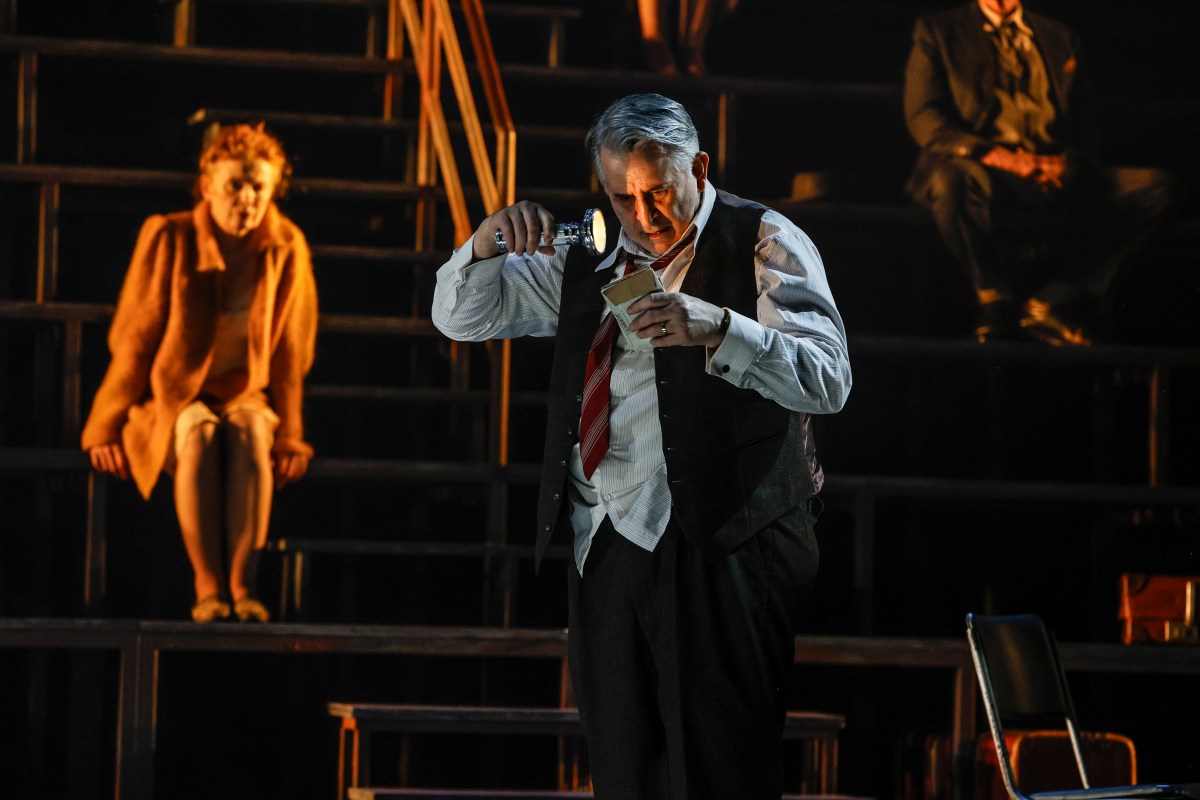
In flashbacks to some 20-years prior, LaPaglia’s Loman is somewhat more sprightly, although stronger delineation between his former prime-life self and his present-day decay would make the performance stronger.
Linda Loman, played by the ever-brilliant Alison Whyte, is sturdy and stoic – a practical woman who loves her husband, but cannot understand the root of his dissatisfaction about life.
She is his strongest ally, and her fears for his declining mental health and suicidal ideation lead her to convince Biff to move back home, and to make something of himself – to start a business and win at the American Dream, as is his father’s wish for him.
Whyte brings such rich emotional depth to the role that it’s difficult to be mad at Miller for writing a character who seems firmly at the Madonna end of the patriarchal dichotomy of possible manifestations of womanhood.
But it’s both women and men who lose out in a world where men must shoulder the burden of economic responsibility and deny their own vulnerability to present an appearance of keeping-it-all-together, and Linda is a woman whose own success and life’s happiness is necessarily tied to that of her husband’s.
Her primary motivation will always be for him to succeed – or at least not wind up dead.
Death of a Salesman: a winning cast
The cast is across the board excellent. Ben O’Toole as Happy is quick as a whip, his youthful, younger-son charisma making his often (laughably) ludicrous sexist comments and behaviour feel true to character.
Josh Helman as Biff captures the essence of a man battling an existential crisis of identity and masculinity. He exudes a gentle vulnerability yet is crushed by the weight of his father’s expectations as he’s made to feel inadequate for dreaming of an ordinary life. Long before it became a term, Death of a Salesman presents all the necessary ingredients for the proliferation of toxic masculinity.
And Linda’s final line: ‘We’re free. We’re free,’ she repeatedly declares, her eyes ablaze, over Loman’s grave. It’s a mantra, and perhaps if she repeats it ardently enough, she might continue to believe it.
Death of a Salesman continues to be an indictment on the lies and false promises of an impossible American Dream, where the system itself makes the dream unrealisable, supported by a culture where if you don’t make it, it’s your fault. You simply haven’t worked hard enough. You’re not good enough.
What a brilliant play. And Armfield’s production is focused and confident – and leaves no doubt of the continuing relevance of the play more than 75 years later.
If you haven’t seen it, it’s well worth it.