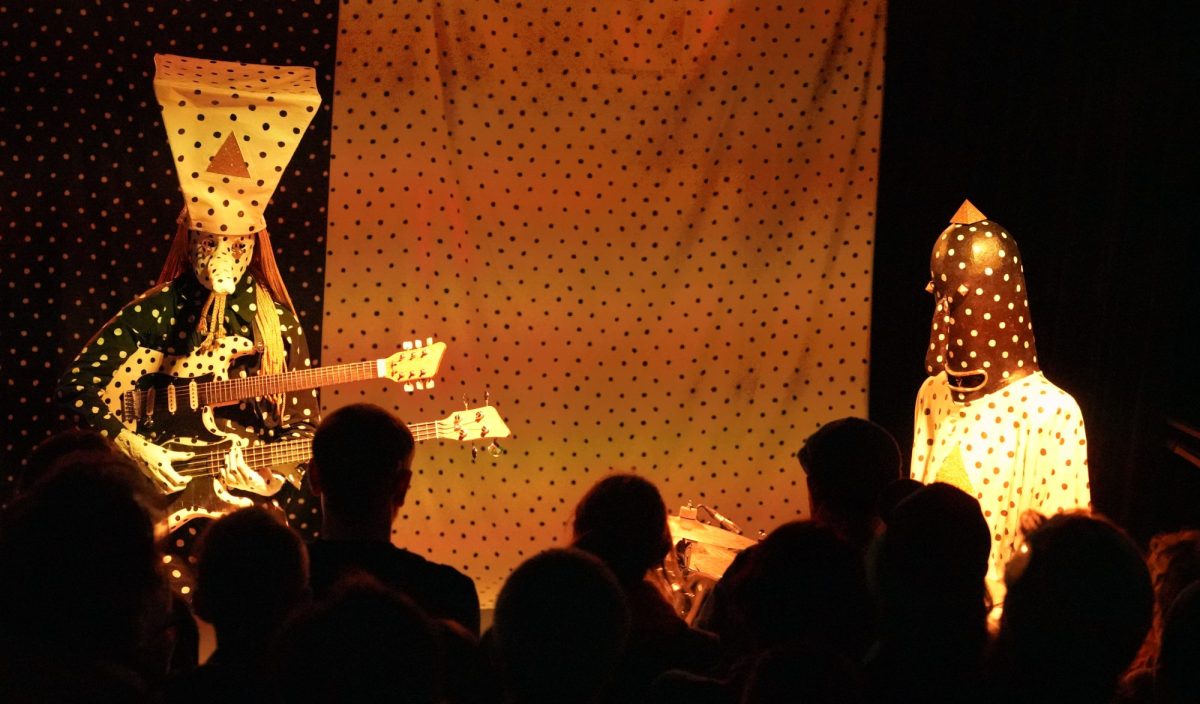
Angine de Poitrine are an unlikely hit. In fact, everything about Angine de Poitrine seems unlikely: a duo of pseudonymous French Canadians, who perform in elaborate polka-dot covered masked costumes that look like plague doctors reimagined by Yayoi Kusama.
The band’s name refers to the chest pain associated with heart attack. Their music involves brain-melting time signatures and loops played on a double-necked guitar/bass. It is impossible to even begin to assign them to a genre. In a very short time they have become ludicrously popular.
Even against that background, it’s still bizarre to learn that a fake version of the band is currently touring Russia. Footage of the imposters has started turning up on social media, and while they don’t seem to be as good as the actual band – and they’re using a single-necked guitar! – Russian audiences either don’t seem to know or don’t seem to care.
Homage and imitation in music – quick links
Angine de Poitrine in action
Deception versus tribute
Concertgoers thinking they’re seeing the real band would of course be entitled to be angry. So would the band themselves. Someone is stealing their IP and profiting off their hard work, and probably damaging their reputation in the process.
Before we get too comfy on the high horse, however, recall that tribute bands are a long-established part of the live entertainment landscape. Some are outrageously successful. The Australian Pink Floyd Show, for instance, claim to have sold some five million tickets.
Of course, there’s an important moral difference between outright deception and homage, and tribute bands do not claim to be the bands they emulate. (Some, like ABBA tribute act Bjorn Again even have the blessing of the original band.)
Yet given the sometimes extraordinary lengths tribute bands go to in order to look and sound like the originals, it’s hard not to think audiences are being asked, on some level, to suspend disbelief. If you’re prepared to do that, your experience might not be as good as seeing the original band, but it might be considerably better than nothing. This is particularly the case given tribute bands almost always appear after the original has disbanded, so fans can no longer see the real thing.
I don’t want to let the fakers off the hook here, but an Angine de Poitrine fan in Russia – a country where western acts currently find it morally and logistically near-impossible to tour – might not see much difference between seeing the fake band and someone paying to see a guy in a wig mimicking Jim Morrison. Even for fans who genuinely care about authenticity, a decent simulacrum might still be worth the ticket price.
The metaphysics of rock
Arguments over the authenticity of bands can get very heated indeed. When Roger Waters left Pink Floyd in 1985, he was genuinely shocked that his bandmates kept touring and recording. He derided the resulting David Gilmour-led iteration of the band as a ‘fake’. Yet we wouldn’t say that a football club ceases to exist whenever a single player retires, and that a fake team has now taken their place.
But how many line-up changes can a band withstand? You’ve perhaps heard of the ’Ship of Theseus’ problem in philosophy: if a few planks of timber are replaced every time a ship is in port, at some point there will be none of the original timber left – at which point, is it the same ship anymore?
There are plenty of bands where precisely this has happened. Over time there’s nobody left who was there at the start. Even more philosophically intriguing are cases where two or more bands claim to be the original – an example of what’s known in the literature on personal identity as the ‘fission problem‘. Punk icons Black Flag for instance split into two bands, like an amoeba – so which is the band once fronted by Henry Rollins? There are only four possible answers: Black Flag, FLAG, both, or neither. It’s not clear that any of these answers is correct.
Or consider the Little River Band currently touring in the US. No members of this outfit were in the original Australian group’s line-up (in fact none of them are Australian) while the original members of LRB are legally prevented from using the name. So, is going to see Little River Band an evening of fun 70s nostalgia, or a terrifying metaphysical nightmare?
Algorithms and imitators
Interestingly, streaming services now recognise the current LRB and the original band as two separate artists, even if audiences do not. That brings us to a peculiar feature of the digital era: streaming algorithms may not encourage impersonation, but by their nature they can’t help but encourage imitation.
This problem was noted as long ago as 2018, in Jeremy D Larson’s deliciously mean review of Greta van Fleet. After excoriating the band’s cod-Zeppelin stylings, Larson turns to the deeper question of why such bands exist, and finds an answer in the ways platforms like Spotify decide what to play you next. You like Led Zeppelin? OK, here’s some more stuff that sounds like that.
This model discourages artists to try anything new; if you want to sell, sound like something that already exists. Sound too original and the algorithms can’t find you.
In that context, the fact that it’s specifically Angine de Poitrine being impersonated in Russia is extra fascinating. Part of the reason the band seems to have taken off as it did is precisely that it doesn’t sound like anything else. They’re almost a deliberate attempt to subvert algorithmic sameness. (I first heard them via a friend who said ‘Hey, you like Primus, right?’ – another band that’s near-impossible to categorise).
‘Imitation is the sincerest form of flattery,’ as Oscar Wilde never actually said (that was Charles Caleb Cotton, decades before Wilde was born). There’s good money in it too. But at least it seems innovators can still break through – even if the price of fame is to be imitated in turn.
The writer thanks Travis Timmerman and Adam Buben for discussion on this topic.