This review discusses sexual violence.
If you’re working class, Black, your mum’s in jail, and you’ve got a deadbeat, abusive boyfriend who thinks it’s reasonable to suggest pimping you out to help him settle his debts – what hope do you have for finding happiness? Or, as traumas compound, for reclaiming your own power in a world stacked against you?
This is the story of 17-year-old Angelique in British playwright Emma Dennis-Edward’s one woman play Funeral Flowers, now making its Australian premiere at Melbourne’s Red Stitch Actors’ Theatre.
But Angelique is not going quietly into the night, and Funeral Flowers – despite its heavy themes about (content warning!) sexual violence and social inequality – is an elegantly crafted one-hour, one-woman play that feels Shakespearean in its emotional heft and its assured use of contemporary poetic meter.
It’s funny, devastating, and features a truly knock-out performance by Red Stitch ensemble member Lucy Ansell.
Funeral Flowers review – quick links
A wounded teenager with dreams
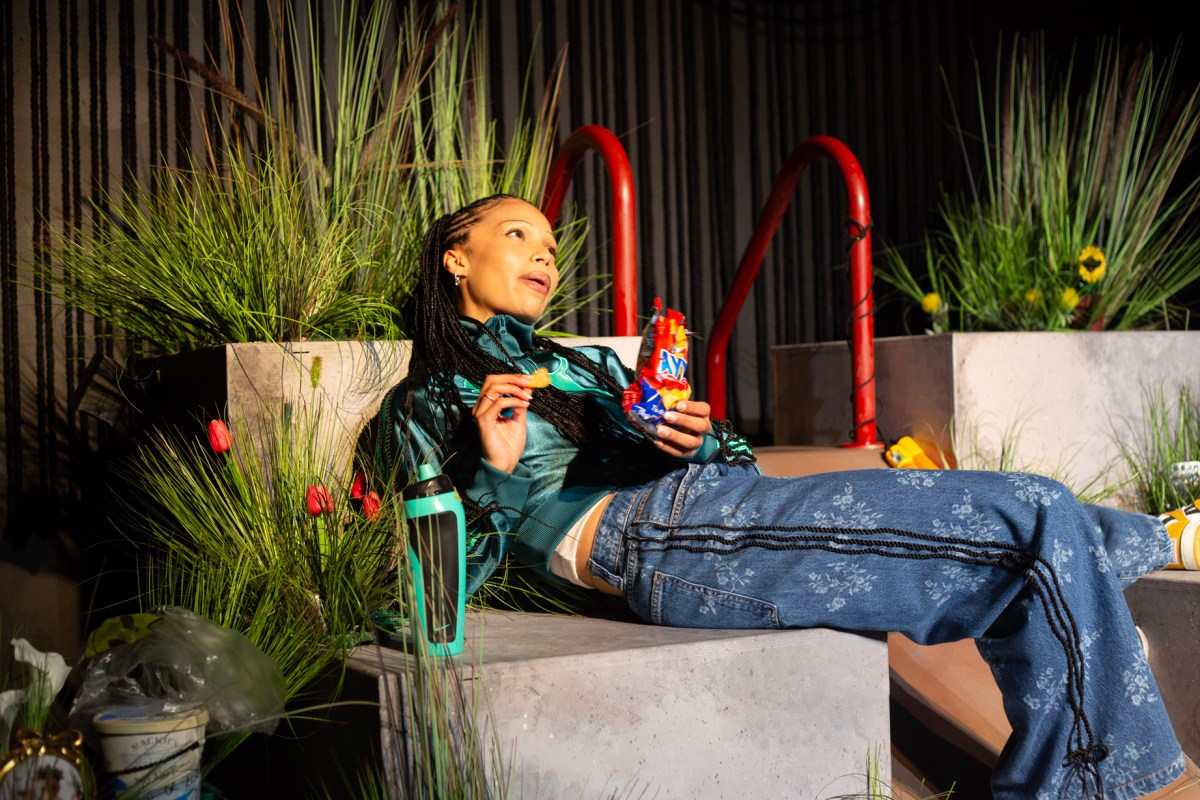
I previously saw Ansell in Emillie Collyer’s Super, playing a laconic, über-cool rebel, and Angelique could not be more different. At 17, she is (in the immortal words of Brittany Spears) not a girl, but not yet a woman. Despite having an absent father whom she refers to as her ‘sperm donor’ and a mum in prison, she’s got dreams.
She’s passionate about her floristry course at college, she’s saved up a significant amount of money that she plans to use to one day open her own shop, and she has respect for her firm-but-fair care-worker, Sam.
Funeral Flowers was first performed in full at Edinburgh Fringe Festival in 2018, where it won the coveted Scotsman Fringe First Award – an award with some pretty prestigious former winners, including Phoebe Waller-Bridge (for Fleabag), Richard Gadd (for Baby Reindeer) and, heading further back into the mists of time, Rowan Atkinson, Stephen Fry and Billy Connelly.
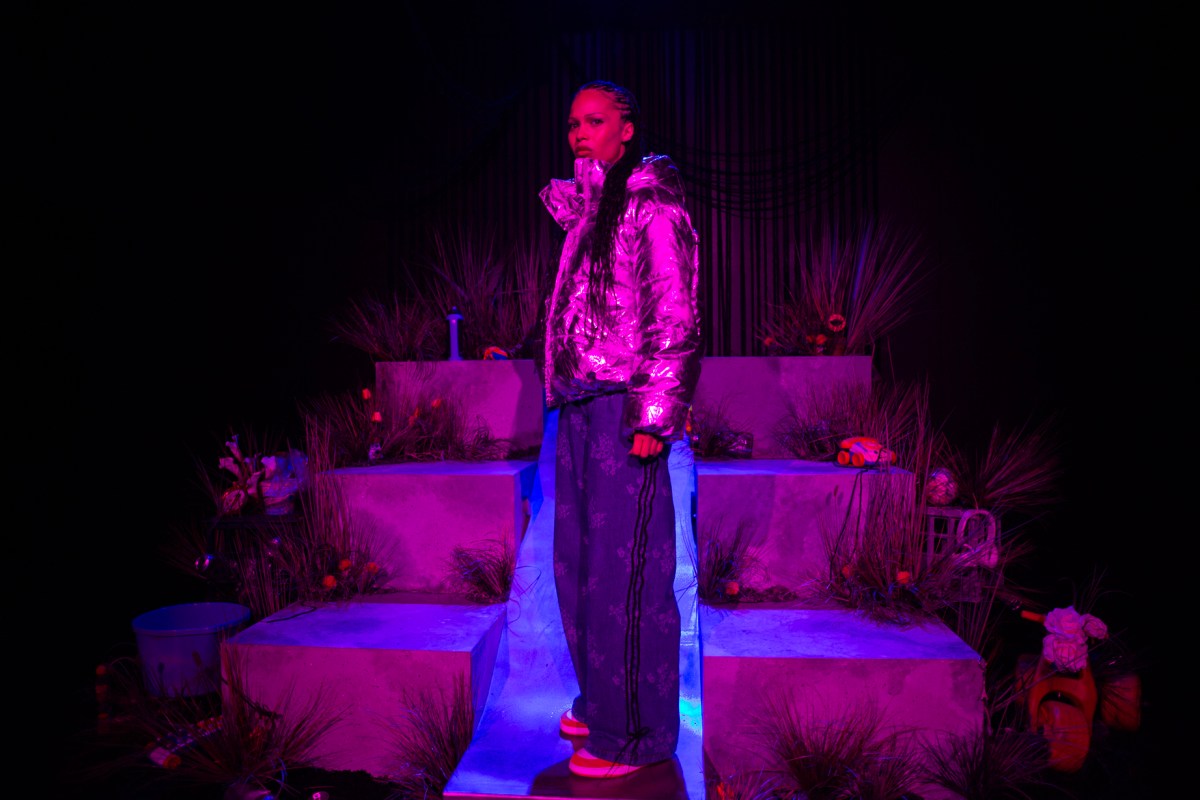
Ansell as Angelique is delightfully loveable: cheerful, charming and playful, dressed in a forest green cropped Puma bomber jacket and high-waisted floral flared jeans, her long braided hair tied up at the crown of her head. She’s street, but she’s also still a kid, and past traumas and enforced self-reliance mean there’s a wounded spikiness just under the surface.
Hip-hop lyricism
Director Candy Bower has leant into the language of the play, Ansell showcasing her vocal and linguistic pyrotechnics as she swoops from fluttering high-pitched girlish exuberance to bassy, don’t-mess-with-me rasping growls. The cadence of her vocal delivery and physicality amplifies the play’s spoken word-like poetic meter, with the RnB and hip-hop-infused sound design by Christian Biko providing the rhythmic scaffolding.
Plays about sexual violence can sometimes use it as a tactic to turn the drama dial up to 11, but Dennis-Edwards cleverly employs humour as both poison and antidote in Funeral Flowers – pulling us in, making us love the parentless Tottenham teen with her charming mix of girlish effervescence and puffed-up bravado, before we get to the dark dramatic heart of the play.
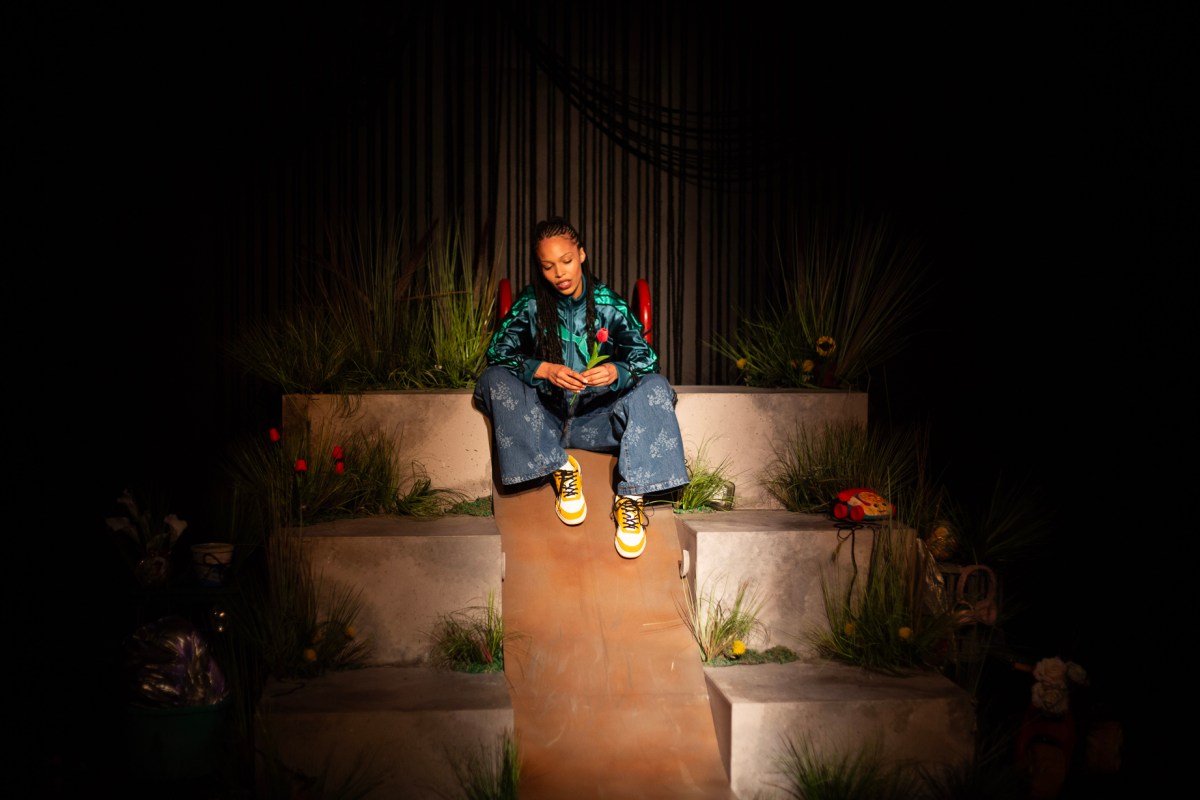
The set, by Bianca Pardo, is stripped back – a sequence of large grey steps dressed with bushels of grass, peppered with flowers, evoking Angelique’s love of floristry and dreams for her own florist shop. It’s decorated with remnants of a fading childhood: a child’s tricycle, a colourful dial-up phone. In the centre of the steps is a slide, a slippery slope connecting Angelique’s unstable upbringing and her precarious future.
Bringing trauma thoughtfully to the stage
Angelique tells us her story in parts, with sections of her story sometimes bookended by a blackout, or the use of flashing coloured LEDs (lighting by Kyra Ryan) that shift with a hip-hop beat.
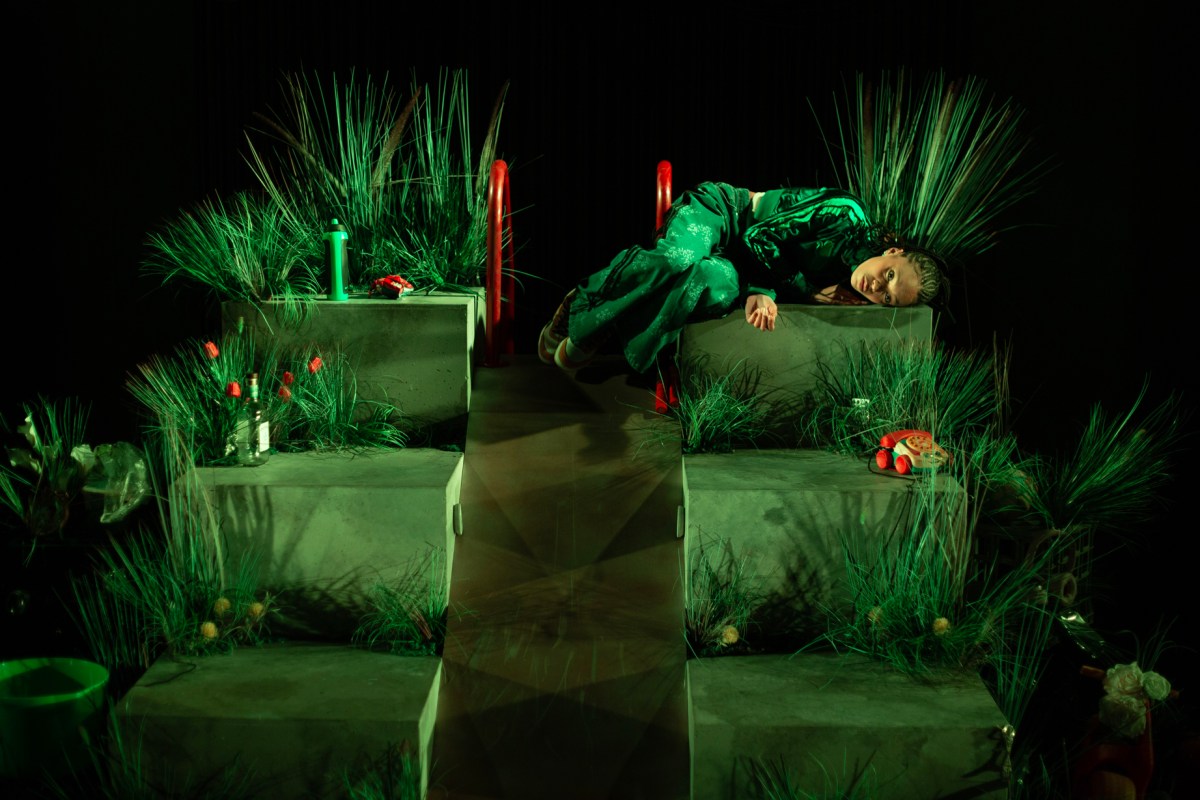
The sparing use of a blue lighting wash on Angelique’s collapsed frame at the centre of the slide, as her voiceover narrates her thoughts in third person, echoing against a background of dull shouts, brings us terribly into Angelique’s interior dissociative state in her moment of trauma. For all its awful horror, the moment is sensitively conjured, artfully restrained, and devastating for its psychological truth.
Angelique’s vulnerability is raw and palpable, but despite the trauma she experiences, there is a blazing flame of defiance that swirls around her: ‘I rise through the dirt, even though I hurt. And I’m still here.’ And as an audience member, you are rooting for her.
Sometimes it feels like stories about sexual violence pull their punches, avoiding grappling with the reality of the ruination it so often causes, the women who don’t ‘rise up’. But Angelique was never going to find justice in the system, so her simple ambition for herself is her armour and guiding light – that vital kernel of hope at the bottom of Pandora’s box.
Funeral Flowers is a powerful, punchy play with a lot to say – and truly it’s worth seeing it for Ansell’s performance alone. But under Bower’s direction, the musicality and rhythm of Dennis-Edwards’ writing shine.