The Melbourne Fringe Board has ‘carefully considered’ – and rejected – an open letter requesting a reduction in fees charged to artists programmed at the Fringe’s Trades Hall Hub and a change to how those fees are charged.
The open letter was signed by 580 artists, producers, theatre technicians, supporters and venues, including 106 anonymous signatories. Submitted to Melbourne Fringe on 11 May, An Open Letter to Melbourne Fringe: Give Artists a Fair Cut made two key demands on behalf of artists programmed at Trades Hall at this year’s Melbourne Fringe Festival:
- That Fringe reverse a proposed increase of its cut of box office for shows programmed at the Trades Hall Fringe Hub from 35% back to 30%, and,
- That Fringe should cease charging its cut on gross ticket sales and charge on net sales instead, claiming that doing so was making artists ‘pay fees on fees’.
A formal response from the Board, signed by Fringe Chair Michael Kantor and released on 12 May, stated: ‘The Melbourne Fringe Board is not able to adopt these requests for the 2026 Festival.’
Melbourne Fringe and A Fair Cut – quick links
A Fair Cut: campaigning for financial equity in the arts

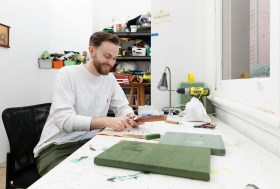
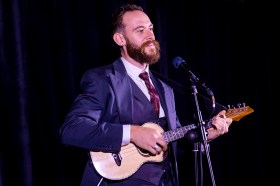
Writer, producer and clown Lukas Meintjes, whose one-man show B48Y Crash Lands on Earth! was programmed at the Melbourne Fringe’s Trades Hall Festival Hub in 2025, spearheaded the open letter and continues to push for change via the Instagram account A Fair Cut.
He tells ArtsHub that at its heart, A Fair Cut is campaigning for art-making to be accessible to everyone regardless of their socioeconomic background.
‘The main core of the Fair Cut campaign is making sure that artists can keep making work, and right now, the only artists that can really do that are those that have extra financial support. And I don’t think that’s quite right,’ Meintjes says.
‘It’s those that can afford to – it’s usually a lot more [of the] wealthier kids [who] get to make art at these festivals. It’s worse at other festivals and of course it changes from festival to festival, but it’s a recurring pattern, and it just feels like it’s gonna get worse.
‘Performing shouldn’t just be for the wealthy. I think [the campaign is also] about making a standard. It’s about trying to change the way that this [Melbourne Fringe Festival] operates so that we can make a profit or even break even more often, which means we can continue to make work – which I think is only better for the industry … Because if we keep stopping because of unfair deals, I think everyone suffers,’ he says.
Meintjes describes the Fringe Board’s response to the open letter as ‘lovely, in the sense that it said lovely platitudes’, and calls the Board’s rejection of the campaign’s main points ‘disappointing’.
‘I thought at the very least they could budge on the fees on the fees … [which] were hardly addressed in the main letter,’ Meintjes tells ArtsHub.
Melbourne Fringe responds to A Fair Cut
Danny Delahunty, Melbourne Fringe’s Acting Creative Director/CEO, says that a primary reason the board could not agree to the open letter’s requests was ‘absolutely’ because the 2026 Melbourne Fringe Festival is only a few months away: budgets, operating costs and related festival expenses are already locked in.
Nonetheless, Delahunty says Melbourne Fringe welcomes the conversation sparked by the open letter, ‘because the pressures artists are experiencing are real and deserve public attention. But once a problem has been acknowledged – as this one has been, thoroughly and without equivocation – the conversation needs to shift toward solutions. The reality is that changing one part of the financial model doesn’t remove the underlying cost of operating a venue. But there are solutions.
‘We’re very open to discussing different approaches and have outlined a range of alternative models and trade-offs for future iterations of the Hub. That’s the conversation the sector now needs to have together,’ he continues.
‘Identifying pressure points is important to begin a conversation, but that has been achieved, and we are far more interested in the difficult work of finding solutions that don’t unintentionally compromise the fragile infrastructure and support that independent artists rely on,’ Delahunty tells ArtsHub.
ArtsHub: This is how we lead the arts through a time of crisis – with integrity not fear
Breaking down the open letter
One of the open letter’s key demands was in relation to Melbourne Fringe increasing the fee charged on box office takings at shows programmed into the Fringe Hub from 30% to 35%.
The Fringe Board’s response – including a seven-page information pack expanding on the key points raised in the artists’ open letter – notes that the underlying costs of operating the Festival Hub have increased substantially, yet ticket prices and associated income have not grown at the same pace.
‘The 2026 model of an increase to a 35% door split is not about Melbourne Fringe seeking to increase profit. There is no profit, and never has been,’ the board wrote in the information pack accompanying its response.
‘This model is about reducing the scale of an operating loss that can no longer continue at previous scale.’
In relation to the open letter’s second main demand, regarding the Melbourne Fringe’s cut coming from gross ticket sales rather than net sales, Delahunty says: ‘The phrase “fees on fees” makes it sound like Melbourne Fringe is stacking profit margins on top of artists. The reality is much less dramatic: we’re trying to recover a portion of the real-world cost of operating a temporary festival venue that runs at a substantial loss. Any model, whether calculated against gross or net, is just a method to distribute costs equitably across artists with different earning capacities. Changing a formula doesn’t make those costs disappear.
‘This isn’t [Melbourne] Fringe taking money out of the sector. It’s Fringe putting money into it. In 2025, artists contributed approximately $185,000 toward the cost of operating the Festival Hub, while Melbourne Fringe covered the remaining $325,000. If we had asked Hub artists to cover the full cost of the venues, staffing, equipment and infrastructure they used, those venue contributions would have exceeded 80% of ticket revenue. Even then, the Festival Hub would only just break even.’
Nonetheless, the Fringe’s 35% split of the takings does seem excessive compared to the 28% fee (against a guarantee) charged by Melbourne International Comedy Festival, where MICF’s percentage is taken from net fees, not the gross amount.
Delahunty responds: ‘I can’t speak on behalf of the [Melbourne International] Comedy Festival, but from our perspective there are some important differences to our venue programming. Melbourne Fringe is a multi-artform festival, so our venues need to accommodate theatre, dance, circus, live art, music, experimental practice and other emerging forms, alongside comedy and cabaret.
‘That means building and operating complex spaces that can flex across a range of technical and production requirements, with infrastructure, equipment and staffing models designed to support a broad range of work rather than a narrower presentation format,’ he says.
Delahunty adds that Melbourne Fringe’s programming priorities result in the Fringe Hub being programmed, ‘to champion artists at every stage of their career and to create opportunities for new work and emerging forms that may not yet have a large audience base. That means taking risks in programming, because our venue’s function isn’t simply to present the most commercially successful work available, it’s to support the future of independent arts practice more broadly.
‘Neither approach is right or wrong, but it does mean there’s a different calculation at play when we’re working out how much venue hire subsidy can be provided, particularly when Melbourne Fringe receives $367,000 in government core funding, less than a quarter of the $1.59 million received by MICF.’
Independent venues commit to new fee structures
The A Fair Cut campaign has generated considerable discussion in the Australian arts sector, with two venues to date publicly committing to a new 70/30 fee structure. One is Adelaide’s Arthur Art Bar, as recently revealed by A Fair Cut’s Instagram page. Another is The Motley Bauhaus, located in the inner-city Melbourne suburb of Carlton.
However, The Motley Bauhaus’ owner, Jason Cavanagh, tells ArtsHub the recently announced commitment to a new fee structure was not a direct respond to the A Fair Cut campaign.
‘The Motley’s change to go with a straight 70/30 split is the culmination of a lot of internal conversations based on feedback we have received over a period of time from various artists within our community,’ Cavanagh says.
‘It’s not a huge departure from our previous model, as that also was based on trying to keep it in the realm of 30%, just making part of that a deposit which works similarly to a minimum guarantee. But we heard people would prefer it this way so we eventually decided to make that change.’
Cavanagh says the change was driven by the need to provide ‘accessible space for artists’, a belief that is central to the existence of The Motley Bauhaus.
‘When prices rise too high, whole sections of the community are locked out of sharing their stories, and I think that as a community we all lose out when that happens. It’s something I feel passionately about and so when I hear members of our community saying that a 30/70 structure would suit them better of course I take notice,’ Cavanagh says.
‘But no, I wouldn’t say that change came about as a result of this campaign, but rather that this campaign has grown out of the same soil that led to us making those changes – something we have been talking about for longer than the last couple of weeks,’ he adds.
Artists following the A Fair Cut campaign will be pleased to know The Motley Bauhaus’ cut will come from net box office receipts, not gross.
‘We are taking our percentage from net box office receipts, but specifically referring to fees incurred at the Motley. This expressly excludes any external fees, including festival charges, or other third-party costs arising from separate agreements entered into by the hirer,’ Cavanagh says.
‘Artists are of course able to perform at the Motley any time of year, including during the Fringe Festival, without entering into any such agreements,’ he adds.
Sounding a note of concern about A Fair Cut’s target
Cavanagh voices concern about the target of A Fair Cut’s current campaign, saying: ‘I’ll note that both the Victorian and Federal budgets have both been delivered over the last couple of weeks and, once again, the arts industry is being utterly and completely left out of the conversation, despite it being a massive industry in dire need of more support across the board.
‘The relevance here is that whilst I agree with the fundamental cause of [delivering] more money for artists – for making what they are doing more sustainable and essentially allowing them to earn a “fair” percentage of their own ticket sale revenue – I think to aim this at the very organisations who are trying to provide them a platform is not going to achieve the outcome they are after.
‘So yes, I applaud [A Fair Cut’s] effort in advocating for themselves and I’m [also] sure, knowing some of the people behind the organisation that is the focus of this campaign, that they will continue to do everything they can to provide the best support they can … But if we as an industry want to start having a discussion about what is fair, and getting the recognition and financial restitution that we all deserve, then I would rather we were working as a collective and taking it to our local representatives,’ Cavanagh concludes.
ArtsHub: National Cultural Policy review 2026 – submission tips, with AI set to find ‘common themes’
Continuing the conversation with Melbourne Fringe
Melbourne Fringe’s public response to A Fair Cut’s open letter included the board’s offer to continue the conversation about venue fees, ticketing charges and other issues impacting independent artists.
‘The concerns raised in your letter are meaningful, and we believe there is value in a broader conversation with artists about what the future of the Festival Hub should look like,’ the board’s response read in part.
‘If our community prefers a lower-cost Hub model, then we need to openly discuss the trade-offs required to make that possible. That may involve changes to staffing models, equipment inclusions, venue configurations, infrastructure expectations and, more broadly, the balance wanted from Hub artists between support and affordability. No option is off the table for future years.
‘The door to Melbourne Fringe is always open. If something about how Melbourne Fringe operates feels unclear, unfair or worth questioning, please ask us,’ the letter stated.
Meintjes says it would be ‘incredible’ to have such a meeting with the Melbourne Fringe Board, but expressed his disappointment that the board’s response didn’t include more concrete details about such a meeting.
‘They just had a vague suggestion that the discussion should continue,’ he says.
To Edinburgh and beyond
Since speaking with ArtsHub last week, Meintjes has subsequently rejected the two offers from Melbourne Fringe to present work at this year’s Trades Hall Fringe Hub.
Updating ArtsHub on the situation, he says: ‘I’ve withdrawn from two festival managed venue offers with Melbourne Fringe this year. The base cut is so high that even in a one-off, 100-seater, the estimated profit was $200 if we sold out … Performing should not just be for the wealthy. Something has to change.’
Meintjes is now focused on the next presentation of his show B48Y Crash Lands on Earth! at Edinburgh Fringe – in a venue where the box office cut is 40% plus Value Added Tax, with additional fees charged for marketing services and merchandise sales, as compared to Melbourne Fringe’s 35% all-inclusive cut – while also pondering what’s next for A Fair Cut.
‘There are so many things broken with the current model and status that Melbourne Fringe has – it doesn’t feel very fringe … it feels like this inaccessible, curated, expensive, high-art place. And to me, it almost gets me thinking, is it time to start the fringe cycle again?’ he says.
Does he mean creating a Fringe of the Fringe?
Meintjes replies: ‘I think that’s possibly the only thing that could be a fix to this, because it means that if it’s built from the ground up again, artists can decide and start making things the way that they want them to work, and set a new standard.’