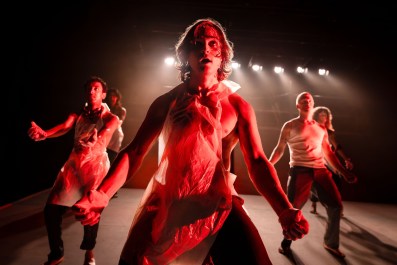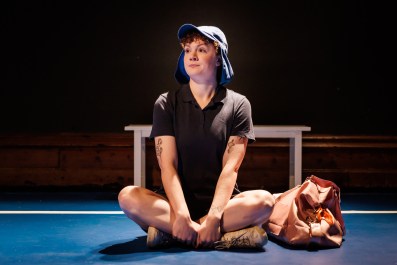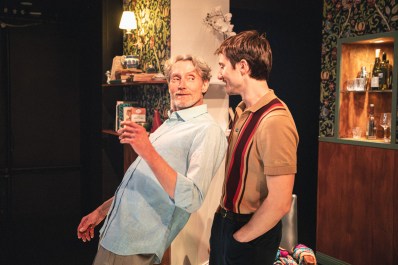
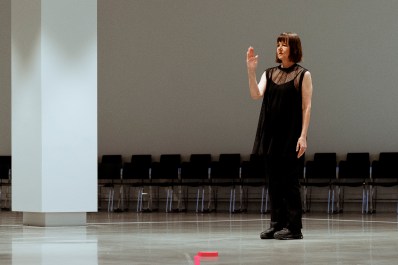



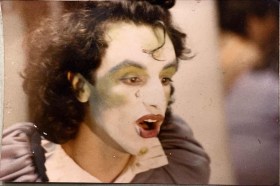

There’s a moment during the second act of Cowbois – A Siren Theatre Co. Production written by Charlie Josephine, currently playing at the Seymour Centre, Sydney – where the men of the play discuss ‘good women’. That moment, for me, signalled the start of the show’s downfall, which is a shame: it had been going well until then.
Cowbois has been billed as a queer Western play ‘where trans audiences feel seen, queer audiences feel lifted, and newcomers get swept into something they didn’t expect but won’t forget’ and is set in an unspecified American outback town during a gold rush
In Act 1, we meet the people the men of the town have left behind in their quest to find gold (wives and children and the local Sheriff), most of whom are scrambling to complete the tasks the men normally would: they can’t find a pastor, they can’t follow up on deliveries out of town and they’re finding it difficult to put down a sick horse.
In true Western style, a dashing stranger arrives, in this case the charmingly dangerous and gender subversive outlaw Jack Cannon (Jules Billington), who wins over the women easily and teaches them to embrace the non-feminine parts of themselves.
To be clear, this is a blissful first act – at least until those gold-hunting men return, just before intermission.
Cowbois: the men return
While drinking at the saloon (of course) the men leave us in no doubt they expect their wives to be obedient, docile and feminine.
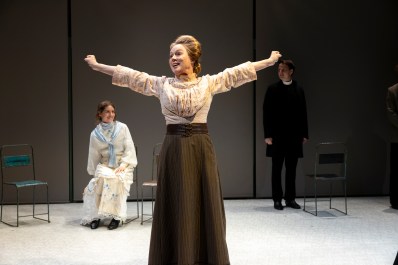
Jane (Amie McKenna), one of the ‘rebellious’ wives, meanwhile, looks to the audience with a mix of resolution and despair, and says ‘cheers to good women’ before taking a swig. It’s a not-so-subtle nod to the audience that the bigotry on stage is discomfiting to all involved – and neither, sadly, is it an isolated incident.
Clocking in at an overly-long three hours, the second half of Cowbois continues unabated with its displays of rampant misogyny, homophobia and racism by the returned male characters. It’s excruciating to watch, and something I was totally unprepared for given Cowbois advertises itself as an inclusive and farcical musical western.

Perhaps the second act suffered mostly because it lacked the phenomenally charismatic performance of Billington. Jack was the heart of the first act, dazzlingly playful but sharp as a knife’s edge.
Their love scene with Miss Lillian (Emily Cascarino) was a soaring and tender dance that left room for complex and fascinating discussion around pregnancy, transness and their desires to have a family regardless of their biology.
Cowbois: what politics?
For me, though, the show’s main problem was its inability to grapple with the idea of ‘politics’.
The saloon brandishes a sign declaring ‘no guns, no politics’. Not only did almost every character wield a gun at some point, but the show never had a clear or convincing definition of what ‘no politics’ actually means here.
Jack suggests early that the bar is successful as a place of ‘no politics’ by virtue of hosting white and Black people – fine, but … is that as far as it goes? (Although, to their credit, Jack is the only character to – accurately º suggest at any point that there is no such thing as an apolitical trans existence when there are still so many barriers for trans people in finding safety and acceptance.)
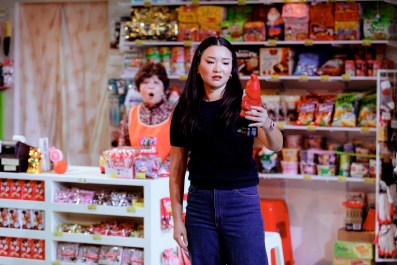
Cowbois is alarmingly simplistic in its racial politics. Branden Christine’s Mary fell into all the traps a Black female side character could: a single mother floating between mammy and sassy archetypes, a sitcom-style friend with little interiority, played with an accent that was transatlantic at best and egregiously stereotypical at worst.
The men, meanwhile, consistently blame their lack of gold on unnecessarily specific racial sub-groups such as Italians and Poles, and use outdated language such as ‘Indians’ to refer to Native Americans. It’s an uncomfortable and egregious choice to continually employ this language when the point is already proven.
Director Kate Gaul attempted to offset this overdone heaviness with a final shootout that felt like a poorly-paced Benny Hill offcut. Throughout this emotional whiplash, I couldn’t tell if Cowbois was meant to be a boring biopolitical fantasy or an entirely untethered production of political realism. Regardless, for me at least, it failed.
Cowbois: what was needed
I would assume that no one in the audience of an explicitly trans and queer-led production would need ‘context’ to understand the necessity of telling new trans and racially-diverse stories. An audience doesn’t need to see gratuitous and perpetual depictions of physical and verbal gendered violence to grasp this idea. What we need is world-building that fights for and humanises trans people and people of colour.
Jack is asked early on how he finds the confidence to dress and act in such a gender transgressive manner, to which he posits ‘is it truly confidence if it’s necessary?’ The second act, in its relentless cruelty and gruelling depiction of racial transmisogyny, was not necessary. Of that, I’m confident.
Cowbois by Siren Theatre Co. is at Seymour Centre in Sydney until 13 December 2025.

This article is published as part of ArtsHub’s Creative Journalism Fellowship, an initiative supported by the NSW Government through Create NSW.