ArtsHub’s Jo Pickup is overseas and taking in the best performing arts from around the world at Theater der Welt in Germany.
South African composer Philip Miller is well-known for his multidisciplinary art projects, including several works with renowned visual artist William Kentridge – a collaboration that Australian audiences might be familiar with via their 2011 production Refuse The Hour, which played at Perth Festival in 2016.
Most recently, Miller has taken a keen interest in the story of apartheid-era gay and Black civil rights and activist Simon Nkoli. His legacy is not familiar to many, but he’s a man who defied all kinds of discrimination – from law authorities, fellow-activists and even his family – to champion Black rights in South Africa at a time when that kind of protesting could easily put you in prison.
In Nkoli: A Fierce and Fabulous Life, which premiered in Johannesburg in 2023 and had its European debut last week at the international Theater Der Welt festival in Germany, Miller brings Nkoli’s story to life in the most brilliant way possible: in a contemporary opera that both celebrates and destroys its historic form, led by a group of talented Black artists who are rarely seen on opera stages, and in whose hands the artform becomes something more exciting, more daring and arguably more alive.
Nkoli review – quick links
A thrilling announcement of new energies and forces
Supported by a small orchestra of Black musicians (two violinists, a cellist, a double-bassist, a trumpeter and a percussionist) who are led by conductor Tshegofatso Moeng, Nkoli opens with rousing orchestral sounds that are contemporary, upbeat and totally electrifying.
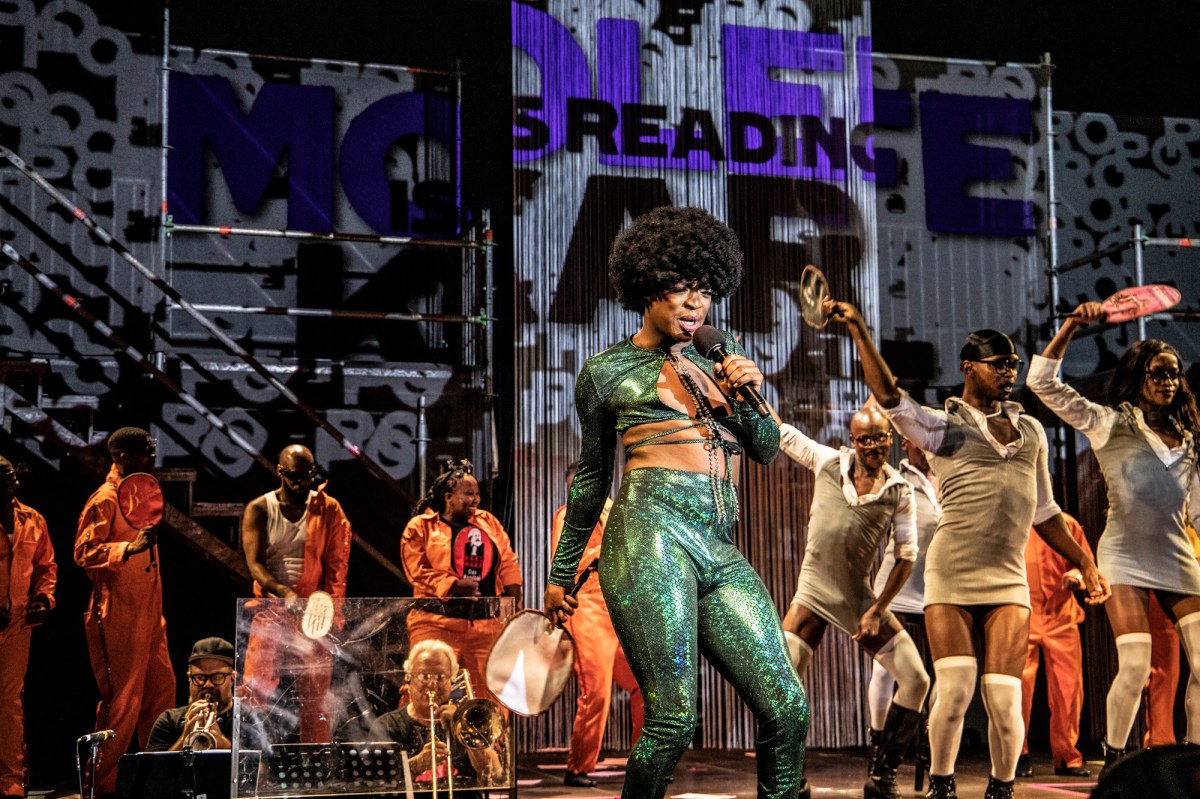
As the stage lights rise, we see an equally exhilarating set piece that resembles a rundown split-level urban housing block (presumably in Johannesburg) with a half-dozen 1980s-style TV screens plastered across its exterior.
These old-school TV sets blast soundbites from news reports on topics like the AIDS crisis and political power-sharing negotiations, but sometimes these clips are deliberately interrupted by streams of static white noise.
This opening has a decidedly 1980s vibe, mixing a kind MTV-generation cool with serious street protest activism. It’s the perfect set-up for the work’s 18 performers to appear for the first time, as they inhabit the stage’s main set piece, poised in its various windows, doorways and stairs.
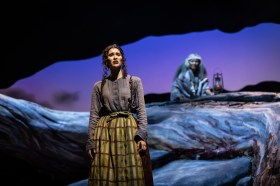
A final highpoint of the work’s introduction is when we are properly introduced to its protagonist, played by Simbone Qonya, who breaks into a stunning solo aria under a beaming spotlight.
As his voice rings out it’s like a beautiful announcement that these performers and their characters are here to show us what this artform has been missing all these years, with its history of marginalising (if not completely excluding) non-European artists and presenting narratives that uphold predominantly white, heterosexual, patriarchal world views.
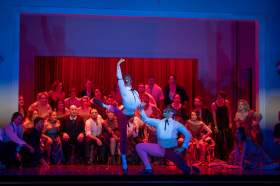
So, when the ensemble embarks on a RuPaul style catwalk number that excitedly chants, ‘We’re here, we’re queer, we’re everywhere’, the stage feels like it’s overflowing with the exhilarating message that (finally!) opera is changing, and these artists are leading that charge in extremely high style.
An activist’s dynamic life both celebrated and critiqued
While the work’s opening scenes do many important things – including setting a fun tone for the night while sending powerful political messages – the remainder of the opera’s journey, while interesting in story, doesn’t sustain its early energy and spark.
But before it starts to lag, we are treated to some incredibly dynamic scenes including those that cover the early years of Nkoli’s life in the 1960s, where, under the guidance of the work’s drag queen emcee (played by S’BO GYRE, who also co-wrote the work’s lyrics) we discover Nkoli was a proud young gay man who was also quiet in his moves to keep his sexuality under wraps in apartheid-era South Africa.
In Nkoli’s case, he was also facing contempt about his sexuality at home, especially from his mother, played by Ann Masina, who viewed his homosexuality as a sin and ‘a product of Western tradition’. Indeed, at one point, his mother tries to have him ‘healed’ of his queerness, including one especially funny scene where she is seen wielding a white dildo like a knife aimed towards her cowering son.
But as Nkoli persists down his path to finding love, his head held high, several other political dangers lie ahead of him that will eventually see him serve four years in prison.
Among these retellings of Nkoli’s role in the Black civil rights movement of the 60s and 70s, there is one particularly well-delivered scene led by performer Nokuthula Magubane, whose exquisite voice takes the lead in a plaintive song that accompanies a funeral procession. This song is one of Nkoli‘s most touching, offering a sad reminder of how dangerous peaceful protests at the time could be.
Along the way, we also learn of the often overlooked nuances within these political movements that are rarely acknowledged outside their direct circle of participants.
How is it for example, that Nkoli’s fellow civil rights protestors saw him as damaging their cause on account of his queerness? And how could some of them distance themselves from him when he was most in need?
Also, how could Nkoli himself take umbrage at the success of his fellow Black gay rights campaigner (and close friend) Bev Ditsie when, after many years of being unrecognised for her work, she was finally invited to speak at the UN?
These questions are nicely threaded through the story to ensure it never descends into stereotyping or becomes an act of hero-worship.
But there are also some obvious structural problems that let the work down by its end.
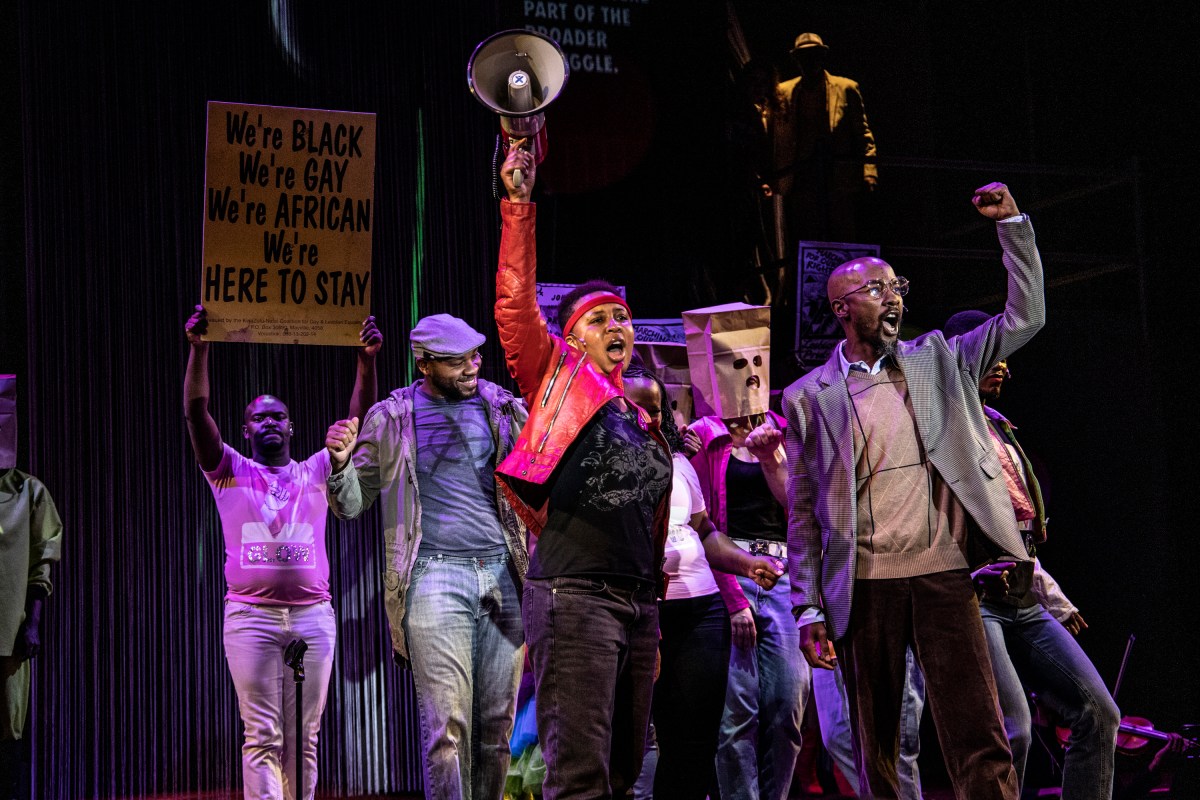
By the middle of the show, with numerous songs that vary little and slow the pace, the show’s tyres felt like they were sagging, and Nkoli never regains the levity and punch of the first 40 minutes.
The performers do their best to sustain its momentum. (Frequent, vogue-style choreography by Llewellyn Mnguni helps a lot here.) But overall, the show’s promising opening energies, which declare the intent to break apart an old, institutionalised artform, are not handled adeptly enough to leave us on the kind of high that could have been achieved, had the work’s structure and its sometimes repetitive compositions been different.