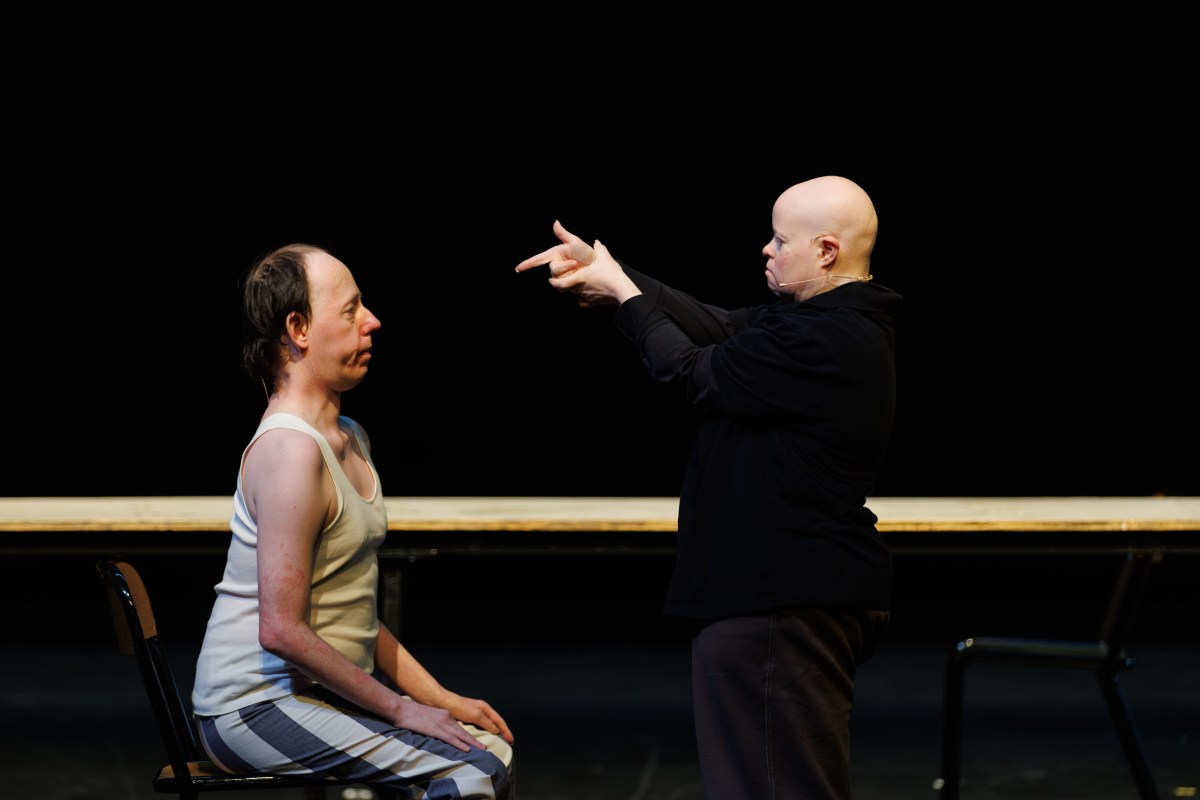
Geelong’s multi-award-winning Back to Back Theatre Company is restaging Ganesh Versus The Third Reich at UMAC Theatre in Melbourne in the lead up to their appearance as the featured ‘Portrait’ artist at the prestigious Festival D’Automne in Paris later this year.
Only on for three performances, this is the first time the Helpmann Award-winning play has been staged in Melbourne since it was presented as part of the Melbourne Festival in 2011, where it won the Melbourne Festival Age Critics’ Award.
Since then, the play has toured the world, winning the Edinburgh International Festival Herald Angel Critics’ Award in 2012, while Back to Back Theatre went on to win the International Ibsen Award (regarded as theatre’s Nobel Prize) in 2022 – becoming the only Australian theatre company to do so – followed by the Golden Lion for Lifetime Achievement in Theatre at the Venice Biennale in 2024.
And all those accolades aren’t for nought. Theatre-lovers should take note: if you haven’t seen Ganesh Versus the Third Reich, stop reading immediately and buy a ticket before it sells out.
It’s funny, it’s clever, it’s absurd. It’s dramatic and conceptually rich. It’s the sort of theatre that recalibrates your experience of what theatre can do. It makes you feel, then immediately makes you critique your own feelings, whipping you into a spiral that tips you off-balance. It’s moving, but this move feels permanent: a profound skewing of the scales, a theatrical paradigm shift.
That feeling is so rare, and gosh it’s just so good.
Ganesh Versus the Third Reich: the players
Ganesh Versus the Third Reich was devised by an ensemble of Back to Back actors, working with the company’s artistic director Bruce Gladwin. The play is performed by Simon Laherty, Scott Price, Tamika Simpson, Brian Tilley and David Woods.
ArtsHub: Back to Back Theatre recognised as ‘a singular artistic voice’ on the world stage
The structure presents a play-within-a-play, as a company of actors who identify as having an intellectual or physical disability are directed by a non-disabled actor, David (Woods), in a play about the Hindu elephant-headed god Ganesh travelling to Nazi Germany to reclaim the swastika – a Sanskrit symbol for good luck and prosperity.
The action of the play switches between rehearsal room scenes and the performance itself, with the performers donning or pulling off their costumes on-stage as they discuss scenes or move large tables and chairs and roll across floor-to-ceiling curtains on their rails to form the sets.
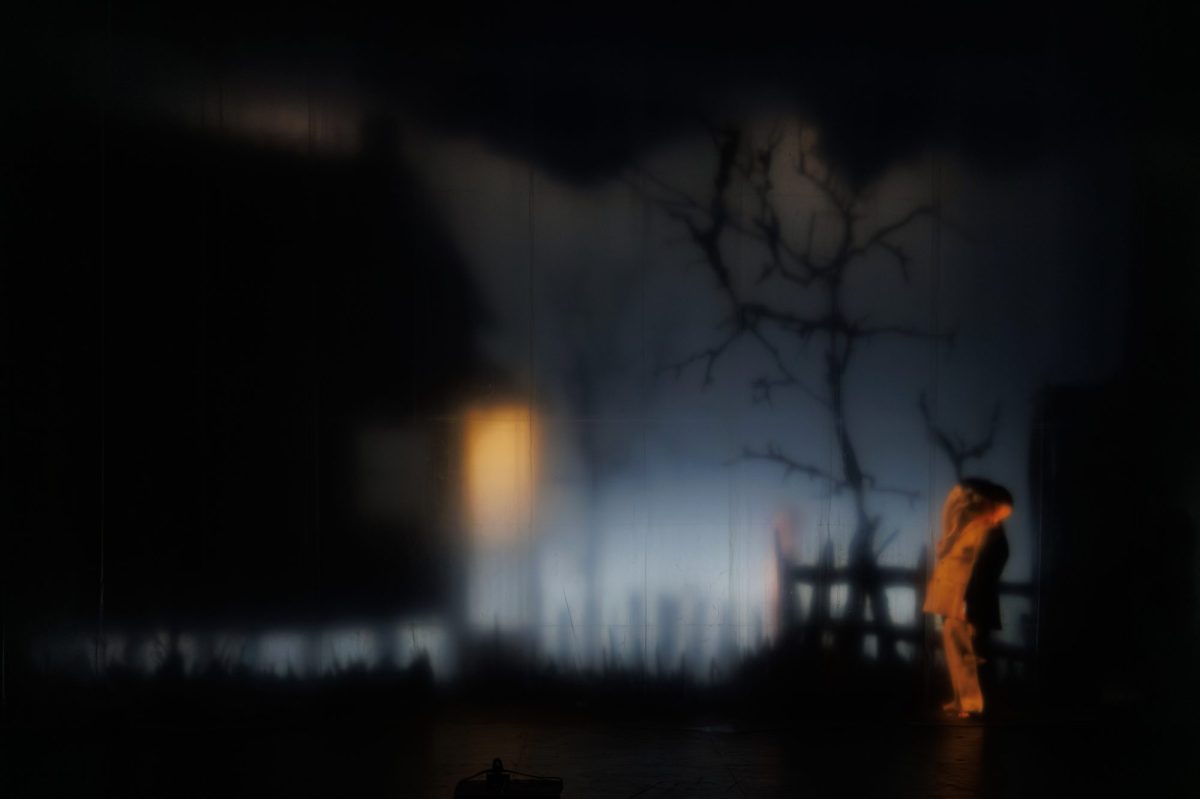
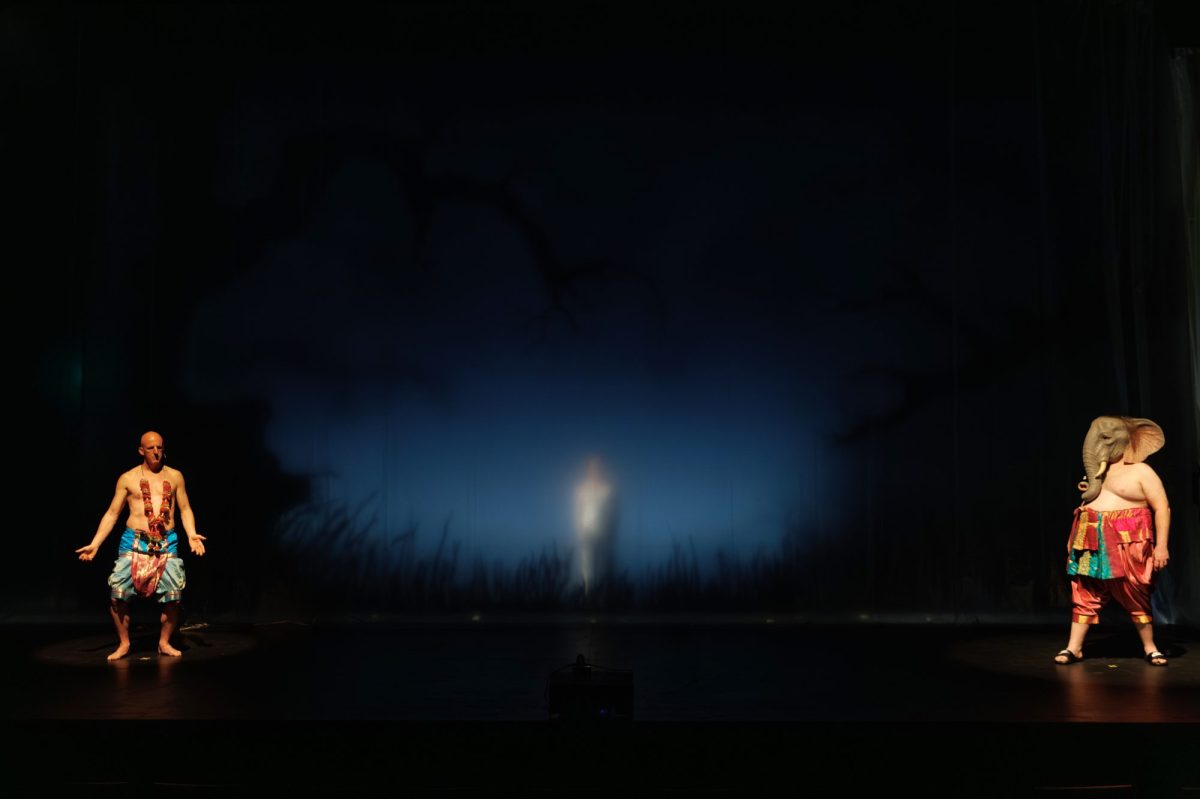
The layers of parallel, translucent curtains build scene through light and shadow, conjuring scenes of remarkable depth and diaphanous light, taking us from Auschwitz to a train carriage rumbling across rolling hills, a lit-up cabin in the woods or the divine realm of Ganesh.
In rehearsal, Woods is as an imposing, fast-talking, gym-shorts wearing, theatre evangelical, who variously cajoles, manipulates and bullies the actors into performing the way he envisions.
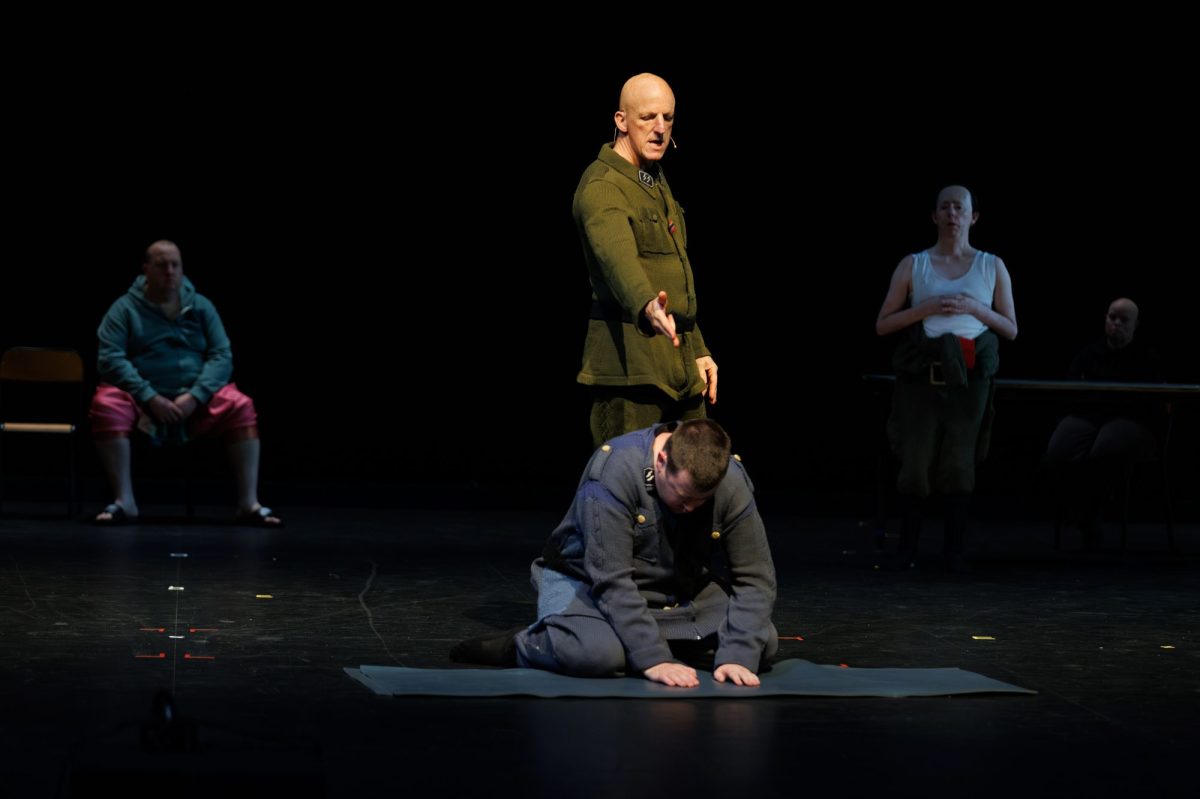
Simon Laherty is cast as a Jewish man, handpicked by Woods’ notorious Nazi doctor Josef Mengele, Auschwitz’s ‘Angel of Death’, for the purpose of conducting his notorious medical experiments. Scott Price becomes a gun-toting SS agent, and Brian Tilley, the play-within-a-play’s writer, is transformed into Ganesh as he places the elephant mask on his head, his voice becoming a godlike booming baratone.
Tamika Simpson is coaxed into the role of Hiter by Laherty. ‘It’s a great role’, he says, deadpan.
Ganesh Versus the Third Reich: uncomfortable by design
The parallels between the fascism of the Third Reich represented in the play-within-a-play and the increasingly abusive fascism being played out in the rehearsal room makes for some deeply uncomfortable viewing.
As the wants and needs of characters with and without disability clash, the dramatic tension escalates, forcing the audience to think about our assumptions and how we view disability and non-disability, in terms of agency, power and consent.
In Ganesh Versus the Third Reich, Woods as the group’s director is relentless – dismissing actor Laherty’s concerns about not being able to perform the role of a Jew at Auschwitz because he’s not Jewish, and forcing the reluctant and increasingly agitated Scott Price to be shot and ‘die’, again and again, so that his body falls that way Woods wants it to.
The pernicious dictatorial ideology that runs through the director is that – there is a ‘right’ way to perform theatre.
David is obsessed with creating ‘a real moment of truth’ onstage in the play. He asks Mark, who’s been thrown in the role of Hitler (‘it’s a good role’, says the equanimous Laherty) and whose primary mode of communication is in shouted ‘yeah’ and ‘nah’s, whether he knows the difference between what is real and what is not real. ‘Yeah’ says Mark, decisively.
To demonstrate how theatre can create moments of real truth, David looks out to the audience and tells us: you are here because you have come to look at an aquarium, a zoo. A ‘freak show’. The weight of his words hangs awfully in the air, before he turns back to the other actors. See, he says, that’s what I could say once there is a real audience there.
Back to Back’s Ganesh Versus the Third Reich is compelling theatre at its best. It refuses to let an audience sit safely and unmoved in the dark.
It’s theatre that reaches out, digs into your heart and mind and makes you see through your own eyes, anew.