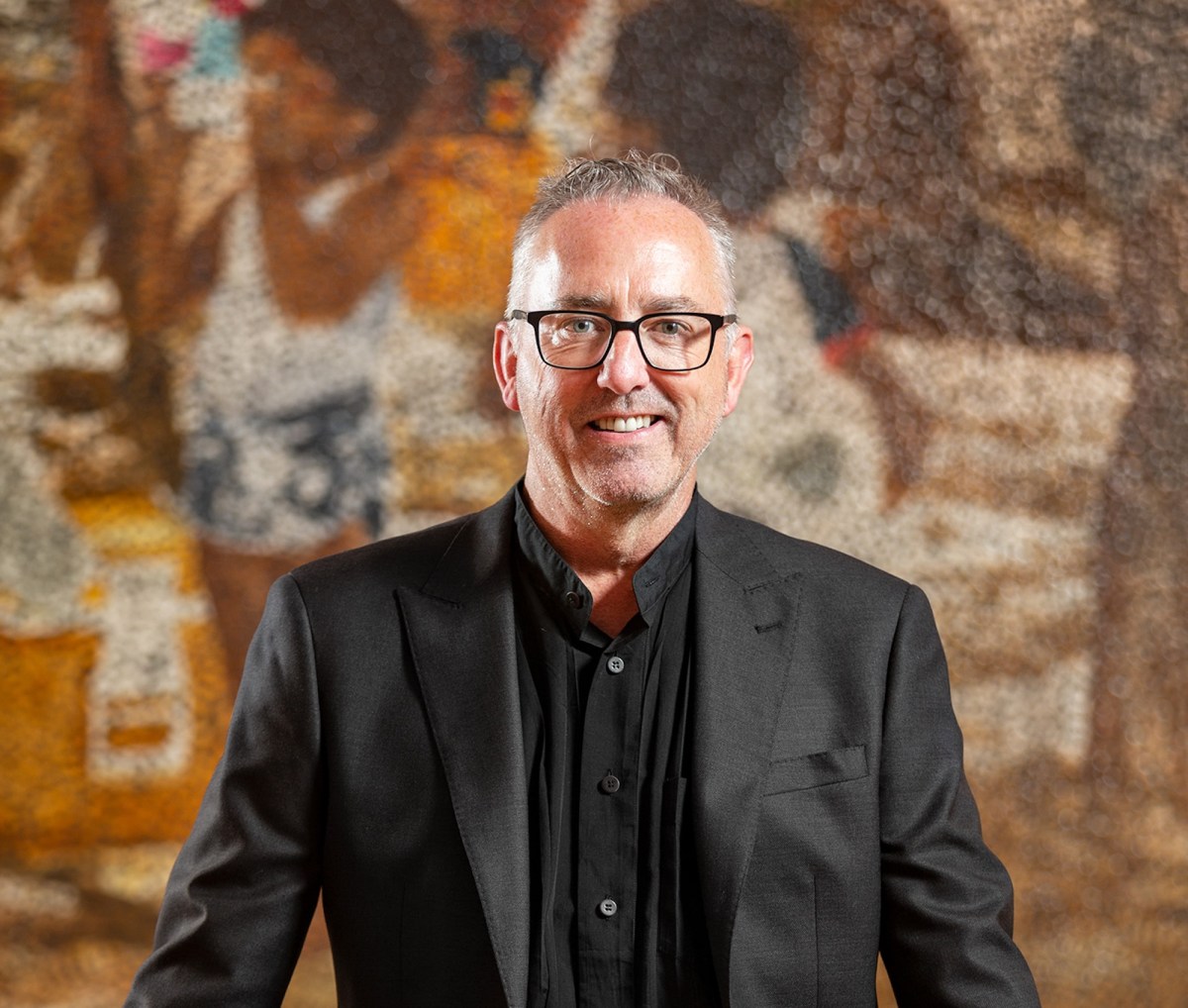
After eight months on the job, Art Gallery of South Australia (AGSA) Director Jason Smith sat down with ArtsHub to answer questions about how different the reality is to the perceptions – and the expectations – of leading a state institution.
‘The reality is always more sobering,’ Smith says with a laugh, but adds that the opportunities are great.
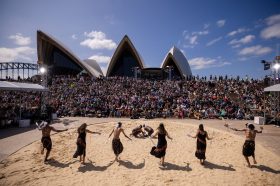
Sitting in the AGSA courtyard on the opening weekend of Tarnanthi – the Aboriginal and Torres Strait Island festival driven by the Gallery – one can’t help but feel an affection for this institution, which continues to punch above its weight.
But in many ways, AGSA is facing significant changes.
There are key vacancies to fill for senior staff, especially in the First Nations space with the departure of Nici Cumpston OAM for her new role in the USA; the shaping of the next decade of Tarnanthi in a changing funding environment; a State Government moving towards a March 2026 election and, to top things off, a toxic algal bloom forcing tourists to consider other activities this summer. The Gallery has, it seems, carte blanche to re-gear for its future.
AGSA Director looks ahead – quick links
When a state faces an environmental disaster, look indoors
In March 2025, a month after Smith started at AGSA, news of a major algal bloom impacting the coastal areas of South Australia made national headlines. It came within days of the SA Government’s announcement of a new $80 million cultural policy – the state’s first 10-year strategic cultural plan. It was a bittersweet reality.
Months later, that environmental disaster has killed thousands of sea creatures and taken a toll on businesses and tourism. Heading into the summer season, Smith tells ArtsHub: ‘I think all organisations are feeling the effects because it has necessarily redirected the Government’s economic focus.’
He continues: ‘The economic impact of the toxic algal bloom is real, and it’s huge, and it will continue to have a massive impacts on the economy.’
This is a concern as the SA Government prepares for a March 2026 election, and the Gallery – which is arguably underfunded – is in desperate need of state investment to expand its footprint and operations.
The one upside is that people will be looking for alternatives to a beach summer and the Gallery is primed to harness that opportunity.
The dream: planting the seed for AGSA’s expansion ahead of state elections
It is no secret that AGSA is bursting at the seams – both in terms of collection storage and exhibition real estate.
It is a problem that has long been on the table for discussion with Government. Former AGSA Directors Nick Mitzevich and Rhana Devenport both lobbied State Government with creative solutions – which were not realised. Smith says: ‘It’s no secret that an expansion for AGSA has been on the agenda, and this of course remains a priority for me. Like previous directors, I of course hope that this will be realised under my tenure and we are actively engaging in discussions with Government.
‘Previous governments, and the current Government, have fulfilled an ambition for a collection storage facility that’s slightly off site, which is due to be operational in mid-2026. It’s magnificent but it’s not as much space as we need.’
Smith explains: ‘I’m inspired by the new V&A East [in the United Kingdom], the audience engagement potential of which is going viral around the world. And I believe there could be capacity to create a similarly extraordinary open view storage facility for AGSA.
‘Powerhouse have done it at Castle Hill, TarraWarra Museum of Art has just opened a fabulous open-view storage and events space, and it is a trend catching on globally.’
Smith says the Gallery is, ‘taking a very careful approach to what we’re discussing with the Government as our key priorities ahead of the March elections.’
Sponsorship and philanthropy: the need to secure AGSA’s future partnerships
Nici Cumpston, the inaugural – and outgoing – Artistic Director of Tarnanthi tells ArtsHub: ‘We’ve always known that we have to diversify our funding in addition to that provided by BHP.’
Smith adds further clarity. ‘We have to continue to work closely with those partners who have sustained Tarnanthi, but then to diversify and welcome new partners into what Tarnanthi will become.’
Read: Too Deadly review: looking at 10 years of Tarnanthi at AGSA
As AGSA celebrates Tarnanthi’s 10th anniversary, Smith was clear that the signature exhibition and festival are ‘not going anywhere,’ adding that its ambitions only continue to grow.
‘Naturally there are always competing priorities and unforeseen challenges when stepping into a role like this, what I’ve done is focus on immersing myself in the Gallery’s philanthropic and development spaces looking forward to AGSA’s future.’
Smith is naturally optimistic and tells ArtsHub that one of the pleasant surprises has been witnessing how much the collection is loved by Adelaide and South Australia. ‘That has exceeded my expectations, and that’s been really lovely to encounter.’
Staff relationships: optimism and the other side of the AGSA exodus
Smith says that while establishing a sound and productive working relationship with State Government over his first eight months has been important, coming in as a new director at ‘a moment of transition in the Gallery – whereby there has been a significant move of senior staff, and particularly a transition in our First Nations leadership, and the inevitable unsettlement upheaval with the new era of a new director – embedding myself in the team, and understanding what their motivations are, has been a priority.’
Smith continues: ‘I’ve always seen those things as moments of great opportunity’. In terms of establishing a new team dynamic and ensuring an even keel, Smith explains that he has always had a very strong team-based approach. ‘And while that is easy to say it is harder to effect. What has worked for me is my emotional intelligence: I know what I don’t know. I said that to the staff at the beginning. “You’re here because you are subject matter experts, and together, we will create a holistic organisational whole”.’
He adds: ‘I’m not a dictatorial person. I’m not an autocrat. I’m not a micromanager. But I know my mind.
‘Strategic is a hackneyed word but you’ve got to be strategic. You need to understand the machine within which you’re working and then just keep it well oiled. In some ways you’re a bureaucrat with a creative soul.’
AGSA’s future sustainability
In his first week on the job, Smith sat before the SA Government’s statutory authority review committee. ‘Part of the questioning was related to the Gallery’s funding and its financial sustainability,’ he says.
‘I have learned over 20 years working in not-for-profit art museums that a strong and sustained relationship with Government ensures that they can listen. And, I am greatly impressed by the SA Government’s commitment to listening and acting where they can, but they have so many financial imperatives to balance. I’m not alone in Adelaide, amongst cultural organisations that are desperately in need of additional funding.’
Since Smith has been at the helm, the SA Government has released an arts investment fund that has materially helped the Gallery’s budget and programming, including investment in a new winter art series as a new economic driver, designed to give AGSA space in an international market.
‘It means that we can actually call our international partners and say, “We have the capacity. We can meet the fee”,’ adds Smith. ‘In the market for major international exhibitions of true consequence money is essential, it talks, and we can actually enter into meaningful dialogue with partners, and that opens all sorts of [doors]. It makes conversations real.’
Jason Smith commenced as Director of the Art Gallery of South Australia in February 2025. The exhibition Too Deadly: Ten Years of Tarnanthi continues to 18 January 2026.