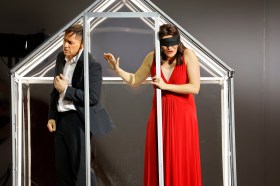
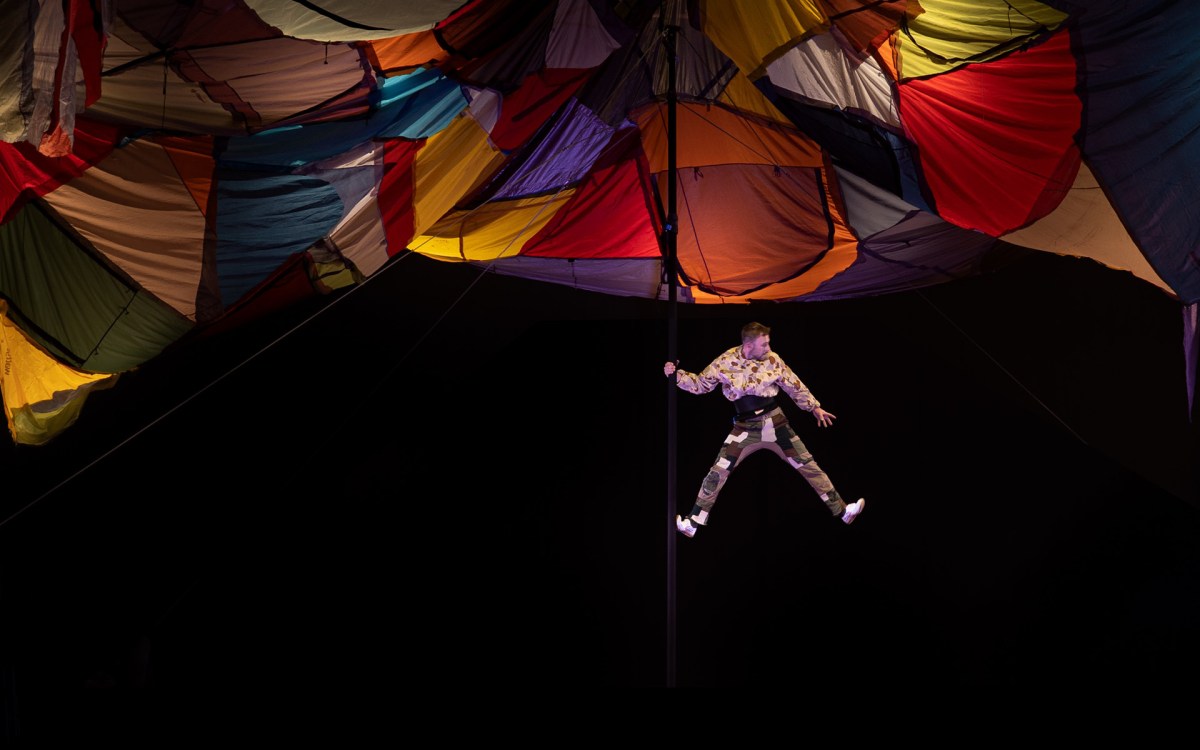
CircusWA’s Eclipse is a contemporary circus production that examines the complexities of existence in the Anthropocene. A dystopian fairy tale, it leverages the innate power of a multifacted artform to explore sociopathy and hope.
Combining contemporary circus, original music and a nuanced narrative, Eclipse explores the critical role of youth voices in building a better future. By engaging both established and emerging creatives, Eclipse simultaneously showcases and elevates youth artistry within the context of a professional production.
Yet it opens this month in Perth missing one of its key contributors, the Nigerian-born Ayuba SOQS. Despite having lived, studied and worked in Perth for eight years, residency and visa issues delayed the production and ultimately prevented SOQS from joining the performance.
Circus WA’s Eclipse – quick links
Visa issues for Ayuba SOQS
CircusWA is committed to working with youth artists like SOQS. ‘Eclipse gives young artists a platform to express their perspectives,’ says the company’s Artistic Director Jo Smith. ‘Young people face unprecedented environmental and social challenges, yet they continue to bring extraordinary creativity, resilience and hope.’
Smith sees a need to correct inaccurate perceptions and reverse attitudinal bias against youth artists. These aims drive her to facilitate opportunities for young performers to work alongside professional directors, composers, designers and musicians on high quality productions, such as Eclipse.

SOQS is one such artist, also known in Perth through his award-winning band, TAB Family. He played a pivotal role in the development of Eclipse, co-writing the lyrics that gave voice to hopes and fears revealed by youth artists during creative development. He was also tasked with performing the work alongside fellow singer-songwriter Maia Harcourt.
In 2025, SOQS was required to return to Nigeria while awaiting confirmation of his Australian Permanent Residency. CircusWA delayed presenting the finished work, hoping his application would be processed in time for SOQS to perform in Eclipse.
It wasn’t, and CircusWA advocated on SOQS’ behalf, applying for a short-term Entertainment Visa to bring him to Perth for Eclipse this July. Unfortunately, the application was rejected.
At the time, CircusWA issued a media release stating that the team was ‘heartbroken that Ayuba will not be able to join us for the premiere of Eclipse‘. The company also continued to advocate for inclusivity, with the release stating, ‘Through the arts, we work to build understanding and connection, locally and globally.’
Smith says, ‘We have Ayuba on recording, so at least his voice is still an integral part of the work, but it’s unfortunate the performance can’t include his physicality. Why are there so many hurdles in enabling him to continue his work over here? For what purpose would his visa be denied?’
Smith has a point. It is hard to understand why SOQS’ four-week Entertainment Visa was denied, considering his contract with a reputable organisation, his strong artistic credibility within Australia, and his well-established efforts towards attaining Permanent Residency. But as it happens, these kinds of opaque decisions are part of what Eclipse is trying to explore.
Tackling the Anthropocene on stage
Given that Eclipse’s most prevalent themes are environmental destruction, sociopathic leadership and the negative impacts of human existence, it would be easy to assume the artists’ perspectives have been shaped – at least in part – by nihilism, fear or despair. And that might be the case, but this generation of artists won’t give up without a fight.

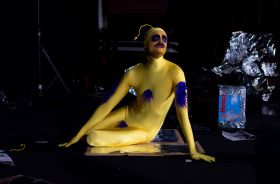
Smith describes Eclipse as beginning with ‘punk Mad Max‘ vibes, before ‘transitioning to a place of beauty and hope’.
The hope embedded within this show isn’t a simulacrum of youthful idealism. It’s a current of truth that runs directly from the artists themselves, charging the entire production with voltaic authenticity. This polarised blend of justified despair and constructive optimism isn’t specific to a particular paradigm. Rather, as Smith says, ‘it embodies a global perspective’.
Contemporary circus is the perfect language for this kind of story for reasons including, but not limited to, its inherently multidisciplinary nature, which demands intense collaboration and nuanced cooperation between artists of differing backgrounds.
Contemporary circus narratives emerge through movement, enabling audiences to feel ideas before they can consciously analyse them, thereby transcending barriers imposed by language, age or culture. Concepts aren’t just conveyed to the audience, they’re felt, both consciously and instinctively.
Bodies function as metaphors, adding symbolic depth and emotional resonance to an overarching narrative. For example, balance can be used to explore trust, stability and peace, while falling might become a metaphor for failure, abandonment or grief.
A performer dangling six metres in the air isn’t performing the illusion of danger or instability. The danger is real. There’s no need to articulate the abstract concept of precarity to an audience when they already feel it on a visceral level.
The world of contemporary circus
Eclipse’s narrative – which deals with fundamentally terrifying concepts of environmental destruction, political extremism and flawed humanity – makes strong use of suspenseful physicality and symbolism to explore its core themes.
‘What we do at CircusWA has been termed by Circa as “contemporary circus”,’ explains Smith. ‘We communicate a narrative to the audience, and hold their response as we carry them through the story.’
Australian contemporary circus companies like CircusWA, Circa, Gravity & Other Myths and Circus Oz are celebrated for the artistry, storytelling and emotional depth of their work. While this has contributed significantly to correcting misconceptions about the circus arts, old attitudes still prevail.
Contemporary circus (emphasis on the word contemporary) is a complex artform that stands its own ground, often exploring complex themes through multidisciplinary artistry and high-concept narratives. It encompasses so much more than the traditional associations around the c-word – ringmasters, popcorn and clowns.
‘The word ‘circus’ has such strong connotations,’ says Smith, in relation to outdated associations with ‘that word’. She believes the issue stems from a fundamental misunderstanding of what circus entails, and how it has evolved.
Smith laments how outdated assumptions – and a lack of understanding about the distinction between ‘contemporary circus’ and ‘circus’ more broadly – subtly undermine perceptions of the artform.
This negative bias is particularly prevalent in the context of youth circus, possibly due to internalised ageism or other socio-cultural factors. Smith believes that the circus arts often suffer from undeserved judgement, ‘even within the arts sector itself’.
Watch the trailer for Eclipse
Moving towards hope
With Eclipse’s narrative offering a resonant reflection on the state of the world, it’s hard not to notice poignant parallels in SOQS’ absence.
Could this bureaucratic decision have stemmed from misconceptions undermining circus as a serious artform? Might there be an element of discrimination against the legitimacy of youth artists? Could it just be the luck of the draw, or a hasty decision made by a hangry assessor shortly before their lunch break?
There’s no way to know. Ultimately, it doesn’t matter what caused the rejection of SOQS’ application, because the outcome can’t be changed – and that in itself is part of the problem. Do the powers-that-be share the core values of the people they represent?

This challenging question threads through Eclipse’s first act. Perhaps the next chapter of SOQS’ story will follow Eclipse’s second act trajectory, transcending chaos?
‘The hope is that he will come back, and that we can re-present this work at a later date,’ says Smith. ‘For now, Melbourne and Adelaide are the next chapters for Eclipse.’
Eclipse is more than just an entertaining production, or the physical embodiment of abstract concepts around the Anthropocene. It’s an opportunity for audiences to experience one of Australia’s most innovative artforms in an authentic exploration of beauty, chaos, fear and what comes next.
‘This is a phenomenal work of scale for a circus youth company,’ Smith says. ‘We need people to come to this show, have their hearts open, and see these extraordinary young people. We need people to listen to their stories. We need to tell them, “You’re magnificent, you’re amazing, there is hope!”‘