Unfortunately, there was to be one more glitch in the [Museum of Contemporary Art‘s] battle for secure core funding from government. Just as we were making progress on all sorts of fronts, we hit a major roadblock which showed how difficult it is to ensure that funding won’t be affected by political change.
Premier Bob Carr had announced a five-year funding commitment in 2001, and everyone expected that the renewal of the funding agreement would be a formality, especially as the process was being led by our former general manager Alan Pigott.
Alan was working on the final details of the new funding agreement [in 2025] when a bombshell hit: Premier Bob Carr unexpectedly resigned and Morris Iemma duly became premier. Alan rang me in despair to say that he had been on the point of getting our agreement signed off, but now everything was under review.
Unfortunately, our funding had never been passed over to the Ministry for the Arts – it came from Treasury. With Carr as arts minister and premier, no-one had seen this as a problem, but now was a very different scenario. Not only had we lost our champion in Bob Carr but Treasury was taking the ruler to all expenditure.
Fortunately, the new arts minister, Bob Debus, was very supportive and we had another important champion in Frank Sartor, former lord mayor, who been elected to the NSW Government in 2003. But everyone soon realised that the Treasury was looking for ways to make cuts in art expenditure. We were right in the firing line.
My heart sank when I heard informally that the Treasury’s view on the MCA was that now we had been stabilised, we could go it alone without government support. I could hardly believe it. Were we faced with re-rehearsing all those arguments? I said to close friends that I really didn’t think I could go through it all again.
I realised that we had made a mistake in relying on the premier. Although the public servants were very supportive, we needed more support at cabinet level to counter the Treasury.
I drew up a list of the new cabinet and tried to work out who might be most sympathetic. I found out that the Deputy Premier John Watkins’s daughter was studying art, so we invited him down for a tour of the museum.
We were also delighted when the new premier accepted our invitation to the chair’s dinner which we held in the galleries every year with our key business supporters. David Coe was someone whom both sides of politics respected. I had the chance to sit next to a member of Iemma’s staff and asked him what the new premier’s priorities were. I was surprised when he responded, with disdain, ‘Mental f***ing health.’ When I said that was an admirable concern, he replied, ‘Try selling that to the voters.’
I knew this kind of attitude was not coming from someone we were likely to win over. However, armed with this knowledge, we set out to convince the premier himself that the MCA could help him with his agenda.
Like most politicians, he didn’t know much about what the MCA did, other than the exhibitions, which he had never visited. He was particularly interested in the Bella program, which had become one of our most important initiatives for young people with special needs, and the work we were doing in Western Sydney.
We were also able to point to an ongoing project that arose from the 2004 Biennale of Sydney, curated by Isabel Carlos, which demonstrated the role that contemporary art can play in mental health … [Despite progress with the premier] we had tried to engage the treasurer, to no avail. He refused all our invitations, so I resorted to subterfuge.
The events team had tipped me off that he was coming to an event in the [Museum of Contemporary Art’s] Foundation Hall. I hung around in the foyer and when he arrived, went to greet him. I said I wanted to offer a personal tour of the museum when he could spare half an hour. He muttered something and kept walking as his minders ushered me away.
Eventually, the proposal to renew our grant was taken to the cabinet. Someone told me afterwards, confidentially, what happened. The treasurer opposed the renewal, at which point the normally mild-mannered Minister for the Arts Bob Debus yelled at him, ‘When are you going to cease this jihad against the arts?’
Apparently everyone was so shocked at this out-of-character outburst (which nonetheless struck a chord) that the funding proposal, supported by the premier and the deputy premier, was passed forthwith.
The Ministry for the Arts quickly made sure that this funding was now part of their portfolio so we would not have to go through all this again in five years. We expected to be assessed against our objectives in order to justify the funding but at least we would not be subject to the vagaries of political upheaval. We were also fortunate that Frank Sartor’s desire to become involved in the arts again came to fruition a couple of years later, when he became minister for the arts.
Once the government funding was secured (again), a major focus for Euan [Upston, Chief Operating Officer] was the lack of storage for the collection. Thanks to the generosity of the Coe and Mordant families, we had been acquiring work, and although we were very cautious about the number of works we acquired each year, the collection had nonetheless outgrown the onsite storage facility.
Also, as Euan pointed out, storage was not a great use of a piece of prime real estate. He began to explore possible options for offsite storage which would allow us to expand the galleries on Level 4 … [He] eventually came to the board with a proposal for offsite storage in a building owned by the NSW Government that the arts ministry was keen to secure for arts organisations.
The former Army parachute regiment store in Lilyfield was to be renovated for storage for the Australian Opera, among others. However, the standard of building required for art storage is much higher … Euan proposed that we raise funds to adapt the building for storage and, using his consummate negotiating skills, persuaded the arts ministry to agree to a level of rent commensurate with our capital input.
We knew that this project would only appeal to a certain kind of donor, one who wanted to help the museum fulfil its potential and was not concerned about public recognition. We found one, a family foundation that preferred to remain anonymous, which gave us the required $1 million. The agreement was signed and Euan began the work of transforming the parachute building.
The prospect of moving storage offsite had given us the opportunity to create more gallery space … [Architect] Sam Marshall was delighted when we told him we were ready to implement one stage of the building improvements, the conversion of the storage space into galleries once the collection moved out. He duly produced the design, working closely with Euan and the install team.
In the course of these changes to the collection storage, we decided we needed to find out what John Kaldor’s intentions were regarding his collection, which the MCA had been storing since 1997. Because of the pressure on our storage, the board had decided that we could not continue to store works we did not own, with the exception of the Power Collection, for which we had a legal obligation to the University [of Sydney]. As we were therefore not in a position to keep the Kaldor collection on long-term loan, John made his own arrangements for storage.
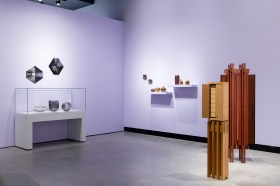
The collection storage move offsite was transformative. We now had extra space to display the collection, especially important now that we were acquiring work again. The launch exhibition across the whole floor was of new acquisitions alongside other works from the collection.
However, as the MCA’s audience continued to grow and its programs expanded, the building’s shortcomings, including poor circulation, access to some galleries only via a goods lift, a lack of facilities for education groups, cramped foyers and no outside signage, became more acute.
One day, I got a call from a board member saying he couldn’t get into the building for the board meeting as the foyer was crammed with schoolchildren. We were now attracting not only more general visitors, but more school groups, which had to check in their bags in our small foyer.
I realised I would have to overcome my resistance and consider expansion.