This exhibition has been a long exhibition in coming for the National Gallery of Australia’s Head Curator Australian Art, Dr Deborah Hart, whose early interactions with the artist Rosalie Gascoigne had spanned the decade before her death in 1999. That deep knowledge carries a sincerity across this major retrospective – the most significant look at her work in three decades.
Rosalie Gascoigne review – quick links
Largest consideration of her work, and its impact
This exhibition is large, and that scale is part of its pleasure. The last significant survey, Rosalie Gascoigne: Material as Landscape, was presented at the Art Gallery of New South Wales in 1997. Gascoigne was still alive, and that exhibition included 30 works. The NGA’s presentation brings together more than 80 in the upper level one galleries, giving her practice a breadth and depth rarely experienced in one place.
Plus, the exhibition will travel to nine regional venues, extending access well beyond Canberra. It offers a timely opportunity to reconsider Gascoigne’s contribution to Australian art and introduce her practice to a new generation.
Familiar works sit among rarely seen pieces, inviting unexpected connections across her career. The result is a portrait of an artist whose restless experimentation offers a reminder that creative transformation can happen at any age. Gascoigne did not begin exhibiting until she was 57 and her rise was meteoric – driven by some unnamed quest to constantly be bolder in her expanded vision of the Australian landscape – until her death at 82.
Walking through the exhibition, each room has its own identity, and unfolds into the next. Although the exhibition is organised by material, it is clear to viewers that Gascoigne was collecting and working with these materials concurrently. The arrangement makes visible the persistence and interconnectedness of her practice without imposing a false sense of linear development.
An eye for the landscape
In those early years, when Gascoigne first arrived at Mount Stromlo (outside of Canberra) to join her new husband, astronomer Ben Gascoigne, in 1943, she would forage the landscape on foot for her materials. It was six years before she bought a car, and that intimacy with the landscape proved fundamental to her practice. It allowed a different speed of engagement, one shaped by shifting weather, and the faded colours and patinas left by time. So by the time she started showing in 1957, her eye was already so attuned.
In many ways Gascoigne came to making through the Japanese tradition of ikebana, and we see examples of those earliest works from the 1960s in this exhibition. She was still wrestling with her identity as an artist, but an encounter with Japanese ikebana master Sōfū Teshigahara in 1967 proved particularly significant. When Gascoigne gathered grasses for his arrangements, he reportedly praised her eye for material, an affirmation that stayed with her.
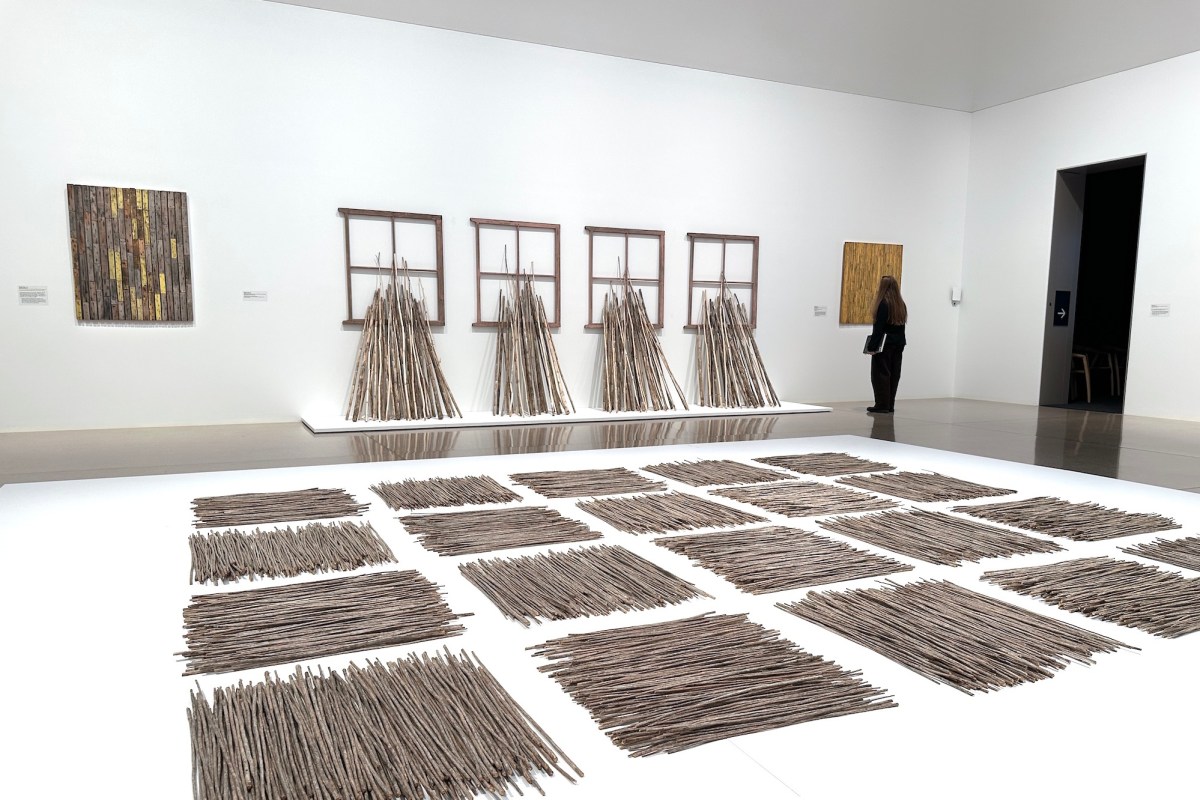
This retrospective is simply a celebration of that eye. And visitors tap into this environmental sensitivity as they move from room to room. It is particularly evident in Piece to walk around (1981), a floor work clustering sun-aged thistle stalks in a grid that evokes a tessellated landscape or aerial view of fields.
Gascoigne moves easily between floor and wall. Nearby, Take over bid (1981) brings the same stalks into conversation with wall-mounted frames. This is not simply an Australian landscape, but the landscape of the Monaro.
That grid structure is repeated again and again in her work, and is an easy connection for viewers to follow across differing material. ‘She really envisioned the way that we see place,’ Hart says, describing Gascoigne’s work as possessing ‘remarkable vitality’. It is hard to disagree. The retrospective makes a compelling case for an artist whose sensitivity to the ordinary produced work of extraordinary subtlety and reach.
Gascoigne’s place in Australian art
Gascoigne’s evolution traced a parallel journey to Australian art through the 1970s and 1980s, with its awakening and celebration of new forms of making: assemblage, abstraction, minimalism, installation and conceptual art. This exhibition offers touchpoints through that trajectory.
Rather than following a chronological sequence, viewers get a sense of Gascoigne working out these new ideas through found materials, and once harnessed, distilling them into deeper, more rigorous dialects. A great example is Eighty-nine parrots (1981), constructed from Arnotts biscuit packaging, and its pathway to the later work Parrot country (1980-83). Unusual for its vibrant colour and jagged edges, it seemingly captures the squawk of these birds.
Gascoigne described the parrot to Hart as being to her what Ned Kelly was to Sidney Nolan: an enduring subject through which to explore the Australian landscape. This piece is owned by Museum of New Zealand Te Papa Tongararewa and rarely seen in Australia.
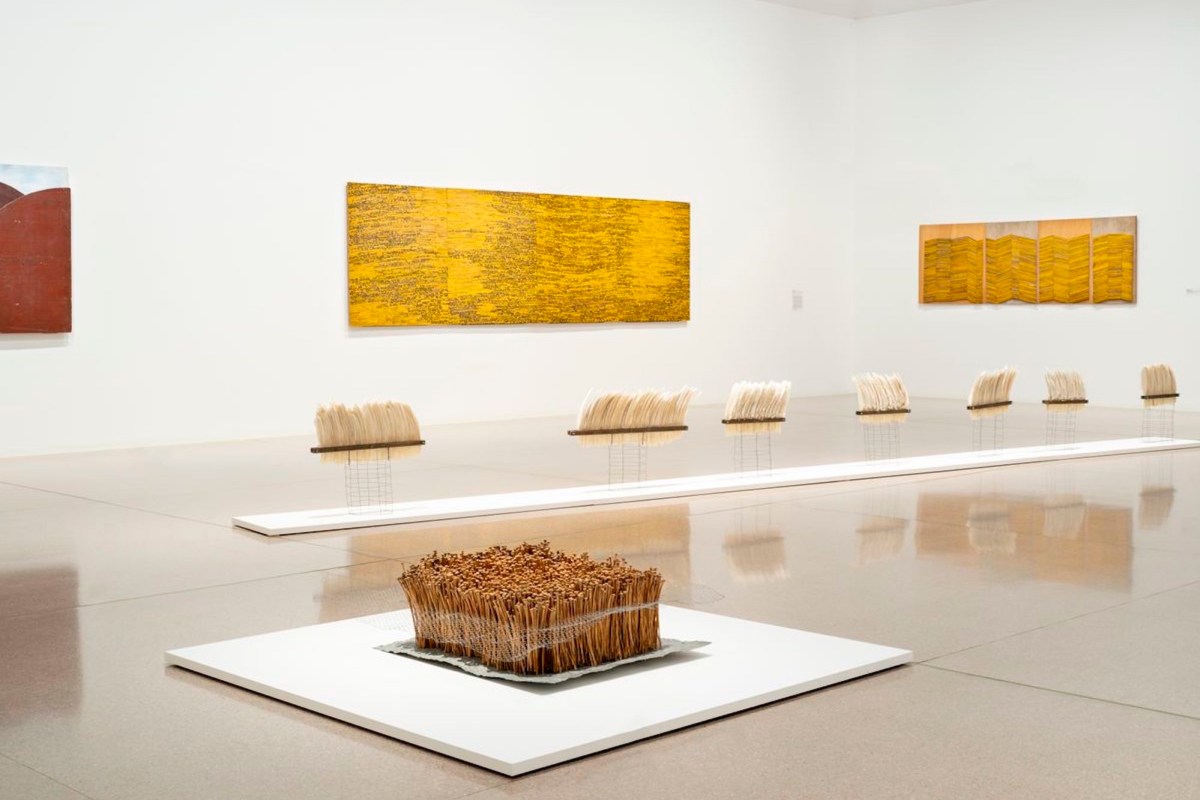
Across the exhibition we are witness to that birdlife becoming less literal as she began working with feathers. Feather fence (1978-79), which sat in her front lawn before being included in Nick Waterlow’s landmark 1979 Biennale of Sydney exhibition. It is one of the retrospective’s anchors. Hart describes it as an attempt to convey the spaciousness of the environment and that intangible element of air.
Another gem of a work is Feathered chairs (1978), a recent NGA acquisition whose Duchampian quality introduces a wry note. The exhibition also reveals the evolution of Gascoigne’s approach to domestic materials. It moves from enamelware, boxes and window frames to lino flooring with its pattern and colour, eventually becoming a vehicle for abstraction in her hands.
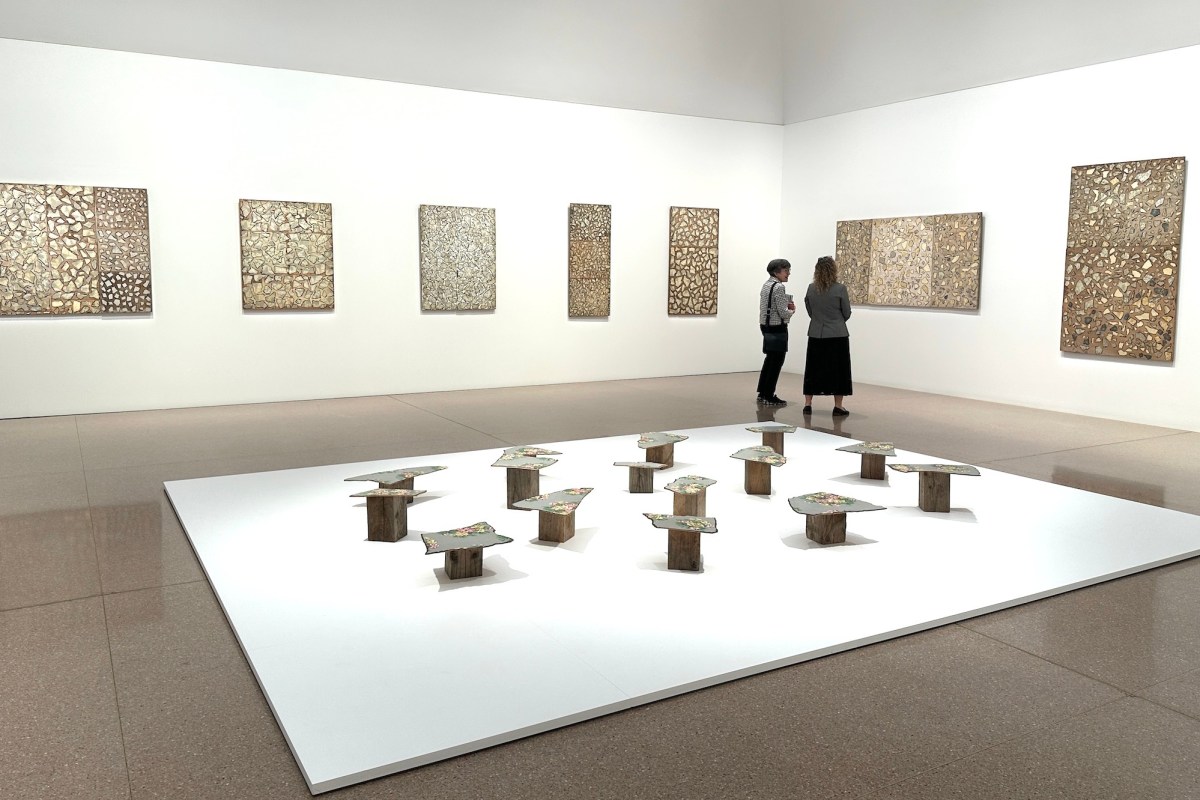
Visitors witness that progression from the floor-based Stop through (1977), with fragments literally mounted on timber blocks, to later works that almost become more painterly. It is a gift to be able to absorb them in volume.
A nice transition in this retrospective, sitting alongside her lino abstractions, is a small room with a 10-panel work created from used formboard. Earth (1999) was made in the final months of her life, and is rarely exhibited. Today it is part of the NGA’s holdings. While a more sombre work, it has an ethereal Rothko-esque quality. Our brains are hardwired to smell pungent sod, and this low-lit room triggers many emotions. It is a fitting reminder of how far Gascoigne’s visual language had travelled.
The belly of a career: drink crates and road signs
For many visitors, Gascoigne’s drink crate assemblages, concentrated within the central spaces, will be the familiar anchor in this exhibition. Their origins trace to 1978, when the artist discovered a bottle depot in Queanbeyan. The crates opened up a new material vocabulary for Gascoigne, with their fragments of lettering and weathered surfaces offering both structure and the possibility of abstraction. They also connected Gascoigne to the period’s broader interest in text-based art. Yet, she makes the material and its existing inscriptions entirely her own.
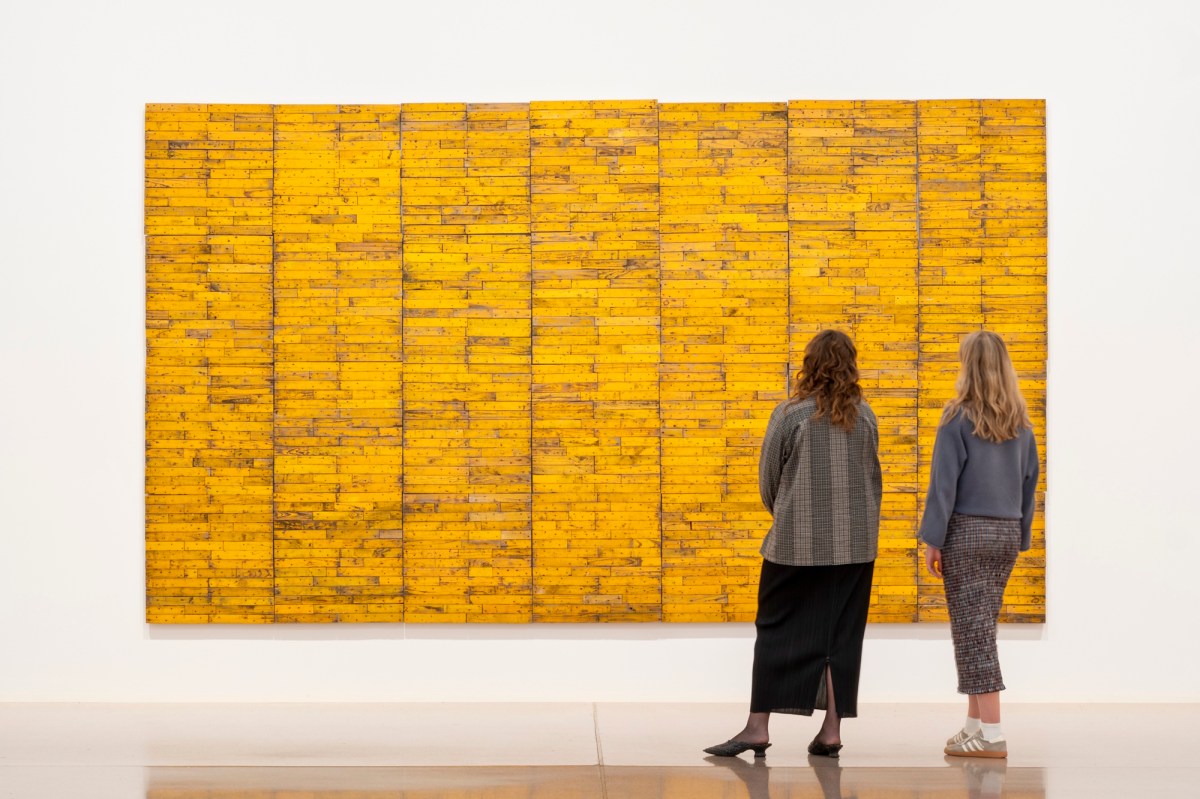
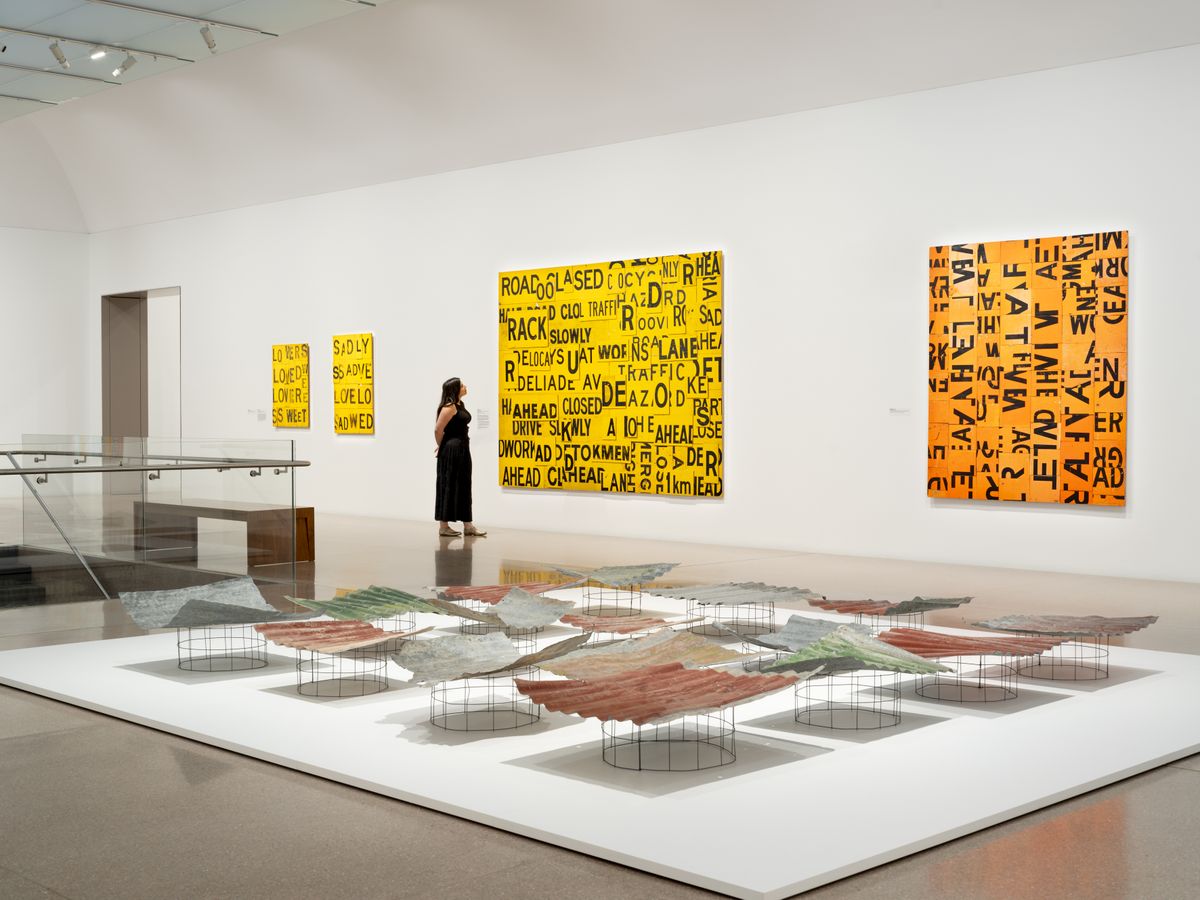
Over two decades, the lettering moves from legible wordplay towards abstraction, and eventually carries into her works using reflective road signs. It is fascinating to see March past (1978-79), her first work made from soft drink crates, within sight of her expansive four-panel work Monaro (1988-89), made from those iconic yellow Schweppes crates, where the words seemingly roll across the surface like hills, their meaning dissolving into rhythm and pattern.
This same gallery space brings together her first reflective road sign work, Highway code (1985), with her last, Metropolis (1999), which was made in the year of her passing – offering a chance to consider a 14-year obsession across a couple of meters. These are incredible moments in exhibition-making. Further, the sightlines between the rooms gently connect viewers across the different series, seemingly leapfrogging us forward in excitement.
Conversations beyond Canberra
The person behind the work is also present. Gascoigne grew up during the Depression in Auckland, and there is a palpable sense of resourcefulness in her embrace of materials. Her years at Mount Stromlo brought their own isolation, and there is a no-frills stoicism that also sits beneath these works. And yet, poetry was her constant companion from an early age, and its sense of metre, clarity and compression persists throughout her practice. Indeed, Hart aptly describes her work as ‘the poetry of [the] commonplace’ in the exhibition’s publication.
One of the more intimate discoveries in the show, is a seemingly benign quilt Gascoigne sewed during her early years at Mount Stromlo, when she was negotiating the expectations of motherhood and marriage while searching for an artistic voice. It offers a glimpse of the life behind the assemblages, without reducing the work to biography.
Similarly, Pink window (1975), one of her earliest works, carries a personal resonance – Gascoigne later described it as being about loneliness.
‘Chance is a wonderful thing and nature is full of it,’ Gascoigne once said. She described setting out in her station wagon, hoping that turning right rather than left might lead her to something unexpected. This exhibition invites us to do the same: to look more closely, follow a hunch and discover the possibilities in things we might otherwise overlook.
Hart guides that journey with great sensitivity, revealing a practice not defined by a conventional career trajectory but by a lifelong cycle of observation, collection and reinvention.