By Ianto Ware, University of Sydney
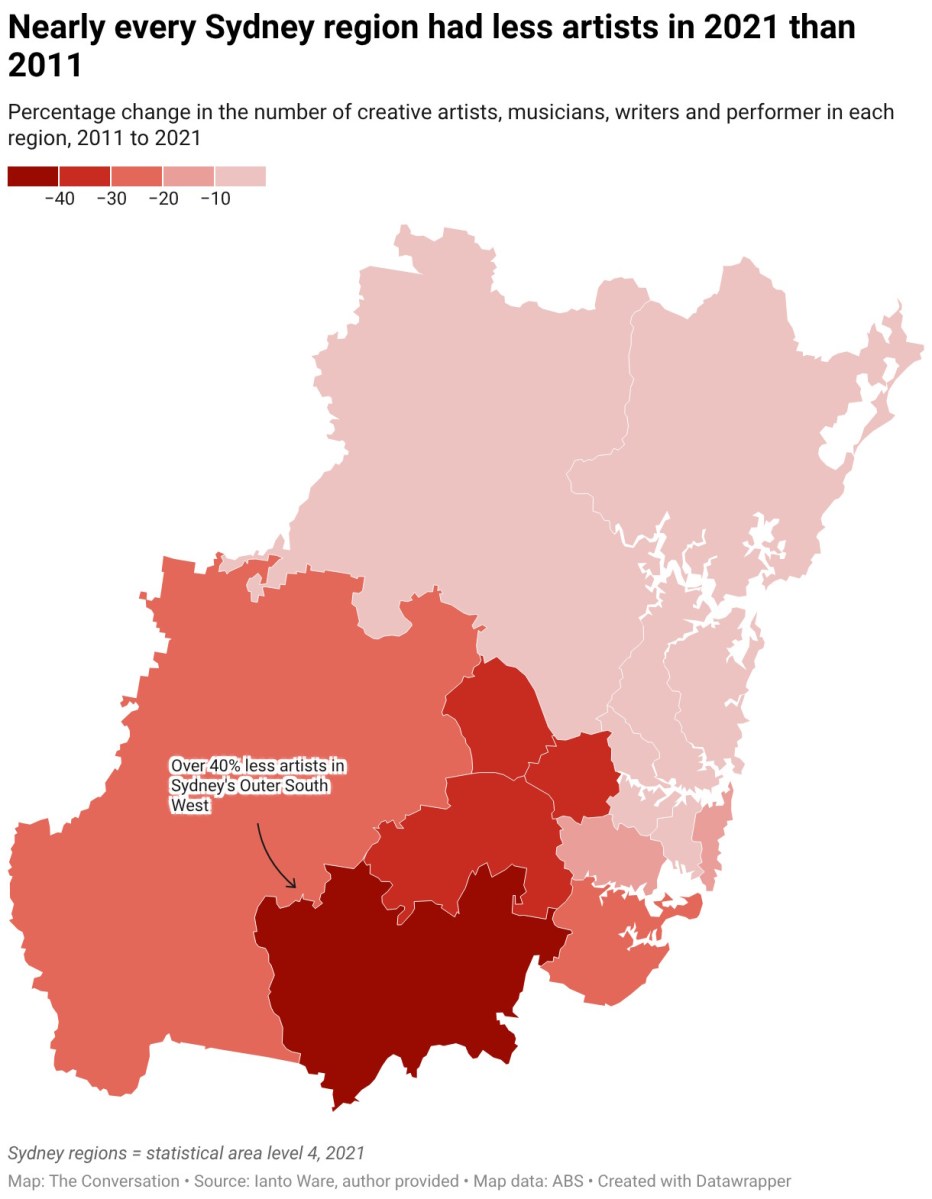
Between 2011 and 2021, the number of professional artists, writers, musicians and performers living in Greater Sydney shrank by 17% – even as overall employment increased by 20%.
This didn’t happen anywhere else in Australia. On the contrary, most of the other capital cities had growth of artists above the rate of employment.
Among Sydney’s policy makers and art sector, there’s an entrenched belief the decline is specific to the inner city, with increasingly diverse artistic communities migrating out to the western suburbs.
But the data consistently shows the opposite: the artist population fell in all areas of Sydney, becoming less diverse, both racially and economically. And a new survey suggests things are probably getting worse.
Exploring the data
I first saw this trend in 2021, analysing data from that year’s census. I wasn’t surprised. Working in the cultural strategy team at the City of Sydney we’d already seen the drop in the 2016 census. Our own research showed a 28% decline in creative spaces – studios, rehearsal rooms, small galleries and venues.
Still, so many people insisted Western Sydney’s creative community was growing that I tried cutting the data in different ways. I always came up with the same results.
As the census only allows you to list one profession, and most artists have day jobs, I also checked the Australian Bureau of Statistics’ participation in select cultural activities data. That shows both ‘participation’ and ‘paid participation’ across a variety of art forms.
But the trend was the same: an overall decline across Greater Sydney, not an outward migration. Proportionally, more artists now lived in the inner city.
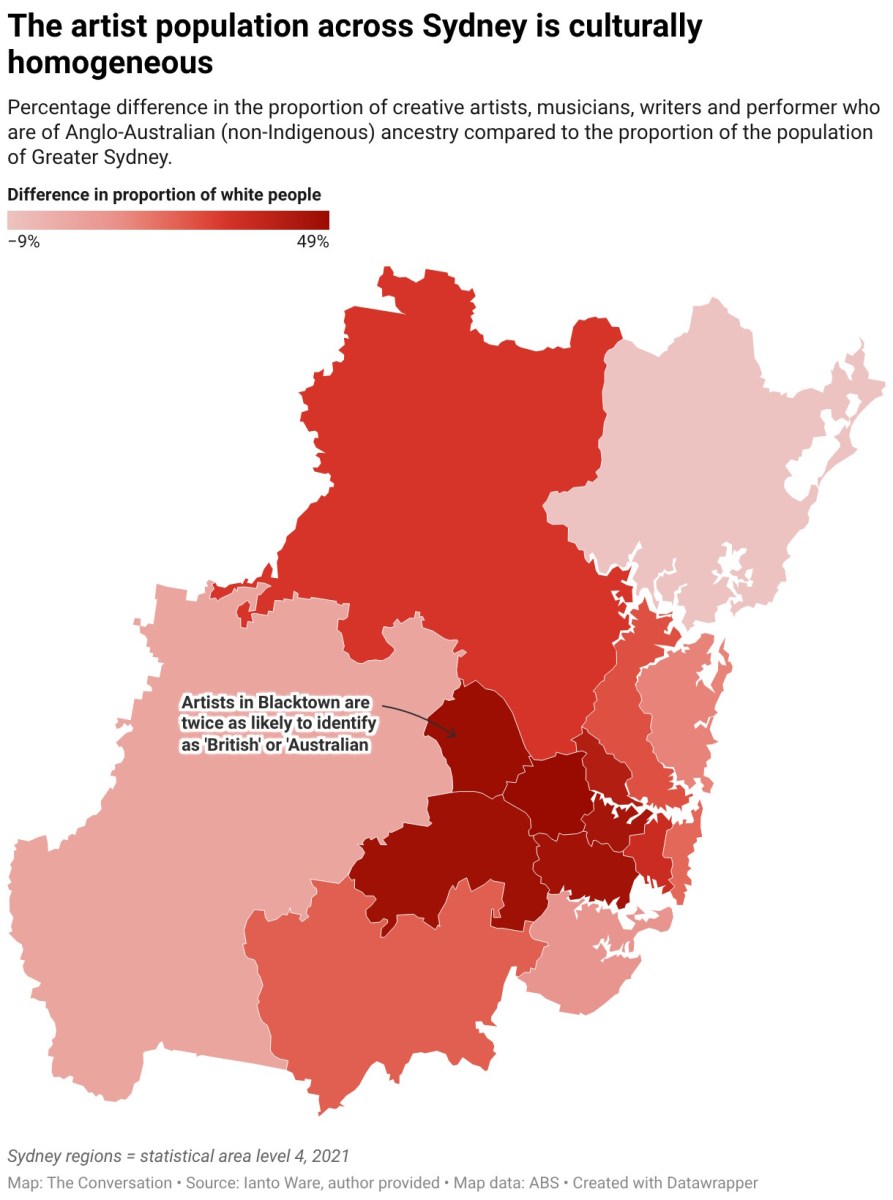
Western Sydney’s artists did show greater signs of cultural diversity, but it was relative. You can see this better if you look for ‘homogeneity’ rather than ‘diversity’.
In the census, there’s an over-representation of artists who list their ancestry as either ‘British’ or ‘Australian’, excluding those who identify as Indigenous. In 2021, this Anglo-Australian demographic made up 43% of Greater Sydney’s population, but for artists it was 63%. In Western Sydney, it was 37% of the whole population, and 59% of artists.
That means Anglo-Australian artists were over-represented by about 20% in Greater Sydney, and 22% in Western Sydney. Although the portion of Anglo-Australians declined across both areas between 2011 and 2021, the rates of over-representation remained consistent.
Measuring incomes
I also worked through a range of income stats, which produced another surprise: professional artists were uniformly over-represented in higher income households, across all regions.
It seems counter intuitive. David Throsby and Katya Petetskaya’s 2025 report for Creative Australia found artist incomes were ‘notoriously unstable and uncertain’, well below the average income.
But they also found ‘one quarter of artists depend on the support of a partner or family member’. Other research supports this finding, with artists more likely to be in a marriage or de facto relationship than the rest of the working population.
This is probably what we see within the household income data: below average personal income is offset by higher family or partner income. This support has probably grown more important as living costs have increased.
Surveying artists on housing and income
In 2025, to understand how household income, ancestry and geographic location impacted on creative practice, my colleagues and I released our own survey.
Of the 300 professional artists who responded, 57% were considering leaving Greater Sydney, and 80% had colleagues who had already left. You could see why. Housing costs were, on average, around 40% of income. We used an existing formula to estimate workspace costs: artists were paying three times more than they could afford for studios and rehearsal rooms.

After factoring in housing, workspace, tax and the expenses of art practice, the average professional artist was living on somewhere between A$7,816 and $10,640 per year. That’s not viable in a place like Sydney.
We also included questions on annual income. Compared to Throsby and Petetskaya, we found artists earned less from their art, and were more reliant on other income sources. Only around 20% of professional artists had received funding from state or local governments, and only 13% from federal sources.
The sample size was too small to be certain, but it looked like the people who did get funding were concentrated in inner city locations, and came from the narrower racial and household income cohort.
The changing face of the artist
Living and housing costs have an obvious impact on who gets to make art, or at least who gets to do so professionally. As those costs have eclipsed even the most generous funding programs, Australian arts policy is probably losing its impact and pooling resources within demographics who are economically better insulated.
This explains the homogeneity I observed among higher income, inner city households, which skew towards Australian and British ancestry. Artists haven’t migrated outward to places with cheaper rent. They’re coming from demographic clusters where rent isn’t so much of an issue.
None of this is specific to Sydney. The city has been ahead of the bell curve on housing and living costs for a long time but is no longer unique. In the lead-up to the 2026 census, people are already assuring me artists have moved to Melbourne, or Brisbane or Hobart. You could make that case out of the 2021 census data, but those figures are five years old.
Housing and living costs have gone up across Australia, and cultural policy is surprisingly uniform across state lines. When the next batch of data comes out, it may well show the trend has spread beyond Sydney.
Ianto Ware, Honorary Associate, Department of Gender and Cultural Studies, University of Sydney.
This article is republished from The Conversation under a Creative Commons license. Read the original article.
Discover more screen, games & arts news and reviews on ScreenHub and ArtsHub. Sign up for our free ArtsHub and ScreenHub newsletters.