Sydney Contemporary 2026: standout booths, artists in demand and the energy on the ground

Did Sydney Contemporary’s 10th anniversary edition feel different, and what were the standout booths at Australasia’s largest art fair?
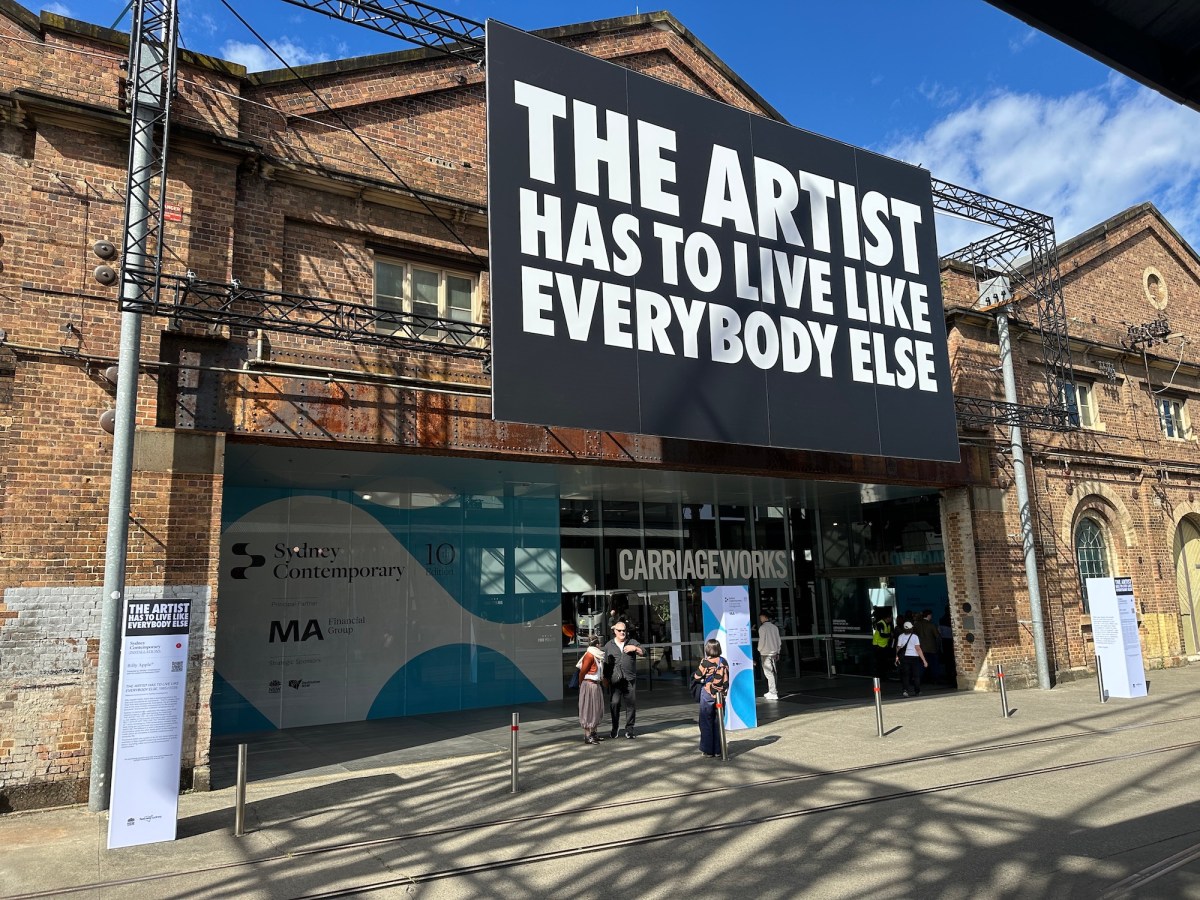
Billy Apple®, The Artist Has to Live Like Everybody Else, 1985/2009. Installation view, Sydney Contemporary 2026, Carriageworks. Photo: Gina Fairley. Courtesy: the artist, 1301SW and STARKWHITE.

As punters arrive at this year’s Sydney Contemporary art fair, the first artwork they encounter is a billboard-sized declaration across the industrial façade of Carriageworks: THE ARTIST HAS TO LIVE LIKE EVERYBODY ELSE.

The work by late Aotearoa/New Zealand artist Billy Apple® feels particularly pointed in 2026. At a moment when the arts sector continues to feel the economic squeeze, this deadpan reminder that artists have bills to pay lands somewhere between slogan, provocation and plea.

Presented by 1301SW | STARKWHITE as part of Installation Contemporary, a section of the fair curated by University of New South Wales Galleries Director José Da Silva, it is also a neat curtain-raiser for a fair in which the question of sustainability – for artists, galleries and the market itself – is impossible to ignore, especially given the fair’s 10th anniversary.

ArtsHub: Ten editions on, has Sydney Contemporary kept its big promises?

Sydney Contemporary founder Tim Etchells put it plainly when welcoming media: ‘We are very focused on sales, because at the end of the day, if the galleries don’t make sales, quite simply they won’t come back.’

Yet economic caution has not dampened the mood of this anniversary edition. If anything, there is a welcome confidence on the floor, helped by news that one artist’s presentation had sold out within an hour of Wednesday’s VIP Preview.

Across more than 100 exhibitors and 500-plus artists there is, inevitably, a lot to absorb. But certain booths cut through the visual noise. Who was that sell-out star of 2026? What were the other standout booths, and does Sydney Contemporary’s anniversary edition feel different for visitors? Let’s take a look.

Sydney’s Sabbia Gallery again makes ArtsHub’s list of leading presentations, following the gallery’s transformative space last year, which took viewers into the fantastical world of Adelaide glass artist Tom Moore and Nick Mount. 

This year Sabbia continues its successful split-booth model, pairing two mini-exhibitions: First Nations Adelaide ceramicist Alfred Lowe on one side and Canberra glass artists Annette Blair and Kirstie Rea on the other.

The pairing may seem unlikely, but it makes perfect sense. All three artists are demonstrating how material-led practices once too readily filed under ‘craft’ now sit comfortably within the contemporary art market. And, Lowe is indisputably having a moment – winner of the MA Financial Emerging Artist Award at Sydney Contemporary in 2024 and the 2025 Rigg Design Prize, his new body of work sold out within an hour of the VIP Preview.

Work by Annette Blair and Kirstie Rea, presented by Sabbia Gallery at Sydney Contemporary 2026. Photo: Adam McGrath.

Similarly, Blair has just been awarded this year’s Fuse Prize for glass, and Rea has recently returned from Singapore, where her work was a finalist in the important Loewe Foundation Craft Prize.

Last year I predicted we would see more glass creeping into Sydney Contemporary, and that shift is now becoming visible. There are playful glass objects by Floria Tosca at Nanda\Hobbs, minimal light-and-glass works by Cobi Cockburn at Dominik Mersch Gallery, Jessica Murtagh’s sandblasted urns at Martin Browne Contemporary, Louis Grant’s quirky sculptural installation for Sabbia and Lynda Draper bringing glass into conversation with ceramics at Sullivan+Strumpf.

What Sabbia has done particularly well over time is not simply argue that craft belongs within contemporary art – that argument feels increasingly redundant – but demonstrate its collecting gravitas within a highly competitive commercial environment.

New Zealand galleries shine at this year’s Sydney Contemporary

Gow Langsford Director Gary Langsford tells me Sydney collectors like colour, energy and texture. He laughs, however, because this year the Auckland gallery has gone in almost the opposite direction. After last year’s punchy bubblegum-green booth – complete with an ox-like sculptural painting support carrying Dale Frank’s work – the 2026 presentation is an exercise in restrained blacks and whites.

Work by Bosco Sodi and Tony Cragg on view with Gow Langsford at Sydney Contemporary 2026. Photo: Gina Fairley.

The calibre of Gow Langsford’s presentation continues to mark the gallery as a leader at this fair, and its focus is on excellent offerings by international artists Tony Cragg, Lee Bae and Bosco Sodi, among others, moving across stainless steel, charcoal, textile, pigment and paint.

Colour arrives through Yuki Kihara’s embroidered pandanus works that respond to Tropical Cyclone Harold, which passed through the Pacific in 2020. While in concept they are similar to the extreme weather carpets of Swiss artist Franzieska Further, exhibited at the NGV Triennial in Melbourne in 2023, the use of pandanus for traditional storytelling, and the artist’s work with communities impacted by Harold, give these pieces their own authenticity.

Gow Langsford is just one of a notably strong Aotearoa New Zealand contingent this year. At PaulNache, Tūranganui-a-Kiwa Gisborne sculptor Glen Hayward delivers one of the fair’s quirkiest installations, Better Paul Saul.

Work by Glen Hayward exhibited with PaulNache at Sydney Contemporary 2026. Photo: Gina Fairley.

Here, Hayward has taken surveillance cameras and signage seen in London, Austria, Switzerland, Sydney and New York and painstakingly hand-carved them in wood. They are objects we normally ignore precisely because they are everywhere, but here, their mass absurdity becomes impossible to miss.

Another clear standout booth is 1301SW | Starkwhite, which operates across Melbourne, Sydney and Auckland. At the top end of the gallery tier, its group hang is confident without being overcrowded, pushing material relationships around what Director Max Homaei describes as ‘the unseen, overlooked or forgotten’. It is easily among this year’s best booths.

A paint-soaked paper work by Hadieh Shafie, with its text almost swallowed by the surface, is a highlight, as is a punchy wall piece by Márton Nemes positioned against Jonny Niesche and Mark Whalen’s casually priced, $80,000 marble floor sculpture Lucky Fingers.

With works sitting in this upper price band, I loved that visitors can walk away from 1301SW | Starkwhite with a free BILLY APPLE ART FREE FOR THE TAKING print or one of his ‘receipt of sale’ shirts from the PAID series. Apple is known for his lifelong blurring of art and economics, an ideal that feels especially apt at this year’s fair.

The big galleries: where polish pays off

Among the Australian heavyweights, the strongest booths are those that resist simply lining up trophy works and hoping name recognition will do the rest.

Annandale Galleries returned to the fair this year, and has scale on its side. Its drawcard is clear – new works by internationally renowned South African artist William Kentridge – an artist much favoured by the Australian market. His works spills beyond the booth into Installation Contemporary with a suite of substantial bronzes – showstoppers indeed.

Michael Reid is another gallery that puts on a big production fair booth, with a build out of walls, tote bags and a magazine – and it delivered that high standard again this year in doses.

Olsen Gallery at Sydney Contemporary 2026. Photo: Gina Fairley.

But it was Olsen Gallery, another of Sydney Contemporary’s consistent exhibitors, that got the balance right this year, creating enough variation and breathing space to maintain energy across a large footprint. Visitors are drawn into the booth by a wall of new ceramic pieces by Stephen Bird. That’s followed by a strong group of works by Stephen Ormandy, digital prints by Joseph McGlennon and pieces by Aaron Crothers and Evie Adasal, which add an alternative dimension and visual abstraction. It is simply just a lovely curated selection that sits well together.

One of Australia’s powerhouse galleries, Sullivan+Strumpf, was the talking point among collectors this year, thanks to an incredible suite of new paintings by Gregory Hodge that expand his current Melbourne exhibition. At first glance their surfaces appear collaged, or physically constructed, but upon closer inspection they are a kind of micro-version of Hodge’s signature gestures. My guess these works will remain a talking point for some time.

Adding some international muscle is Messums London, with significant sculptures by Laurence Edwards, while works by Korean photographer Koo Bohnchang can be found at Gallery LNL, a gallery that caught our attention last year for its Moon Jars and is being watched.

Elsewhere Melbourne gallery Neon Parc placed its investment in a new series by Darren Sylvester that rewards attention, while Roslyn Oxley9 focussed on Jenny Watson in its booth, and Kirtika Kain’s Midnight, as part of Installation Contemporary.

The monumental suspended work is presented in a darkened space alongside Photo Sydney, and is one of the fair’s anchors. Kain is currently in France ahead of her participation in the 18th Lyon Biennale, making Midnight feel like a timely encounter with an artist whose international trajectory continues to accelerate.

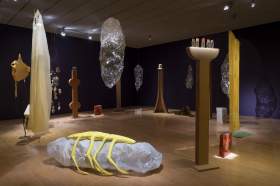
And then, of course, there is Mike Hewson, who recently joined Roslyn Oxley9 too. His palm trees and construction materials seem to take a pit stop from their showing in The Key’s Under the Mat at Art Gallery of New South Wales before heading into storage. Hewson has transformed the fair’s café, as well as taking up major real estate in the main hall, adjacent to the gallery’s booth, with the makeshift fountain Frog Pond. It is playful, slightly ridiculous and hot conversation among collectors – which may also be the clearest reading of Sydney Contemporary at 10.

But if there is a broader observation here, it is that scale and reputation don’t automatically make a great art fair booth. Some of the biggest galleries play things surprisingly safe this year, and some are frankly disappointing.

Noticably also, some of the top end players are absent this anniversary edition, such as Melbourne galleries Tolarno and Anna Schwartz – which perhaps asks question of the scale of collecting in Australia and the shifting art fair model.

Who shines in Futures, Works on Paper and Photo Sydney?

One gallery doing exactly that is Sydney’s Syrup Contemporary, which impresses across both the Futures and Works on Paper sections of the fair. Its Works on Paper presentation centres on self-portrait prints by Mike Parr spanning 2016 to 2026, while Futures pairs atmospheric media artists David Haines and Joyce Hinterding with emerging painter Eleni Ioakimidis.

Ioakimidis, a recent National Art School graduate, has an explosive confidence with colour and gesture, and her work feel completely at home with Syrup, a Marrickville gallery founded in 2024 by artists Carolyn Craig and Damian Dillon.

The gallery describes itself as bridging the gap between artist-run initiatives and formal commercial representation, and there is something refreshing about seeing a two-year-old operation confidently rubbing shoulders with established dealers. That is what Futures should do.

Works on Paper, meanwhile, feels less congested than in previous years and has almost shaken off its occasional jumble-sale energy. Almost. There remains an over-reliance on tight salon hangs of small works. That may partly reflect the current market – lower price points offer an accessible entry for buyers – but I would still like to see more galleries take risks with scale. Onespace from Brisbane does this with pieces by Teho Ropeyarn and Brian Robinson, and the booth immediately benefits.

Photo Sydney, by contrast, gets the equation right in its second outing. Curated by Sandy Edwards, it is open, airy and allows enough space to properly encounter individual practices. In 2026, it feels like it has found its stride.

More than any other section of the fair, it favours solo presentations – often by self-represented artists – over dense group hangs, and that clarity significantly lifts this section and gives it a different rhythm.

Among the highlights is Cybele Malinowski’s fascinating DEEP FAKE series, along with presentations by Alexia Sinclair, Caterina Pacialeo and Litsa Veldekis. And then there is Hugh Stewart, one of Australia’s leading portrait photographers who is shooting visitor portraits at the fair for $60 – a fun, democratic addition and, for artists perpetually in need of a decent professional headshot, possibly one of the fair’s most practical acquisitions.

And the take away?

In a cautious economy, Sydney Contemporary 2026 does not succeed by pretending conditions are easy. Instead, its best exhibitors respond with sharper curating, stronger material thinking and, occasionally, a welcome dose of weirdness.

Billy Apple’s message may greet visitors at the door – THE ARTIST HAS TO LIVE LIKE EVERYBODY ELSE – but inside, the fair makes another case just as forcefully – that artists also need people prepared to take risks on them. This is underscored in the Collector’s Lounge, where curator Sebastian Goldspink has brought together significant works acquired over the last 10 editions of the fair – a kind of affirmation or endorsement in that hub where collectors take a pause with a Pommery champagne.

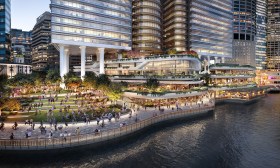
Meanwhile, the masses can walk away with a portrait by Hugh Stewart or a free art poster by Billy Apple®. It is this democratising of art that is perhaps Sydney Contemporary’s greatest success, testament by a year-on-year growth of visitor numbers. And by taking this fair beyond the Carriageworks precinct this year with pop up installations at Sydney Fish Markets and Barangaroo, talk of best booths and sales start feels almost superfluous.

Sydney Contemporary 2026 is presented from 3 to 6 September at Carriageworks, Sydney.

Discover more screen, games & arts news and reviews on ScreenHub and ArtsHub. Sign up for our free ArtsHub and ScreenHub newsletters. 

Gina Fairley is ArtsHub's Senior Contributor, after 12 years in the role as National Visual Arts Editor. She has worked for extended periods in America and Southeast Asia, as gallerist, arts administrator and regional contributing editor for a number of magazines, including Hong Kong based Asian Art News and World Sculpture News. She is an Art Tour leader for the AGNSW Members, and lectures regularly on the state of the arts. She is based in Mittagong, regional NSW. Instagram: fairleygina