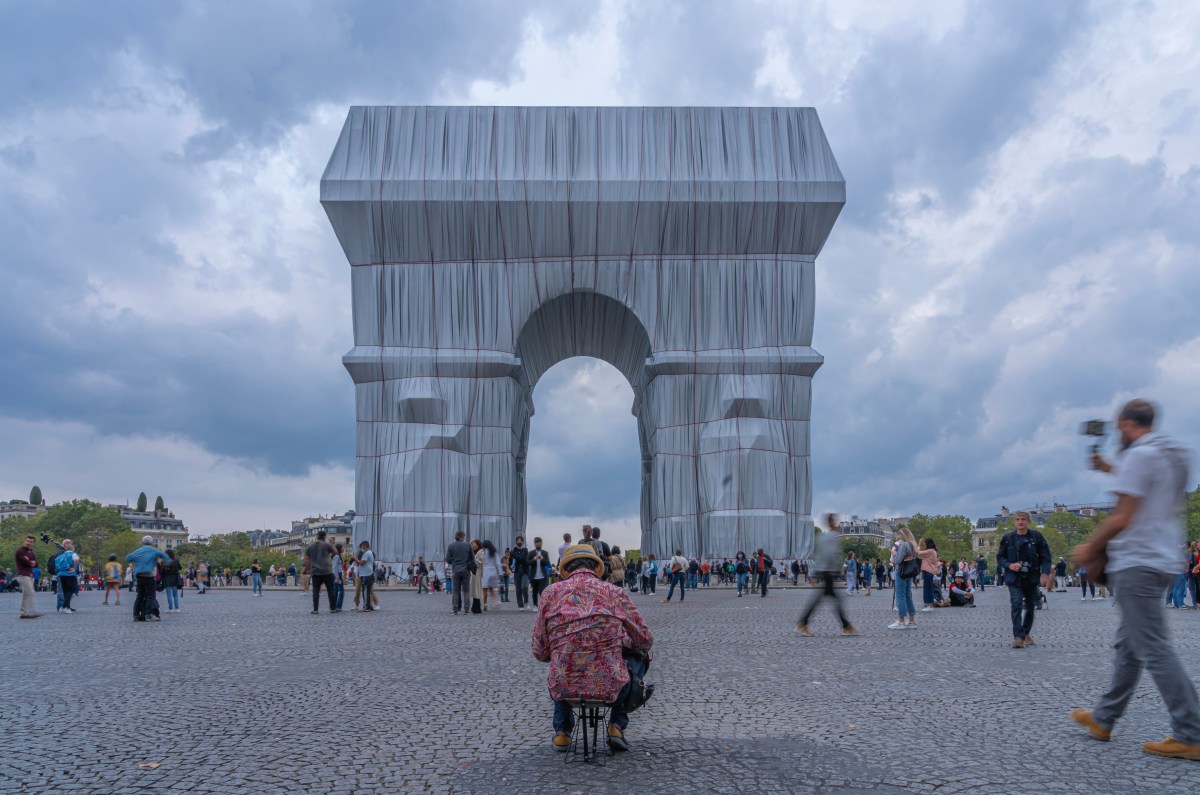
Sixty years ago, world-renowned artists Christo and Jeanne-Claude, best known for covering famous buildings around the world, envisioned wrapping Paris’s monumental Arc de Triomphe.
Today, the 49.5-metre-tall monument has been successfully covered by 25,000 square metres of silvery fabric. The best part? Thanks to social media everyone around the world has an opportunity to enjoy the eye-catching installation. From a 24/7 Livestream to Snapchat’s AR experience, there’s no need to fly to Paris.
Meanwhile, on the other side of the globe. Coffs Harbour Regional Gallery is celebrating its reopening from lockdown with a new Tik Tok series. Already approaching a massive 1 million views worldwide, the gallery has used social media to introduce a new younger audience to their collection.
From influencing creation, curation and perception, there’s no denying social media is changing the way we experience art. It’s an effective tool for generating excitement and keeping audiences engaged. But is it standing in the way of a genuine appreciation of art?
Christo was always about democratising art. He believed that it should be made available to everyone. Following this belief, Snapchat partnered with Sotheby’s to launch a global portal Lens, The Last Christo: Original Works for The Arc de Triomphe.’
The launch of the Lens coincided with the physical reveal of Christo and Jeanne-Claude’s L’Arc de Triomphe, Wrapped in Paris on 16 September. Overlaying Snapchat’s Augmented Reality (AR) onto Christo’s original works, Snap chatters were transported to Place de Charles de Gaulle via their smartphone.
The addition of this digital experience meant Christo’s vision reached an audience size that was unimaginable 60-years ago. In the digital world, big commission artworks no longer have to play victim to location or brief existence. Audiences can engage anywhere at any time.
The L’Arc de Triomphe, Wrapped appearing in social feeds everywhere increases its omnipresence. Intended only to be temporary, after 16-days of being erected, the installation will be gone from the psychical space.
In the digital space, however, it will continue to circulate and inspire. Thanks to social media, a concept first constructed 60-years ago will be experienced by an everlasting audience.
Spurred on by lockdown closures, social media has also shaped the modern experience of visiting museums and galleries.
Traditionally, taking photographs when visiting a gallery would have been frowned upon because of copyright issues. However nowadays, selfies with your favourite artwork are encouraged. In fact, if the content you’re pushing out on social media is good enough, you might even be offered a partnership!
Take 25-year-old Art Historian and TikTok sensation Mary McGillivray for example. Attracting millions of views worldwide through her social media channel @_theiconoclass, McGillivray has teamed up with Coffs Harbour Regional Gallery. Presenting Still Sundays, a series of ten, 1-minute videos, McGillivray unpacks still life art in the gallery’s current exhibition.
A recent episode exploring Jacob Canet-Gibson’s work Seven Eight Two received 875K (and climbing) views alone.
‘In the gallery, you may have walked past this seemingly simple work, yet it is the one that has sparked an enormous response online,’ said Gallery Curator Chloe Waters.
‘Whether you like the artwork or not, it has provoked a reaction and opened up a dialogue, and that’s what still life and art does.’
McGillivray said the online space gives the Still artworks two lives – one in the gallery, and a second in the wider-reaching online world.
Platforms such as TikTok have allowed art fans to breathe new life into art appreciation. Visitors now share the creative stage. This means that like McGillivray, you can now turn the simple act of experiencing art into your own work of art!
The new metrics provided by social media make it hard to know what ‘good’ art is. If an Instagram post of your artwork has several likes and reshares, does that make it a masterpiece? And if your artwork isn’t viral, does that make it unsuccessful?
In 2019, the most talked-about artwork was a conceptual work of art that saw a banana duct-taped to a wall. The piece, titled Comedian by artist Maurizio Cattelan, instantly went viral on social media. Within minutes of launching at Art Basel Miami Beach, memes of the artwork spread across the internet like wildfire.
In cases such as Cattelan’s, it’s evident that social media has completely transformed the way we amplify art. Although many of the memes associated with Cattelan’s work ‘mocked’ the art world, it did capture everyone’s attention.
The downside to viral trends on social media is that it opens up opportunities for money-driven stunts. Tarnishing the ‘art experience’ with blatant aspects of consumerism.
In other ways, social media helps build a dynamic appreciation for art. In the case of TikToker McGillivray, a whole new generation has been introduced to the art world. McGillivray’s own love for art has helped inspire others to genuinely engage with artwork they previously may never have known about.
For Christo and Jeanne-Claude, the purpose of their work has always been to create new ways of seeing the familiar. Viewing an AR interpretation of the Arc de Triomphe being wrapped up in Paris – from the comfort of your couch in Australia – enthusiastically achieves this.
Although it may not have been in the way the artist intended, you can’t help but genuinely appreciate the art.