Full of colour, expressive depictions and emotive interpretations, landscape artworks take many different forms – profoundly full of variation, even within one city. No place represents this variety as much as Tasmania, and the same can also be said of the Hadley’s Art Prize, which is currently on show in Hobart.
From style and scale to colour and innovative techniques, Dr Amy Jackett, Curator of Hadley’s Art Prize, says this year’s award exhibition is ‘a great survey of a whole breadth of landscape art from across the country’.
Equally, as Jackett continues, the themes and politics of Australia seep into the works – from environmental concerns about logging and deforestation, to intimate connections to places, memory and experiences, as well as cultural connections and traditions.

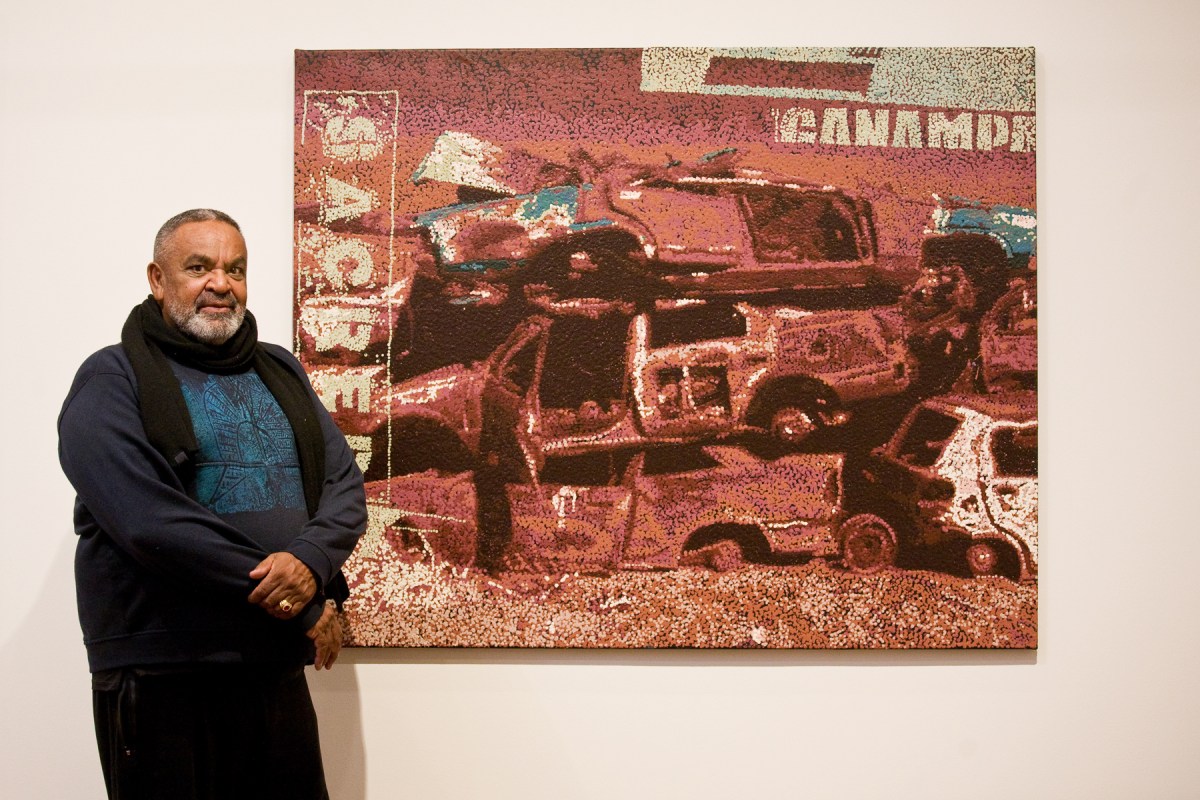
The judges this year include contemporary artist Abdul Abdullah, Mona Curator Sarah Wallace and University of Melbourne Senior Curator Judith Ryan AM. Alongside the expected, unexpected artworks also appear: a nocturnal scene, a miniature artwork, and even a pile-up of cars in Landscape (2026) by Western Arrernte and Yankunytjatjara artist Robert Fielding – the winner of the $100,000 main prize for 2026, unanimously selected by the judges.

Hadley’s Art Prize – quick links
Celebrating connection to Country
‘Landscape is edgy, vibrant and painterly. It yokes together figuration – a pile up of rusted old Toyotas – [and] conceptual abstraction – layered dots of men’s body painting for inma (Ceremony) and text. This winning work was unexpected because it traverses so many layers of family history and Australia’s shared history,’ says Ryan.
Wallace adds, ‘Stacks of wrecked cars are a common sight across parts of Australia, but Robert doesn’t present them as a blight on the landscape. Rather, for him they hold memory – stories of journeys across Country with family – and represent an important means of connecting remote communities. He marks this landscape SACRED and Nganampa (ours).’


Connection to Country is seen through several artworks in the prize. Michelle Pulatuwayu Woody Minnapinni from the Tiwi Islands uses locally sourced earth pigments and ceremonial jilamara designs for Ngiya Murrakupupuni (My Country) (2025), while Betty Muffler, a ngangkaṟi (traditional healer), shares Ngangkari Ngura (Healing Country) (2025).
As Ryan explains, ‘Her inherited visual language of tracks and campsites heals Country that was destroyed and poisoned by the British atomic tests [of] 1956-63 and the Anangu who suffered radiation sickness and were forced to flee this Country. She is this land she paints.’
From the remote landscapes of Australia, Bugai Whyoulter (Kunawarritji, WA), Agnes Rubuntja (Ampilatwatja, NT), Kumantjai Lane (Walungurru, NT) and Betty Campbell (Mimili, SA) all contribute work that speaks to sacred connections.
A Tasmanian perspective on landscape painting
Of the 27 finalists, there are only five Tasmanian finalists. They include early-career artists such as George Kennedy and Harrison Bowe, mid-career artists like Grace Gladdish, and some of Tasmania’s most celebrated and established artists, such as Philip Wolfhagen and Luke Wagner.

However, Tasmanian themes run throughout the award exhibition, such as in Todd Simpson’s lusciously green painting Where Light Settles (2026), which was created after a residency in Hobart. Then there’s Linda Greedy’s Misty Morning, Overland Track (2026), about the iconic Tasmanian walking track, and Melissa Kenihan’s portrayal of a flowing Tasmanian river, in The Nature of Time and Place (2026).
The Packing Room Prize Winner, Alice Mannheim’s Log it! (2025) also captures a calm and serene moment on the water, immersed in foliage. Only the title reveals the tension that continues across the country, and especially in Tasmania.
Likewise, Joe Blundell’s Tormented land (2026) uses paint and sand to explore the effects of deforestation. And Not Everything Caught is Meant to be Kept (2026) by Miranda Hampson echoes this cautious message.
Pushing the medium

From the rest of the nation, iconic names like Ken Done, Imants Tillers and Julian Meagher appear alongside celebrated, early-career artists such as Mia Boe, Bronte Leighton-Dore and Kim Leutwyler.
‘Every time I see a competition like this, I enjoy discovering innovative and surprising things in the ways artists have interpreted the themes,’ says Abdullah. ‘In the 2026 Hadley’s Prize, there were several examples, including works that pushed traditional mediums or introduced novel ways to make a picture.’
Kelsey Ashe, winner of the IAS Art Handlers’ Award, uses botanical inks and photoluminescent pigments that change in the light to create the effect of moonlight in Bunuru Nocture, Derbal Yerrigan (High-Summer Night, Swan River) (2026).
Natasha Bieniek’s miniature Trill (2025) received an honourable mention from the judges for its depiction of an inner-city Melbourne Garden scene, transporting the viewer into space for reflection. And Brenda Croft’s diptych of Chromalux prints scanned from original tintypes, Weerewa (Lake George), after Lycett (for Augusta + Caroline) (2026), examines her family’s matrilineal history and settler-colonial connections to Weereewa/Lake George.


Wallace says, ‘It is a simple yet arresting image: a lone tree in a fenced agricultural landscape, with a palpable sense of history and memory.’ To Ryan, the ‘silvery surface of the tintype’ holds ‘impenetrable mystery’.
The Hadley’s Art Prize reveals the value and love of landscape painting in Australia. It allows the Tasmanian local audience a chance to engage and view esteemed artworks from across the nation – all the way from remote NT to the city hubs. Jackett muses how special this is, especially for the student groups who come through – such as the 16-year-old student winner from Launceston, Hayin Yi, whose artwork depicting the coastal landscape and perspective of Tasmanian seasons is shown with the finalists.
As the Hadley’s Orient Hotel’s long history of supporting landscape art continues, it echoes critical messages about how to protect and connect to the land, to ensure the next generation has a chance to enjoy it, find their own memories, and continue caring for Country.