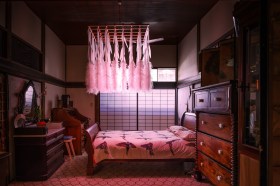
A young woman sits on a bed in a cluttered domestic interior. Her face and hands are painted a lurid green, and her eyes hold the viewer with an unnerving intensity. Titled Self-portrait as a Martian (2016), it is one of the earliest photographs staged by Melbourne-based South Sudanese artist Atong Atem, offering a hint of the trajectory her practice would take over the following decade.
It has led to this major institutional survey, Passage: The Art of Atong Atem, bringing together more than 65 intriguing works at NGV Australia in Melbourne. As both subject and storyteller, Atem reclaims agency over photography, a medium weighted by colonial histories, while inviting us to reconsider who controls the stories told through it.
Atong Atem review – quick links
Agency over the ethnographic lens
When Atem photographed herself for Self-portrait as a Martian, she was speculating, as an ‘outsider’ about what it might mean to exist in a world no longer defined by race or gender. While we have not yet reached that place, Atem invites us to leave our perceptions at the door and embrace a world shaped by alternative truths.
Visitors are drawn into her web of colours and characters, but there is also a palpable sense of narrative recalibration taking place. Perhaps this is because Atem’s human lens is so genuine. She grew up in a household where embroidery, beading, ritual, dance and song were part of everyday life. These are not ethnographic observations; rather, they are expressions of a lived culture, captured and celebrated.
This is the exhibition’s overwhelming strength, and curators Natasha Bullock and Anna Honan have taken a notably light touch in ensuring that the work is not overly mediated by the museum environment.
Reclaiming identity in the art of Atong Atem
Atem’s expansive image-making practice is introduced through her early Studio Series (2015), inspired by West African studio photographers. Here, members of Melbourne’s African diaspora are afforded the same dignity and presence as those influential studios.
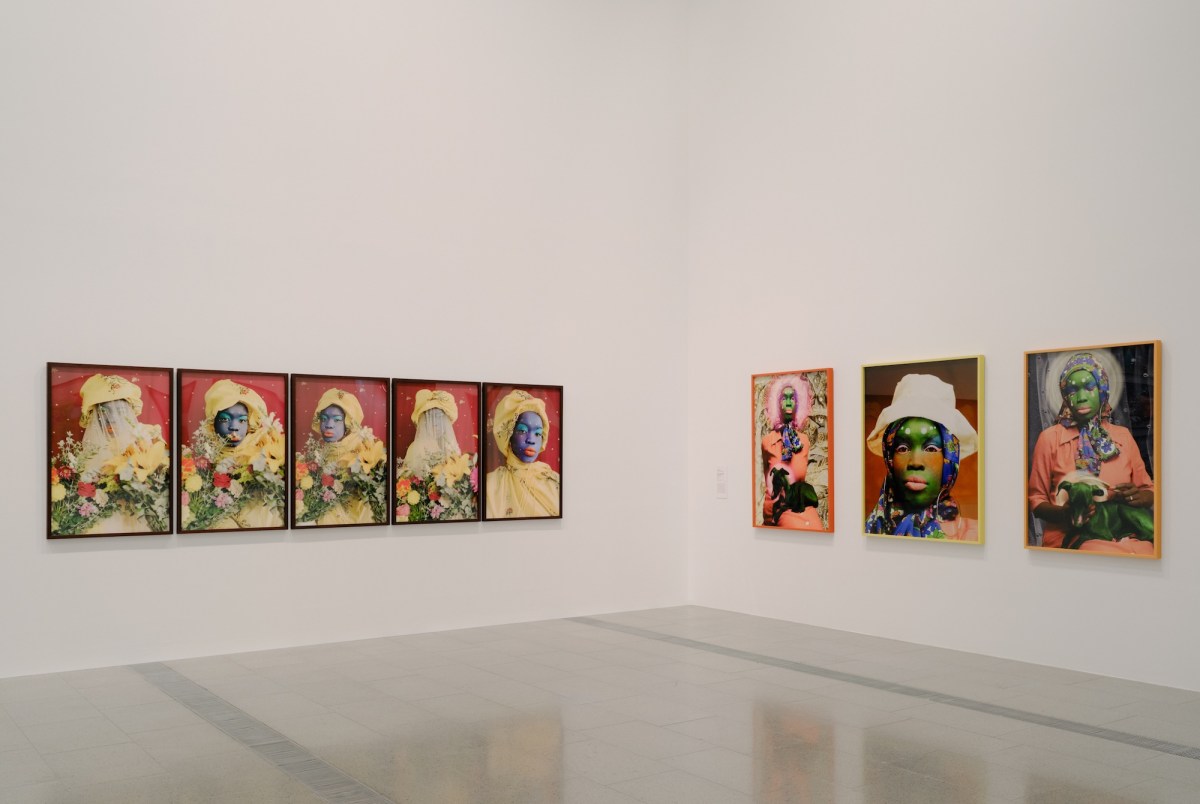
This approach develops through Red dust sticks to you (2022), A yellow dress, a bouquet (2022) and Men in this town (2024), presented together here. The images are at once theatrical and intimate, inviting us to look beyond the immediate portrait and question the histories informing its many details.
Face paint becomes a recurring symbol of alienation in these series, but also an act of defiance against cultural invisibility. Having initially studied painting before turning to photography, Atem brings a painter’s sensibility to her compositions, carefully orchestrating colour, costume, gesture and setting.
Similarly, she slips effortlessly between gender roles. One catches oneself asking, ‘Is that her?’ This moment of uncertainty draws us further into the work, prompting closer attention to the minutiae of each image. It is a deliberate device that Atem uses to interrogate the history of ethnographic photography, the conventions of studio portraiture and the presumed authority of the photographic image – questioning notions of truth that exist both within and beyond the frame.
Atong Atem’s intergenerational storytelling
A pivotal moment in the exhibition is Surat (2022), salon-hung across a corner and presented in its entirety for the first time. Made during the Covid lockdowns, the series restages precious family photographs, bringing relatives – some of whom Atem has known only through photographs – into the present.
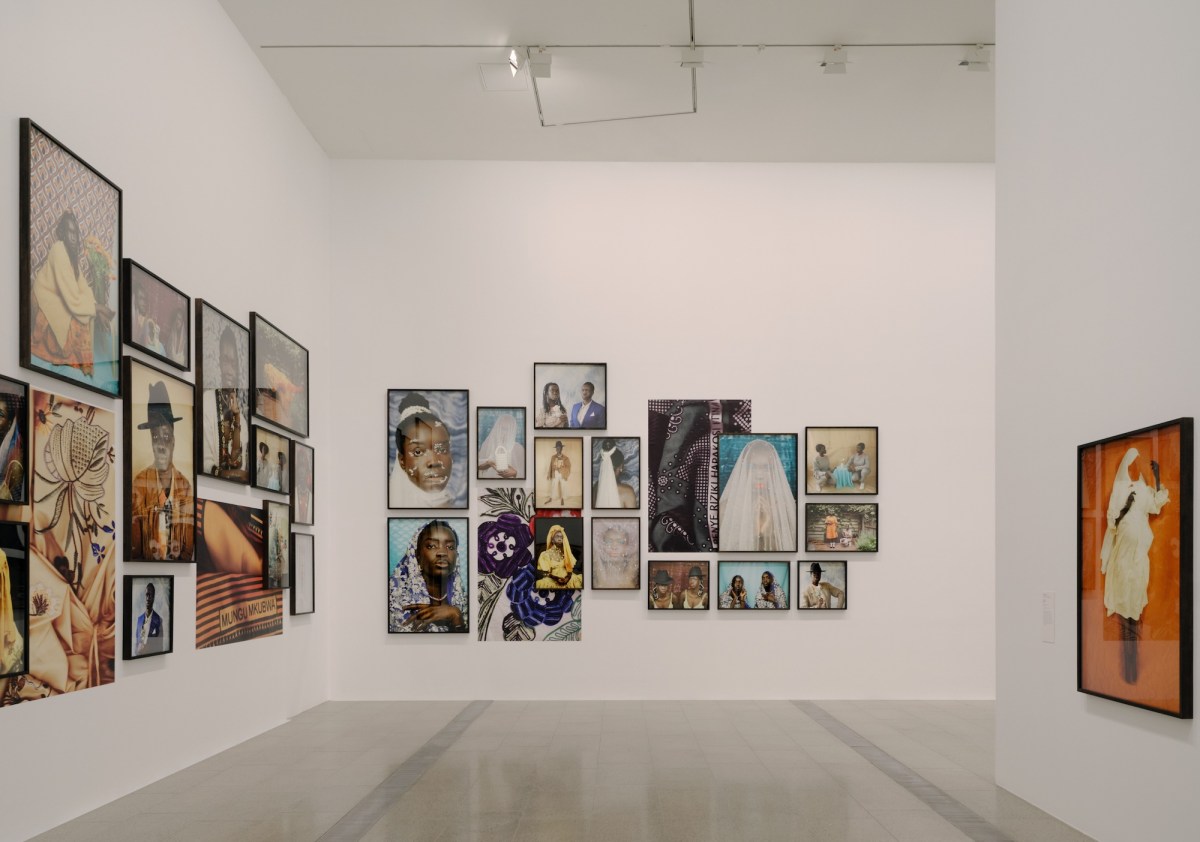
Atem, featuring Atong Atem’s Surat and Dust, The Ian Potter Centre: NGV Australia, Melbourne. Photo: Tom Ross.
Having arrived in Australia at just six years old, she meditates on the photograph as a vessel for memory, ancestry and cultural continuity. Using herself as the sitter, they’re not simply reconstructions, but rather acts of reconnection, allowing personal and collective histories to co-exist across time.
Sitting within sight of this installation is the more intimate series, Dust (2023), one of the exhibition’s most affecting moments. Here, a heavily pregnant Atem lies on red earth, reconstructing a Dinka Bor ritual associated with death and the passage of the spirit into another world.
Traditionally, family members would dance around the deceased, stirring up clouds of dust as part of the ritual. The images hold an extraordinary tension between birth and death, the body and the earth, the beginning and end of life. The red earth also resonates powerfully in an Australian context, where land carries its own profound cultural and ancestral significance. Atem’s work opens up a space for these connections without collapsing the differences between cultural histories.
Cosmologies, colonialism and crystals
The second half of the exhibition introduces a number of newer works, expanding Atem’s visual language through tarot, celestial imagery and beaded bodies.
Among the most compelling works in this section is Scars and Constellations (2024), shown in Australia for the first time. Commissioned by the National Maritime Museum in Amsterdam, the work responds to a site formerly used as shipyard for the Dutch East India Company. Atem considers the sea and sky as seemingly neutral spaces that have been made profoundly political through colonial trade, migration and conflict.
She draws on scarification, an important Dinka Bor cultural practice associated with ritual and healing, but also speaking to the legacies of colonial violence. Around the figures, constellations become another form of inscription. Once used to navigate the oceans, the stars are recast as markers of belonging and survival.
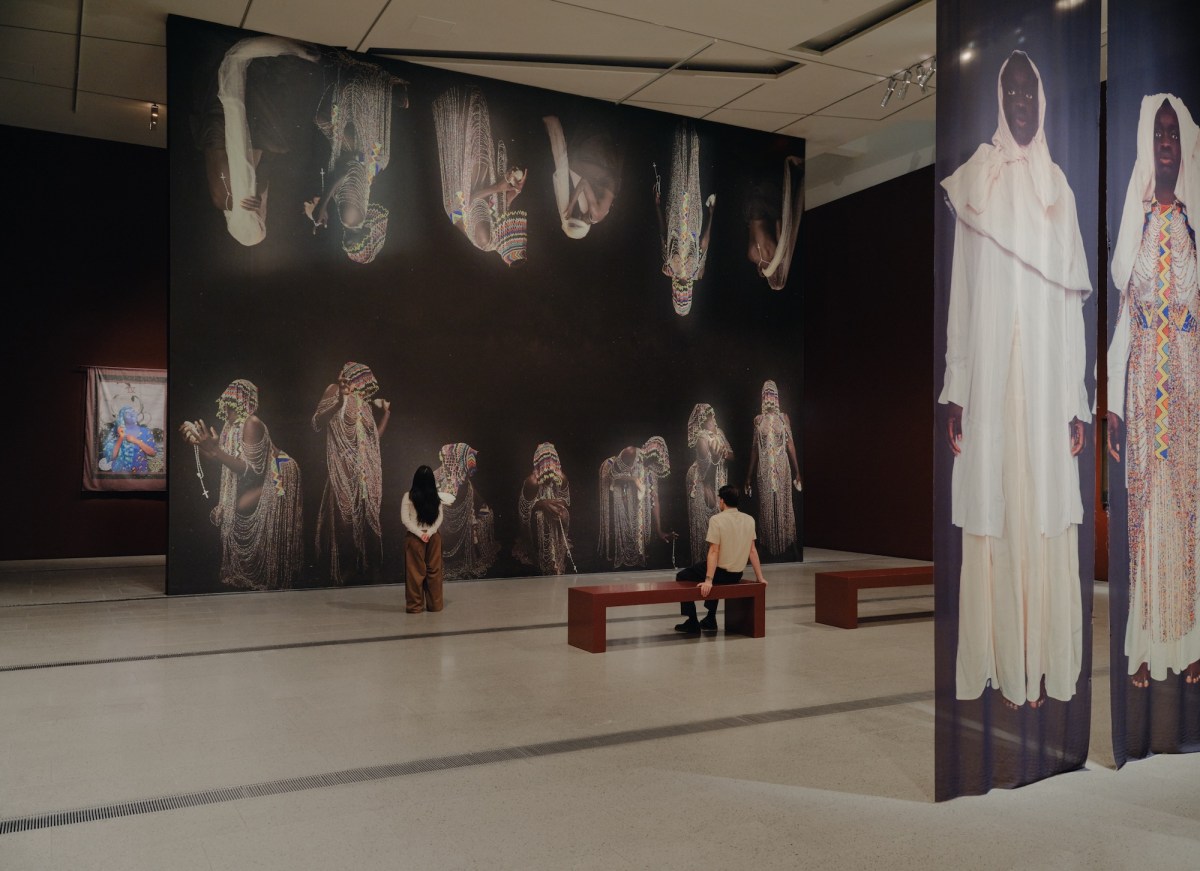
These works connect beautifully with a new commission for the exhibition, As Above, a large-scale installation in which bodies appear to float against a night sky. Drawing together Dinka dance, traditional beading and Catholic iconography, the work also references the astronomical concept of the false cross, a grouping of stars that mimic the Southern Cross. It asks how we position ourselves within vast cosmic, historical, cultural systems that surround and shape us.
ArtsHub: Rosalie Gascoigne’s experimentation shines in sublime retrospective
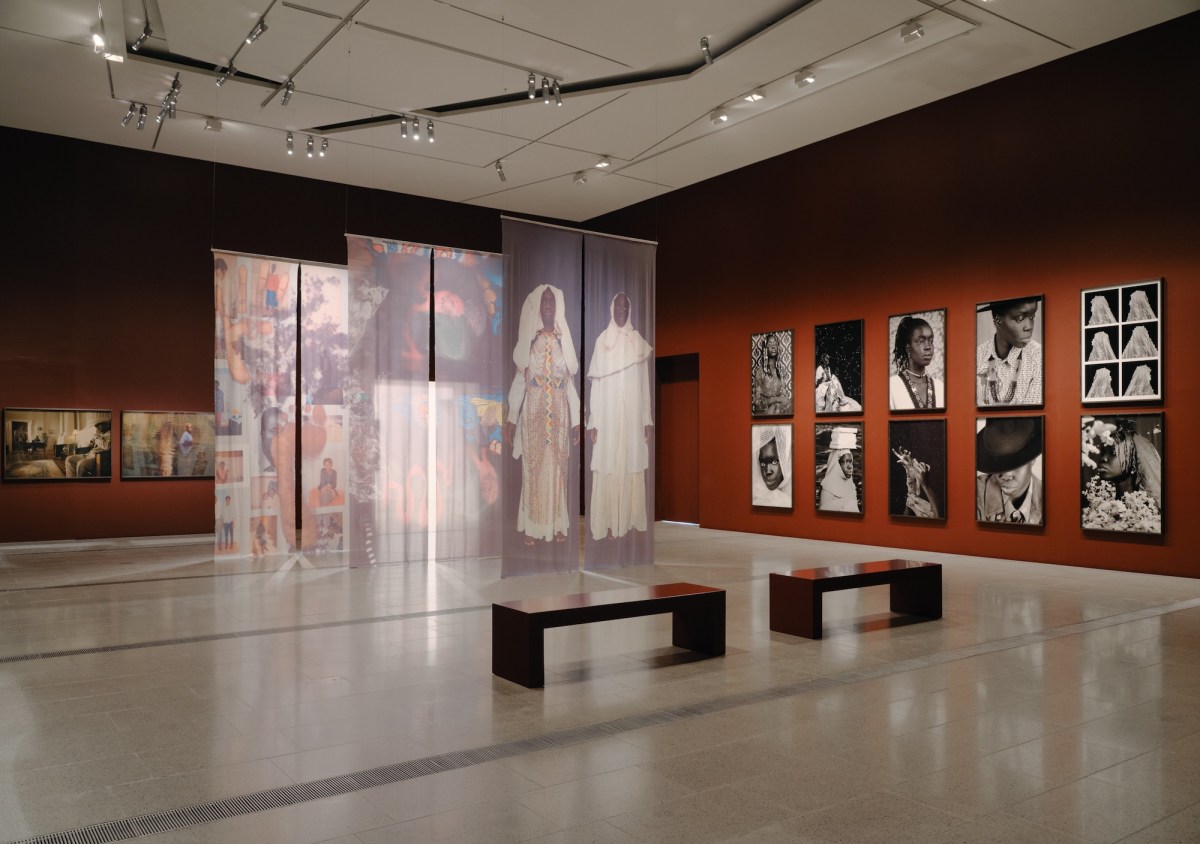
Floating centrally in this large gallery space, and connecting these two series, is A facet for every turn (2022). Here, theatrical scrims further extend the sense of performance, creating layers through which the body is viewed, concealed and revealed. It is nice to bring textiles into this show, with soft animations of the sitters like ghostly apparitions.
The work draws on the manifesto of the North Sudanese Crystalist Group, an artistic movement from the 1970s that explored connections between the faceted structure of crystals and the cosmos. Through this reference, Atem positions her own cultural perspective at the centre of a much larger universe, rather than at its margins.
The power to author one’s own image
What makes Passage such a compelling exhibition is the way Atem brings together the personal and the political without allowing either to overwhelm the other. Her photographs are visually seductive, often exuberant in their use of colour and pattern, but beneath this surface they celebrate an artist’s agency over her body, her culture and the stories that shape her identity.
Atem brings an erudite, meticulously researched and highly individual position to contemporary photography, pushing the medium beyond the conventions of portraiture into a space where performance and ancestral memory intersect.
There is a generosity to her practice, too. While firmly grounded in her own Dinka Bor heritage and lived experience, her images invite us to reconsider our own relationship with identity, inheritance and belonging.
Passage is ultimately about the power to author one’s own image and, in doing so, reclaim the stories that have too often been told by others. It is a remarkable achievement.