Here is a controversial claim: NFTs are not art.
It’s technically true, because these non-fungible tokens are simply a medium for expression aided by technology, just as paper, canvas, photography and video are mediums that have shaped our understandings of culture.
So when NFTs become distant to the dollar sign; when people are tired of the sensationalised headlines and legal scandals, what could come of the medium?
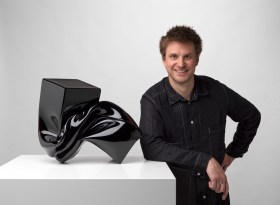
‘I’m predicting that the financial boom last year is giving way to the “who” boom which we are in now,’ artist and Senior Lecturer in Digital Media at RMIT, Shaun Wilson, told ArtsHub.
Wilson continued that, ‘this will lead to the “knowledge” boom in two years when critical theory moves in to validate NFT art as an established art form based on the ideas value, not the auction price.’
Read: NFTs: A year in review
What we’ve been seeing in recent months is a radical shift away from NFTs as a commercial opportunity to one where its future is left for artists to decide.
ArtsHub spoke with several artists on the future of NFTs and discovered who is adapting to this volatile medium – disbanding its stereotypes and exploring its potentials through a critical lens.
NFT’S CONCEPTUAL HORIZON
Wilson told ArtsHub that his academic interest in trend-cycles initially led him to jump on the conceptual horizon of NFTs. ‘I’ve always been interested in fads after the fact – what happens to a fad after it goes through that transition to something else? So I’ve been keeping an eye on NFTs once they get over their fad stage, which is now, and thinking, well, what can we really do here conceptually and artistically?’
Delving into the conceptual possibilities, Wilson recently launched his own NFT collection on Open Sea. Titled ‘Beautiful Thought Coins’ it explores bureaucracy, aesthetics and currency. The project is complete with a virtual exhibition, digital art prints, art book, and a soundtrack of AI hosted podcasts exploring everything from NFTs to chihuahuas.
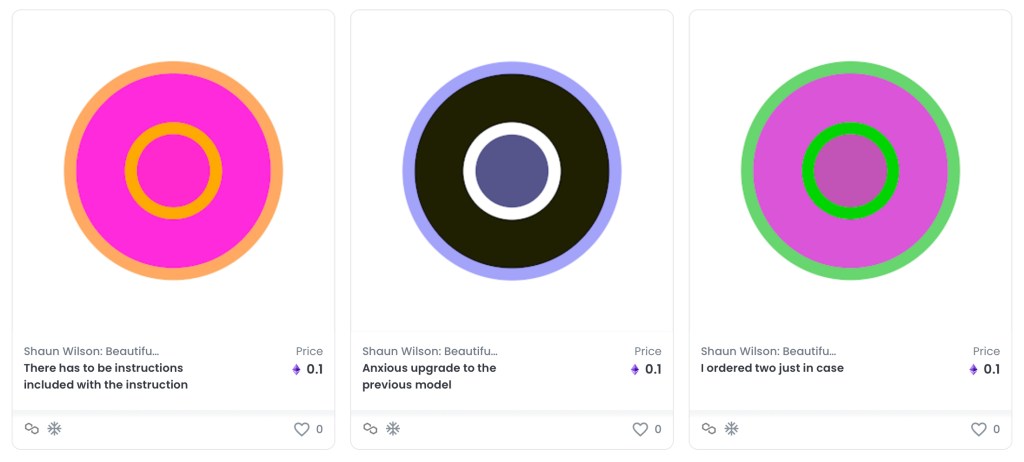
Wilson continued: ‘I think there’s going to be the eBay, bulk, mass digital art illustrations on [NFT platforms], that’s what makes it its thing. But I’m more interested in looking at it from a different perspective as a conceptuality and how do you address that as an artist, rather than looking at it as a venue to make money.
‘[People] need to look at NFTs as a genre and a whole entity,’ Wilson continued, listing British contemporary artist Damien Hirst as an example. Hirst’s first NFT project ‘Currency’ dropped 10,000 NFTs corresponding to the number of individual physical artworks in his signature dot painting style.
While interested buyers only needed to pay USD $2,000 for Hirst’s NFT (some resold for as high as USD$120,000), if they want the physical artwork, they had to trade in their token (the NFT) to be destroyed, or keep the NFT and say goodbye to its physical counterpart.
NFTs are a bit like going into Chemist Warehouse, there’s shit everywhere and all you want to do is find a Panadol.
Shaun Wilson, Artist and Digital Media Lecturer.
‘What he [Hirst] is doing is subverting the idea of NFTs and the way these digital entities work,’ said Wilson. Perhaps abandoning the physical (or at least the valued ideal of physicality) is a necessary process of acclimatisation towards the digital native.
‘If you look at any new technological aspect in art people get really shitty,’ Wilson added. ‘It happened with photography in the 1860s when it was going gangbusters with sales and the art world shut it down because it wasn’t painting; it happened with video art in the 80s; VR in the 90s; and augmented reality in the 2010s.
‘Every time there’s this new thing that isn’t handmade and it starts making obscene amounts of money in its early stages, the general public and the art world gets really cross … But then the fad sticks around and at some point it becomes the norm,’ said Wilson.
Wilson continued: ‘I think the bad thing about NFT art at the moment – and what my art is sort of responding to – is the bureaucracy that is embedded with it that’s saying: “hey, let’s get rich”.’
And so begins the tug-of-war between critical thinkers and crypto opportunists.
A DIGITAL NATIVE REVOLUTION
In this day and age, what does it mean to create art for a ‘digitally native’ generation? From American artist KAW’s virtual collaboration with video game Fortnite and Serpentine Galleries to global mega house Pace Gallery’s first major NFT lineup and Twitter introducing NFT profiles, these are show-tell signs that the art world is facing a juncture where adaptation is crucial.
In Australia, digitally adapted artists are driving this force to experiment, collaborate, and innovate in the virtual terrain.
Sydney based artist Serwah Attafuah is one example. Attafuah showcased her intoxicating digital work ‘Outlines’ at Sydney Opera House’s Stream platform last year, is the judge of the ASUS Creator Xchange Challenge and participating artist of the upcoming Cultural Vault NFT platform.
Attafuah will be working alongside artists Jess Johnson and Dave Court on the ASUS Creator Xchange program and also included in the Culture Vault NFT platform are familiar names including Reko Rennie, Fallen Fruit and The Huxleys.
Attafuah highlighted that NFTs not only allowed her to monetise her work, but also ‘preserve its native digital format’.
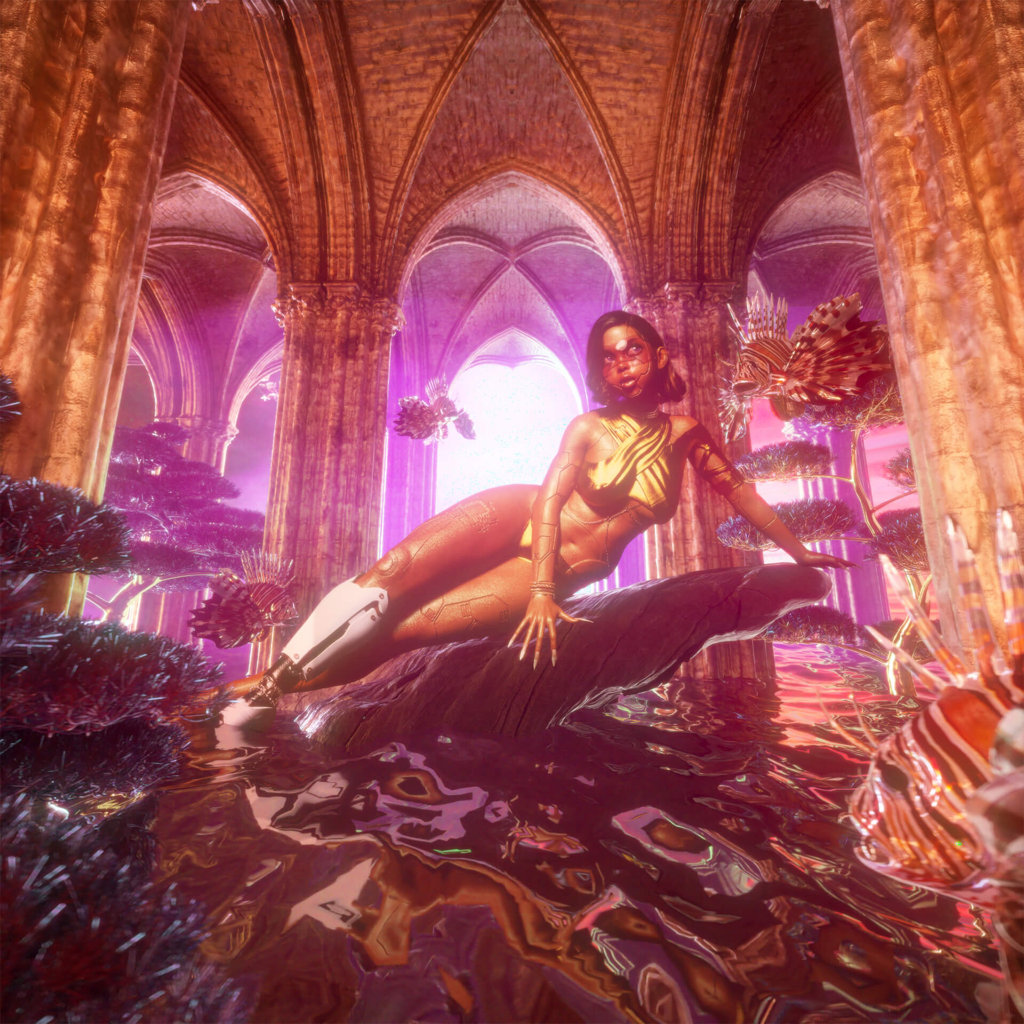
‘[Digital] works can never be the same presented physically, if you print out a digital work it’s never going to have the same vibrancy, or if you make an animation it’s never going to be the same [presented in person],’ Attafuah told ArtsHub.
But the digital medium has helped push Attafuah’s practice further. ‘It’s like art is in the hands of the people now, which I kind of love,’ she added.
NFT is a method of delivering whatever you want to deliver – whether that be artwork, poem, film, game. It could be anything.
Serwah Attafuah, Artist.
Another aspect that artists have to grapple with (or be excited by) in the digital sphere is how fast things change, advised Attafuah.
‘I could wake up and the whole spectrum has changed,’ she said. ‘It’s so hard to keep up, but at the same time it’s so exciting to wake up everyday and see a new website, a new technological drop, a new innovation … It’s inspiring to keep going, you don’t feel you’re ever stagnant with this.’
Ultimately, artists have the power to shape our visual culture.
In the words of Takashi Murakami – whose influence defined contemporary art as we know it, among the likes of Hirst, Koons and Kusama – ‘I think of NFT art simply as art’.
Arguably, it’s because Murakami said it, that makes it so true.