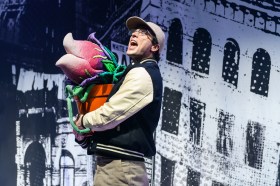

Jacob Sacher’s show, Promising Young Mensch, lived up to its lofty promise. Controversial and moving, the show used the conceit from Emerald Fennell’s Oscar-winning 2020 movie starring Carey Mulligan, Promising Young Woman, about rape and revenge, to ask profound questions about how we absolve ourselves of wrongdoing – and do wrong to others in turn.
Sacher has had previous comedy festival hits with shows themed around a character called Paul Noodle, who is actually – in a surrealist twist – a pool noodle. This new show was both a brave departure with a genuinely fringe element appropriate to the festival, as well as a return to form about the formative experiences of the comedian as a young man.
Promising Young Mensch was a show about what it takes to be a good person, a true mensch. It was also a show about chain reactions. It went as far as the butterfly that flaps its wings in Grosse Point to cause a hurricane in Hawaii, but it took the audience there in a boldly human scale, the scale of the life of the child.
The promising young comedian played a child version of himself whose innocence has been, if not lost, then interrupted. In the process it raised questions about loss of innocence in the history of religion, as well as in our cynical age.
The show was themed around the Royal Commission into Institutional Responses to Child Sexual Abuse, but it was more ambitious than its darkest subject. Sacher, whether as a 10-year-old or a man on the edge of his 20s, is an engaging showman and in a highly discursive and entertaining show, he put the history of religion in his sights.
The result was a comedic pay-off for those familiar with his Jewish culture, and an entertaining anthropological explanation for anyone new to it. With whizz-bang gadgets and schmick comic timing, Sacher proved himself to be adept at eliciting audience participation and at home in monologues both sharp and sassy.
Whether in the guise of a young kid making risqué remarks about cricket, or a world-weary adult learning to say what’s just not cricket for the first time, this was a show that crossed boundaries and broke taboos, all while giving the audience the sense of spending an hour with a young person of promise.
The show was themed around three set pieces, which built to a multilayered climax that made you think as well as laugh.
Read: Theatre review: Beowulf: Reforged, Waterside Forge
If Promising Young Woman was a revenge farce, Promising Young Mensch was a reckoning. It was a smart show that wasn’t afraid to ask what happens when a chain reaction among victims makes more victims. It drew you in with its engaging wit and looped you into a chain of jokes that went somewhere daring, brave and unexpected.
Promising Young Mensch
Trades Hall
Performed by: Jacob Sacher
Presented by: Paul Noodle
Promising Young Mensch was performed at Trades Hall from 2-6 October 2024 as part of Melbourne Fringe Festival.