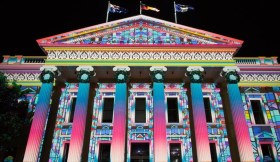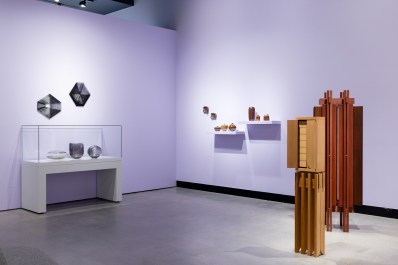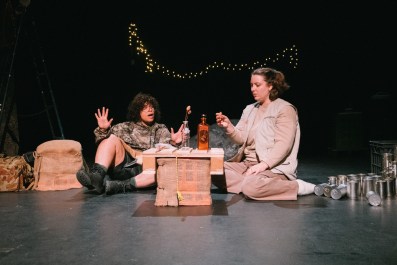
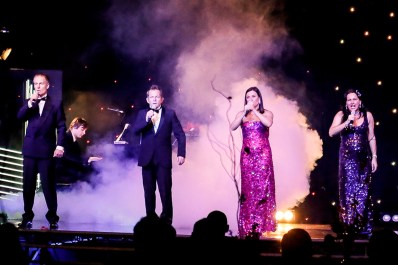


What are some of the expectations people have when going into a library? It’s a vast collection of knowledge, a quiet space for work or study, a place of gathering – the State Library of Victoria fits into all these descriptions, but since opening its new Victoria Gallery, it has also become a destination for contemporary art.
State Library of Victoria CEO Paul Duldig tells ArtsHub: ‘The State Library welcomes over two million visitors a year, and their average stay time in the library is two hours and 20 minutes.’
It means that people are already widely engaged with the facilities and resources on offer at the Library, and Duldig sees this as a major advantage when it comes to exhibition programming.
He continues: ‘There are a whole bunch of different interactions that exist in the Library, and exhibitions play a role in holding people’s attention for a while to show what’s possible in this space.’
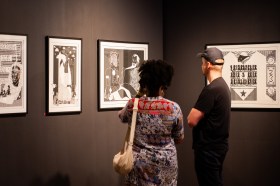
For example, the current exhibition is MIRROR: New views on photography (until 28 January 2024), which features large-scale video displays showcasing over 140 photographs from the State Collection. It not only provides insight into history, through fragments of time captured by the lens, but also how these valuable archives are being stored and cared for.

One of the show’s curators, Kate Rhodes, highlights how working with a library collection requires a different approach. Before joining the State Library, she held positions at the Australian Centre for Design, Craft Victoria and the National Gallery of Victoria, where she was assistant curator of photography and contemporary art. Rhodes tells ArtsHub: ‘Curators have access to the same catalogue as visitors at the State Library, and with millions of Collection items it can certainly get overwhelming.
‘Just like everyone else I start searching through the catalogue with keywords, and whatever pops up will guide me to dig deeper… The question that we often ask ourselves is: “What’s missing?”’
It’s a process that requires curators to think critically about the State Collection, Rhodes continues, and be able to identify the gaps and missing narratives to better determine its future.
Read: Libraries as hubs for change post pandemic
Commissions play a major part in filling this gap, with a range of Victorian storytellers invited to respond to the 140 photographs in MIRROR. From songs, texts and films by the Pasifika Storytellers Collective to the Auslan poetry of Walter Kadiki, contemporary creative practitioners help to shed light on a more diverse representation of histories, stories and journeys. Rhodes, along with co-curators Jade Hadfield and Linda Short, worked alongside four creative collaborators: Anthony Nguyen, Ziga Testen, Louise Wright and Mauro Barocco.
These engagements became a springboard for deep conversations that then informed how the Library can provide better access for underrepresented communities to reclaim those stories.
Duldig adds: ‘What we collect at the State Library can actually be informed by the exhibitions. In some ways it’s like R&D (research and development) for us.’ In essence it’s an interactive exercise that feeds back into the Library, rather than just being a public program.
The State Library of Queensland is another example, with compelling exhibitions that interrogate not only knowledge systems, but also artistic practices.
And, of course, this dabbling into other cultural institutional frameworks is also true on the flip side – museums and galleries are improving, rethinking and promoting their library spaces. One recent case is the Art Gallery of New South Wales, which holds what is said to be the country’s most outstanding collection of fine art publications, rare books and manuscripts. Its renovated lower level space combines library, archive and a brand new children’s art library.
Museums, galleries and libraries: are institutional categorisations still relevant?
There was a time when Melbourne’s Library, National Gallery and Museum shared a site on Swanston Street, and were jointly administered from 1869-1944. The National Gallery of Victoria (NGV) moved to its St Kilda Road location in 1967-1968, while Melbourne Museum didn’t relocate until 2000.
Duldig says this history means ‘there are still significant echoes of that structure in the Library’, but looking to how these institutions have developed today, the similarities reside more in audience engagement than operation.
While high visitations is a healthy sign of the importance of the Library as community and cultural infrastructure, the need to stay relevant is what drives new approaches to programming. This is where innovation comes in, whether that be through recent exhibitions with different technologies (for example in Handmade Universe), high-quality digital displays or online exhibitions. In addition, the State Library of Victoria will soon announce the appointment for its newly created Chief Digital Officer role.
Apart from commissioning contemporary artworks and curating exhibitions, there are other developments that suggest the State Library of Victoria is expanding its visual art expertise.
John Wicks was recently brought on board as Chief Operating Officer and Chief Financial Officer. Wicks previously held those positions at the Art Gallery of NSW and took part in the establishment of Sydney Modern. He also brings international experience as Deputy Director, Museum Operations at Hong Kong’s M+ Museum.
Duldig is also a visual artist in his own right, with an active practice that investigates the environment and climate. He is the Chair of Linden New Art and on the board of Art Monthly Australasia.
Duldig explains that this breadth of expertise is represented across the executive team and core departments, but ‘it’s not about becoming a gallery or a museum,’ he says.
‘It’s about being an amazing library and almost reinventing what a library can be.’
It’s not hard to see that the State Library of Victoria has already got some leverage in the game. It’s one of the top most visited libraries in the world, behind other heavyweights such as the New York Public Library, Brooklyn Public Library and National Library of China. It already has exhibition plans lined up until 2026, including major partnerships and co-curated projects nationally and abroad.
The identity of a library resonates with the community that it serves, and in some ways this uptake in public-facing programming reflects the vast amount of creative talent in Victoria. By inviting in these perspectives into its framework, the State Library ensures that it stays relevant for current and future generations.
As Duldig concludes: ‘If we didn’t have the exhibitions we’d still be a library, but I don’t think we’d be anywhere near as good or as rich.’