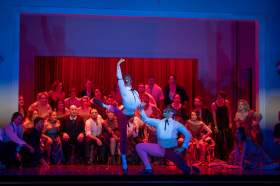
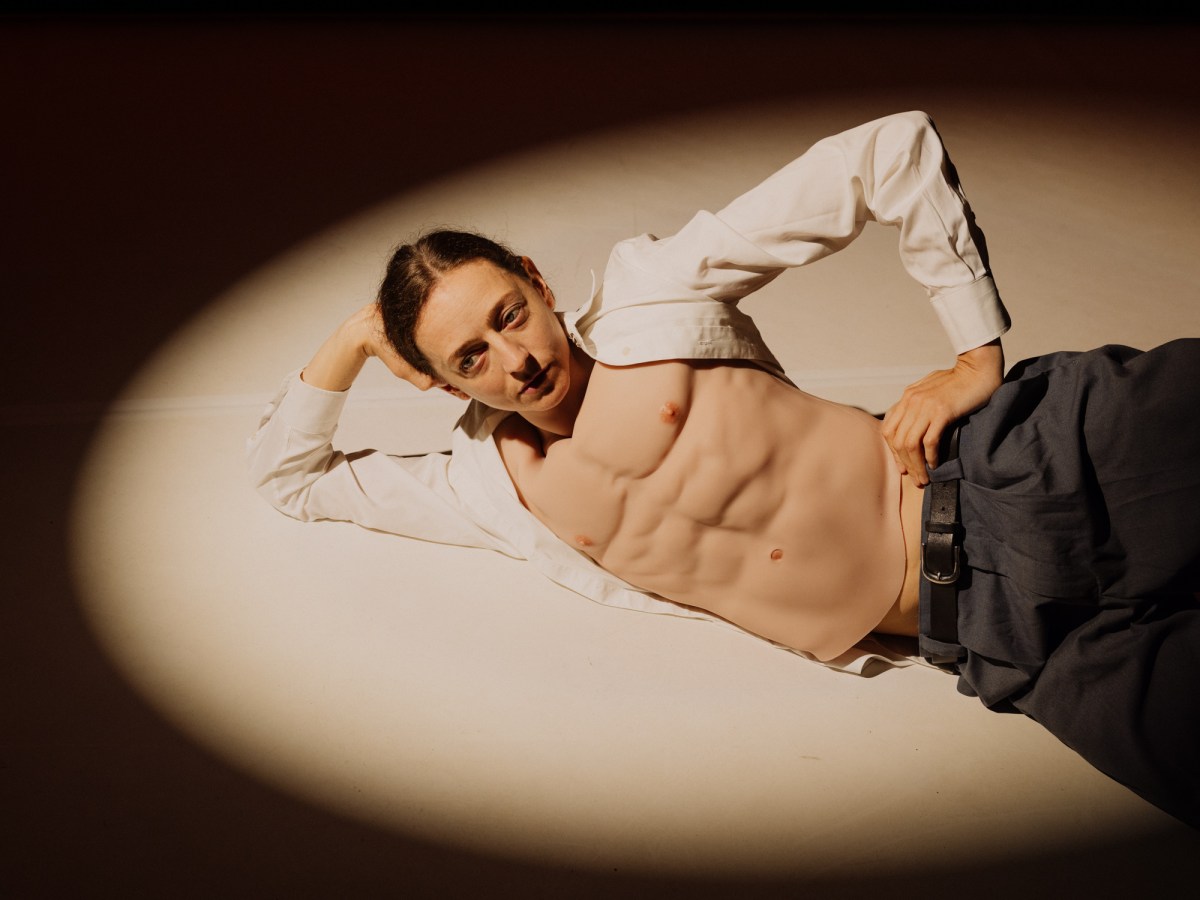
As a solo show that is part performance and part lecture, Quindell Orton’s Making of a Man succeeds where many lectures fail, in arming its audience with surprising information, which, while loaded with political intent, is not didactic or awash with ‘teachable moments’.
Rather, it proves masterful and mind-bending in its ability to open doors to a familiar (some might say overworn) subject – namely the power and dominance of the cis, white, able-bodied male in today’s society.
While the show hits hard on a conceptual level, it’s also an impressive display of physicality by a very accomplished performer.
Making of a Man review – quick links
Dance technique and physical presence
Orton is both a trained dancer and a maker of dance theatre work, and it’s a treat to see their strong dance technique coalesce with their sharp dramaturgical instincts (assisted by dramaturg Maxwell McCarthy) to achieve a work that is both physically and structurally immaculate.
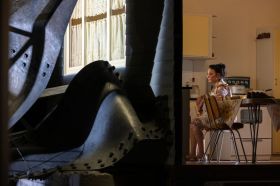
Supported by a stark, minimalistic set, the staging of Making of a Man is another of its most impeccable aspects. It features a large white-lit projector screen, a laptop, a sound desk and a small diorama area where two phone-cameras film various ‘life in miniature’ scenes.
The lighting is almost always a simple, bright white state that helps attune our senses to the performer as our primary focus.
Read: Wright&Grainger’s Eurydice review – reinventing Greek myth at FRINGE WORLD
When we first meet Orton on stage, they are dressed in a costume (designed by Louis Caspar Schmitt) of a white button-down shirt, grey trousers, tied-back hair and a large headset microphone. Their appearance is simple and androgynous, with a businesslike air that is deliberately blank, yet still somewhat authoritative.
But as our teacher/guide begins to speak and move, their guise as a supposedly trustworthy, upstanding professional soon slips away to reveal far more interesting propositions.
Investigating the way we move
Their lecture is essentially a presentation in seven parts, covering topics like ‘Big Boys’, ‘Real Men’, ‘The Hero’ and ‘The Butch’. But it quickly moves far beyond the confines of a regular TEDx style presentation as Orton’s body (and voice) lead us down many curious paths of investigation around gendered thinking and behaviours.
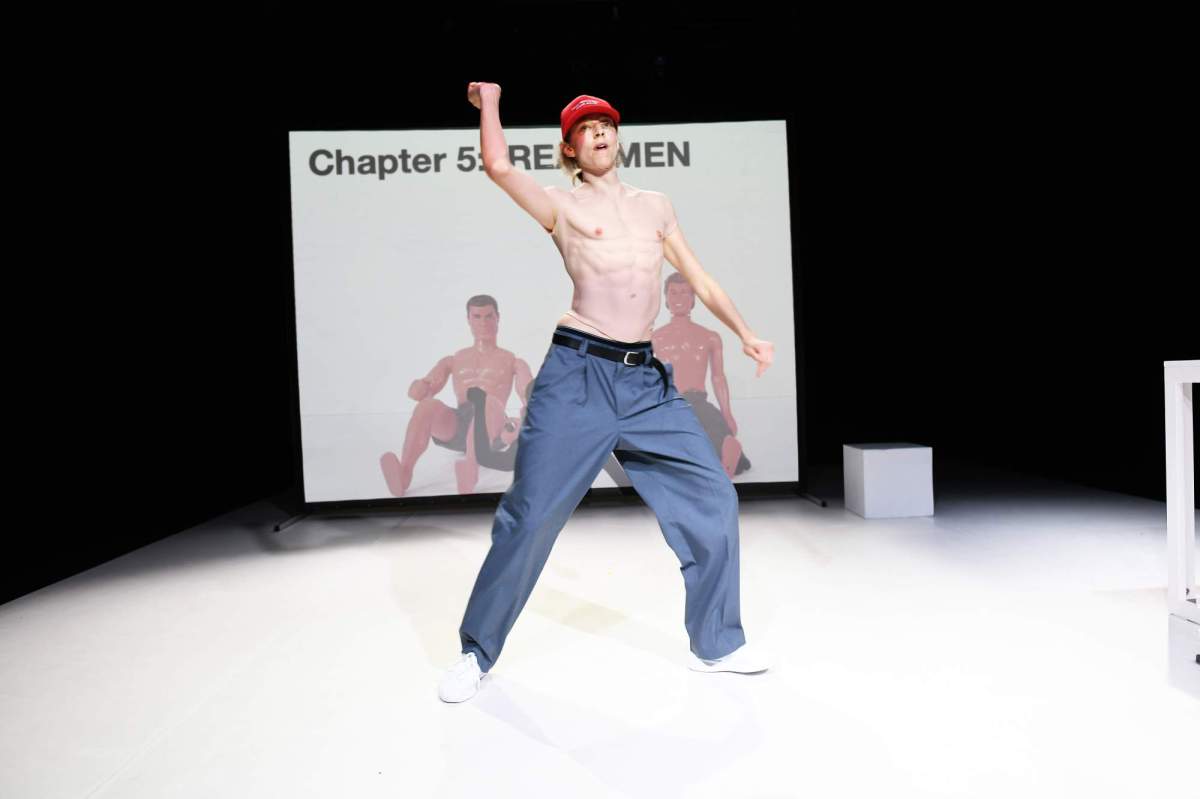
Admittedly, as someone who spends a lot of time in the company of words, it is (ironically) often the power of movement and the body, rather than text, that is the most striking conveyer of meaning. This was certainly the case in this show, as Orton’s surprising physical manipulations sparked many questions around the identities created through – and reflected in – the way we move and the poses we strike.
In one of the show’s most memorable scenes (and there are many), Orton raises the collar of their crisp white shirt over their head and buttons it up to be completely hidden inside. They are suddenly a very tall, yet faceless form, whose jerks and braces feel carefully restrained, but also brash and larger-than-life.
These moves are just some of the vivid reflections of the limitations (and dangers) of the supposedly normalised gender codes we are subject to in modern life.
But what’s also interesting about these movement sequences is when Orton’s body casts shadows upon the stark white screen behind them. This gives us even further room to ponder ideas of performative identities and acts of self-preservation. It’s effective – in some parts it’s funny – and it’s entirely fascinating to watch.
So, for those seeking a quality FRINGE WORLD experience this festival, know that Making of a Man is a finely-tuned, well-researched and thought-provoking exploration of many of the complicated forms and understandings of ‘masculinity’ in today’s world. It’s definitely worth seeing.