I had to pinch myself. Listening to Melbourne talkback radio in August, caller after caller was phoning in angry about the Productivity Commission’s suggestion that Australia’s copyright laws be changed to benefit AI companies. The general public was calling radio stations to defend copyright law!
As an advocate who has worked in the copyright sector across music, literature and visual arts for a decade, this was extraordinary.
Copyright is usually invisible – and brain numbingly boring – for most Australians. Yet here were everyday people understanding what was at stake: the culture of our nation; the livelihoods of our creators; the question of whether big tech should get a free pass to build billion-dollar businesses by stealing the work of Australian artists.
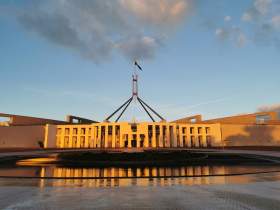
Last week’s announcement by Attorney-General Michelle Rowland ruling out any copyright exception for AI is a significant moment for artists and creators. We shouldn’t underestimate its weight. This is a globally significant development that shows real leadership from the Australian Government.
Like all meaningful policy victories, however, it didn’t emerge from a single announcement or any one organisation’s campaign. It’s been years in the making – starting with patient coalition-building and voices speaking up early when precious few were paying any attention, as well as the careful discipline to maintain unity when facing opponents with resources beyond anything we’ve ever seen in corporate history.
Copyright advocacy – quick links
From collaboration to coalition
In December 2022, Australian visual artists were among the first to call out AI imaging apps for stealing their work. Then in September 2023, the Books3 dataset was revealed to have used Australian books and plays to train AI on pirated content. In January 2024, AI was being used to create fake Indigenous art for stock image sites. First Nations voices sounded the alarm about cultural appropriation at an industrial scale.
In mid 2023, we coordinated the first creative industry roundtable on AI, bringing together organisations across music, screen, literature, publishing, visual arts and news media. We wrote to the then Attorney-General and, together, we signed the first joint public statement calling for generative AI models to be trained only on legally obtained data, as well as for transparency on both the inputs and outputs.
These campaigns weren’t initially coordinated; we were planting seeds and introducing ideas, making the case that this wasn’t just technological progress but a question of rights, consent and cultural sovereignty.
By the end of that year, Attorney-General Mark Dreyfus established the Copyright and Artificial Intelligence Reference Group, bringing together creative sector organisations, tech industry representatives, legal experts and academics to advise government on these complex policy questions.
That coalition stayed together, coordinating responses rapidly and effectively as tech companies pushed for copyright exceptions.
Research became our critical infrastructure. The APRA AMCOS AI and Music report, released mid-2024, surveyed over 4,000 music creators, modelled economic impacts and crucially gave voice to artists and shone an important light on the impact of AI on Indigenous Cultural Intellectual Property. It garnered over 400 news articles worldwide but it wasn’t just one organisation’s campaign tool: it became evidence the entire industry could use.
Other organisations such as the Australian Society of Authors, Australian Writers Guild and the National Association of Visual Arts contributed their research, expertise and relationships to grow our infrastructure. All through our work, artist voices remained central.
Read: We’ve achieved a successful AI copyright ruling – but ‘significant’ advocacy is still needed
As each sector presented evidence and spoke up, the media began connecting the dots. What had begun as isolated stories about tech curiosities became a coherent narrative about the wholesale theft of Australian creativity. This is how the public started paying attention. Not just creators worried about their livelihoods, but everyday Australians who understood intuitively that something was wrong.
Momentum builds
The 2024 Senate inquiry on Adopting Artificial Intelligence, chaired by Senator Tony Sheldon, brought the issue into sharp focus. When Meta admitted during hearings that it was ingesting photos of families and children from non-private accounts to train its AI systems, the abstract suddenly became very personal indeed.
This wasn’t just about artists’ livelihoods anymore. It was about everyone’s data, everyone’s creativity, everyone’s family photos being fed into AI systems without consent.
The federal election in May 2025 returned the Albanese Government, but the pressure on copyright didn’t ease. Tech industry darling and chair of the Tech Council Scott Farquhar took his case to the National Press Club and appeared on ABC’s 7.30, arguing that copyright was holding back AI innovation in Australia.
When the Productivity Commission then floated the idea of weakening copyright to help AI companies, the public responded – passionately. The talkback callers protesting in large numbers weren’t professional advocates. They were people who care about Australian culture, who value the artists and writers and musicians who shape our national identity.
This is what momentum looks like. Each new revelation – each dataset exposed, each artist who spoke up, each economic analysis demonstrating the harm – added to the collective understanding. The issue moved from specialist trade publications to mainstream news, from industry concerns to public conversation and parliamentary inquiries.
And we weren’t alone: this was a global fight. Our international counterparts continue to face the same pressure from the same tech platforms using the same arguments. We coordinate closely, share research, compare lobbying tactics, and learn from each other’s legislative battles.
When the UK withdrew its proposed text and data mining exception in 2023, recognising insufficient creator protection, our arguments were strengthened. The tech lobby is well-coordinated globally – so our response had to be, too.
The industry partnership held through two arduous years of sustained tech company lobbying, attempts to divide us and inevitable tensions. Organisations shared information, coordinated government meetings and ensured consistent messaging. Authors, songwriters and artists were defending their rights. The momentum built. The avalanche wasn’t any single organisation’s achievement, it was the cumulative impact of sustained, coordinated effort.
The hard work of effective copyright advocacy
Looking back over nearly a decade, there’s a clear pattern. When in 2016 the Productivity Commission attempted to overhaul copyright, a broad coalition came together – and succeeded. When Covid-19 hit in 2020, the music industry mobilised collectively – and secured substantial government relief. The AI copyright campaign built the broadest coalition yet of First Nations, literature, music, screen and visual arts voices.
The pattern is clear: patient coalition-building, genuine credit sharing and sustained coordination, subordinating individual interests to collective goals. It’s not sexy. It doesn’t generate the headlines that impress boards. But it works.
Trust is built slowly through consistency. It’s the result of organisations sharing information, coordinating messaging, acknowledging partners’ contributions and building relationships that endure. Last week’s copyright decision came from infrastructure built over a decade.
And all that hard work has only just begun. The next phase of developing practical AI licensing and consent frameworks requires the same approach.
Read: Copyright win for Australian artists vs AI – but how long can we hold off the bots?
But last week’s victory belongs to the visual artists who first called out AI theft, to the authors who spoke up about their stolen work, to the First Nations advocates who exposed fake Indigenous art, to the songwriters and artists who spoke publicly, and organisations who coordinated the sustained campaign that followed. It belongs to government ministers and officials who listened to evidence despite unprecedented tech lobbying.
This is how cooperative advocacy works. Not through any single approach but through the unglamorous, patient work of building trust, sharing information and maintaining unity even when it would be easier to break away.
That’s how we won in 2016 against the Productivity Commission. That’s how we survived Covid. That’s how we won last week on AI copyright. That’s how we build movements that last.