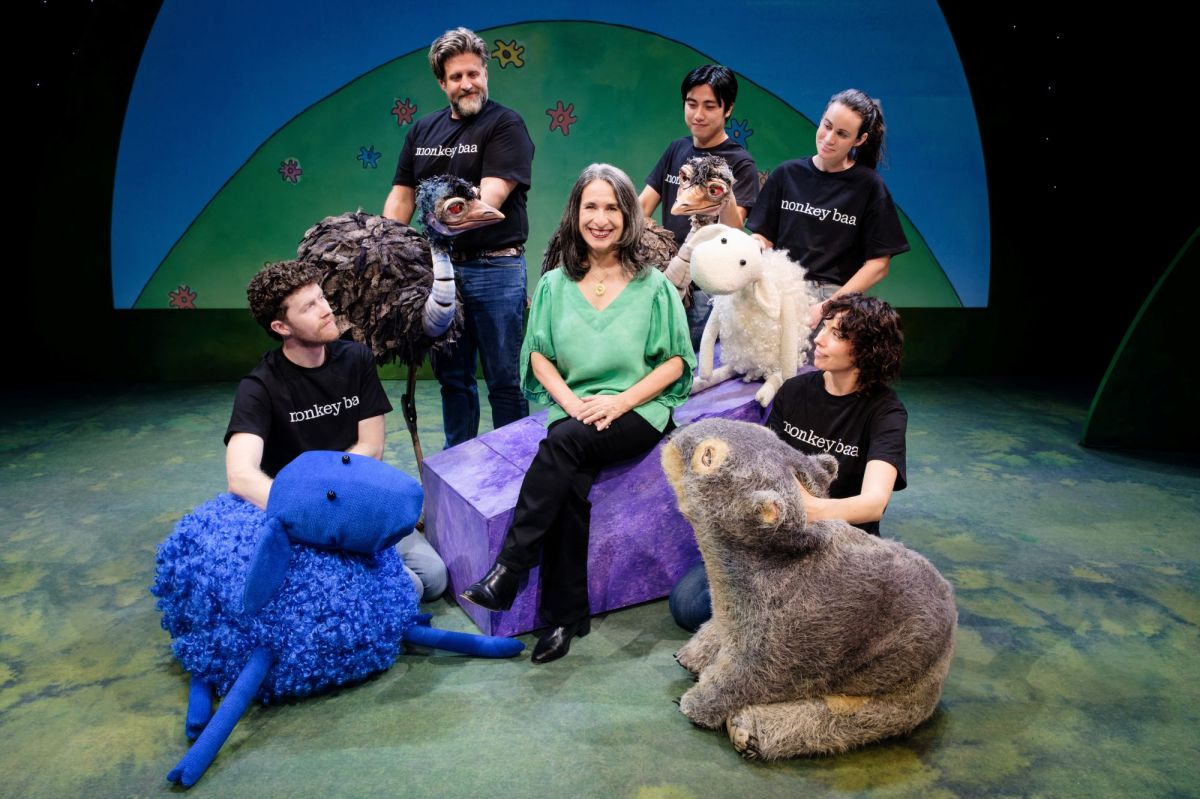
Eva Di Cesare, the Artistic Director and co-founder of pioneering theatre for young audiences company Monkey Baa, today (29 June) announced she will step down from her role at the end of 2027, the company’s 30th year.
The last of Monkey Baa’s original three co-founders – Tim McGarry and Sandra Eldridge amicably parted ways with the company in 2017 and 2023, respectively – Di Cesare tells ArtsHub she has announced her impending departure 18 months early to ensure a smooth and extended handover process for whoever the Monkey Baa Board selects to replace her.
‘Succession is so important in order to keep a company going, and being the last co-founder, and coming up to 30 years … it was last year that I thought, you know what? I really love a round number, and 30 years just feels right to me,’ Di Cesare says.
Leaving at the end of 2027 will ‘give [me] enough time to finish off my projects,’ she continues. ‘I’ve got another one that’s kind of in the making with a collaborator, another artist, so that I can then hand over the directing of that work to him – and I just think slow is better than fast.’
Eva Di Cesare and Monkey Baa – quick links
Eva Di Cesare’s ‘extraordinary legacy’
Di Cesare co-founded Monkey Baa with Eldridge and McGarry in 1997 with the belief that every young person – especially those living in regional and remote Australia – should have access to ambitious theatre works that are complex, thoughtful and moving. That conviction still defines Monkey Baa Theatre today.
‘When Tim and Sandy and I started the company, we thought we were doing one show, and that was The Bugalugs Bum Thief in 1997-98. We thought that was it,’ Di Cesare explains.
‘We were basically just creating some work for ourselves and a couple of other artists. We all loved children, we loved reading books and we loved theatre, and we really felt that there was a bit of a hole in theatre for young people … The conviction that we held then, as people coming from regional New South Wales and Victoria, was about ensuring that children in regional and remote parts of Australia had access to really good theatre for young people, and that has stayed true to this very day.
‘But we thought it was just going to be The Bugalugs Bum Thief, and then, you know, then we got a little bit more money for the next one, then the next one, and all of a sudden, here we are 30 years later,’ she laughs.

Under Di Cesare’s leadership, Monkey Baa has reached more than 1.8 million children and families across every state and territory and internationally. The company has built deep and lasting relationships across regional and remote Australia, and created work that has been recognised with Helpmann, Glug, Sydney Theatre and Drover Awards.
Bronwyn Edinger AM, CEO of The Events Centre, Caloundra, on Queensland’s Sunshine Coast, tells ArtsHub: ‘Eva Di Cesare’s unwavering belief that children’s theatre deserves the highest artistic standards has helped shape an extraordinary legacy. As a founding force behind Monkey Baa Theatre, she has played a defining role in influencing Australia’s cultural landscape … As she steps down, she leaves an indelible mark on the industry and a standard of excellence that will endure.’
Michelle Pearce, Manager – Performing Arts & Venues, Orange City Council, has worked with Di Cesare since a tour of Fairy Wings in 2001. ‘In that time, Monkey Baa has returned to Orange Civic Theatre almost every year, bringing unforgettable theatre experiences to what I estimate is more than 75,000 children … [Di Cesare’s] passion and belief in young audiences have left an indelible mark on our theatre, our community, and on me personally. I thank her from the bottom of my heart and wish her every joy in what comes next.’
The art of adaptation
Adapting Australia’s best-loved children’s books for the stage is an enduring aspect of Di Cesare’s practice. (She has also championed new Australian writing, commissioning work such as Yong by Jenevieve Chang and Detention by Callan Purcell and Kobra Sayyadi.)
Di Cesare has adapted or co-adapted more than 20 productions for Monkey Baa during her time at the company, including Possum Magic, Edward the Emu, Diary of a Wombat, Where the Streets Had a Name and Where is the Green Sheep?, which continues to tour nationally and will be seen by an estimated audience of more than 150,000 young people and families in 2026.
Jackie French AM, the 2014-15 Australian Children’s Laureate, Monkey Baa patron and author of iconic Australian children’s books Diary of a Wombat (illustrated by Bruce Whatley) and the novel Hitler’s Daughter – both of which Di Cesare has adapted for the stage – paid tribute to Money Baa’s departing artistic director.
‘Eva collected me from Sydney airport around the turn of the millennium in a car without intact seats or floor, but brimming with laughter and inspiration and a plan to do the impossible: turn Hitler’s Daughter into a play, encompassing the entire Third Reich on a small stage with four actors. It worked. Eva creates magic, from a theatre company to friendship. It’s made my life, and millions of others, profoundly richer. Two generations of young people have laughed, loved theatre, but also absorbed life’s deeper questions because of her,’ French tells ArtsHub.

Under Di Cesare’s artistic direction, Monkey Baa has also inspired other companies and artists, as Andy Packer, Artistic Director of the Adelaide-based company Slingsby, explains.
‘Eva has always been generous with her knowledge, incredibly encouraging of other makers’ work and an artist who continues to excite me with her bravery, passion for her audience and unwavering commitment to excellence. It is exciting to see Monkey Baa evolve beyond the founding artistic team, but this no doubt is the end of a glorious era. Eva’s work has made an indelible impact on the national TYA [Theatre for Young Audiences] movement – it will be poorer without her indefatigable positivity,’ Packer says.
The importance of touring
Touring is baked into Monkey Baa’s DNA, given the company’s long-established commitment to staging quality theatre for young people in regional and remote areas.
Nevertheless, the skyrocketing costs of touring, thanks in part to rising fuel costs, coupled with a cost of living crisis that sees audiences less willing to purchase tickets to live shows, are challenges for Monkey Baa – as indeed for all companies, as demonstrated by the recent cancellations of tours for the commercial musicals Back to the Future, Beetlejuice and Waitress.
‘For us as well, and for most touring theatre companies, it’s got harder and harder and harder [to tour],’ says Di Cesare. ‘It costs us between $400,000 and $500,000 to make a work … So, just to make the work is really expensive, and then to tour it with councils cutting art funding in regional towns – that’s been happening quite a lot for a lot of our beautiful presenters, on a regional and remote venue level.
‘So, I just can’t imagine what it would be to be a commercial company, that has, you know, probably paid hundreds of thousands of dollars in wages and what have you, every week. It would be very stressful. My heart goes out to those big commercial [productions] as well, because it’s hard for us, and it’s hard for smaller companies than us.
‘And we are rethinking touring, I think, in this country, just from a sustainability point of view. But [touring means] money is going into regional towns, so that arts groups can hopefully grow in those towns as well, which I support 100%. Yeah, it’s just a tricky time. Everything feels unstable in the whole world,’ she says.
Young audiences are Monkey Baa’s ‘guiding star’
In troubled times, committing to young audiences – who Di Cesare collectively calls the company’s ‘guiding star’ – helps both her and Monkey Baa stay focused.
‘I went into a classroom just a few days ago,’ Di Cesare says. ‘I just look at those children, and we play and we have a great time, and I just think, yeah, my life has so been worth it because of my proximity to them. It’s [also] about my own child inside me. I’ve nurtured her for all of those 30 years as well, so it’s been a blessed journey. I mean, it hasn’t been easy, some of it, but it is the children of Australia that have sustained me.’
Throughout that journey, she has nourished and supported people in turn, such as performer, dancer, actor and singer Nat Jobe, who has performed in a number of Monkey Baa productions to date.
‘I will always be so grateful to Eva for everything she has done for myself and countless other artists in the entertainment industry. From the first moment I auditioned for her, she has always nurtured, supported and encouraged my growth as a creative. And I know I am not alone in feeling this,’ Jobe says.
‘Over the years I have watched her champion so many members of our arts community. I’ve watched her lead the way in creating inclusive and diverse work. And she’s done all of this whilst remaining an all-round awesome and loving human. We are all so lucky to have had her at the helm of Monkey Baa for all these years.’
Read: Choreographer Lucy Guerin to step down from Lucy Guerin Inc at end of 2026
Sharing lessons learned with the sector
In a reflective mood throughout her conversation with ArtsHub, Di Cesare is nonetheless quick to share some key learnings from her time at Monkey Baa with her arts sector peers.
‘As an artist, I think something I learned – and it took me a while to learn it – is that I don’t have to have all the answers at the beginning of a process,’ she says.

Di Cesare came to directing relatively late in her career, directing her first Monkey Baa shows in 2017, 20 years after co-founding the company.
‘For a while there, I was really scared because I thought I had to have all the answers before I walked into the rehearsal room, because everyone was going to look at me for the answers. What I learned, with some really great advice from some really wonderful artists around me – including my two co-founders – is that you just don’t have to have all the answers.’
Instead, it’s a matter of trusting ‘the confluence of all the artists that come into the room with you – the people you choose to work with and to collaborate [with],’ she explains, and allowing ‘that organic process to help you solve some of the challenges of the work that you want to present’.
Her second lesson is for artists working in the Theatre for Young Audiences sector.
‘If you are creating work for young people, don’t assume you know what young people want. You must work with young people to understand them, and that is why we have developed a practice of going into schools, working with young people and understanding what’s important to them before you endeavour to create a work for them,’ Di Cesare explains.
‘[Such work] needs the authenticity of connecting with your audience before you create for them. And also, ask yourself why you’re creating for them, because if it’s about making money, if it’s about anything else but the love of creating work for children, yeah, forget it, because it is a hard, hard slog.’