We’re all fiddlers on the roof, Ukrainian milkman Tevye (Troy Sussman) tells us in the opening moments of the eponymous Broadway classic – just trying to make ‘a pleasant, simple tune’ without falling to our deaths. It’s an awkward metaphor, perhaps, but an apt one – and it is, after all, tradition (cue the music).
With music by Jerry Bock, lyrics by Sheldon Harnick, and book by Joseph Stein, Fiddler on the Roof first came to Broadway in 1964. Set in the fictional Ukrainian village of Anatevka in 1905 during the Pale of Settlement, when the country was under the control of Tsarist Russia, it’s based on the works of Jewish author and playwright Sholem Aleichem, who drew on his own formative experiences.
Our hero, Teyve, is a man at a crossroads. A traditional Jewish patriarch, he loves his wife, Golde (Alexis Fishman) and his five daughters, supports and argues with his neighbours, and laments his poverty and misfortunes, often complaining directly to God – which is to say, us.
That’s one way to make an audience feel special. It also underlines our role as moral arbiters of the drama unfolding before us – do we approve? Would God? We, like Teyve, rail against the baffling injustices of His plan – but we enjoy seeing them inflicted on him. There’s no drama without conflict, of course – maybe God just really likes His stories.
This particular story sees Teyve trying to pair off his five daughters through the traditional method of consulting the village matchmaker, Yente (a delightfully crotchety Sigrid Thornton). After some dickering, a match is found for eldest daughter Tzeitel (Freya Boltman) in the form of the widowed, wealthy, but aged butcher, Lazar Wolf (John Waters). That’s bad news for Tzeitel, as she loves her childhood friend, the penniless tailor Motel (Felix Star).
That clash is just the start of Teyve’s troubles. Prickly second daughter Hodel (Ellen Ebbs) strikes sparks with firebrand university student Perchik (Maxwell Simon), while bookish Chava, his third, connects with gentile Fyedka (Jacob Steen), much to Teyve’s horror – his beloved traditions are being torn down in front of his eyes. But while domestic dramas occupy his attention, in the background the threat of pogrom is rising.
Fiddler on the Roof: old and new
There’s a risk with something like Fiddler on the Roof, a story that was already old when it first hit Broadway back in the 60s, will feel dated. What’s impressive about this new production from director Jordan Fein and resident director Gary Abrahams is how much it defies that expectation.
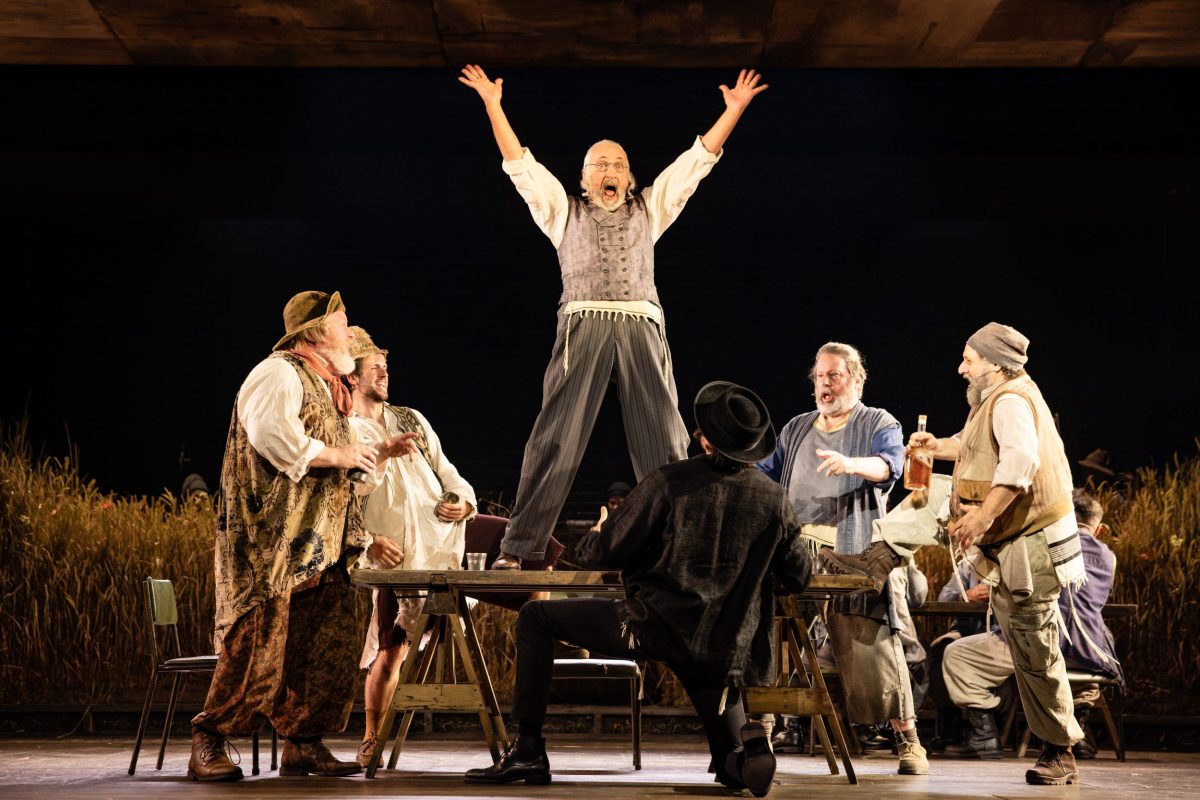
Interestingly, things don’t have to be changed much to be relevant; the oppression of women, antisemitism, ethnic identity, and the threat of genocide and forced migration remain horribly timely topics. Sometimes its just the details; it’s hard to watch a show set in Ukraine without thinking about, well, Ukraine (Tom Scott’s elegant, versatile production design, all fields of golden wheat, nods to this).
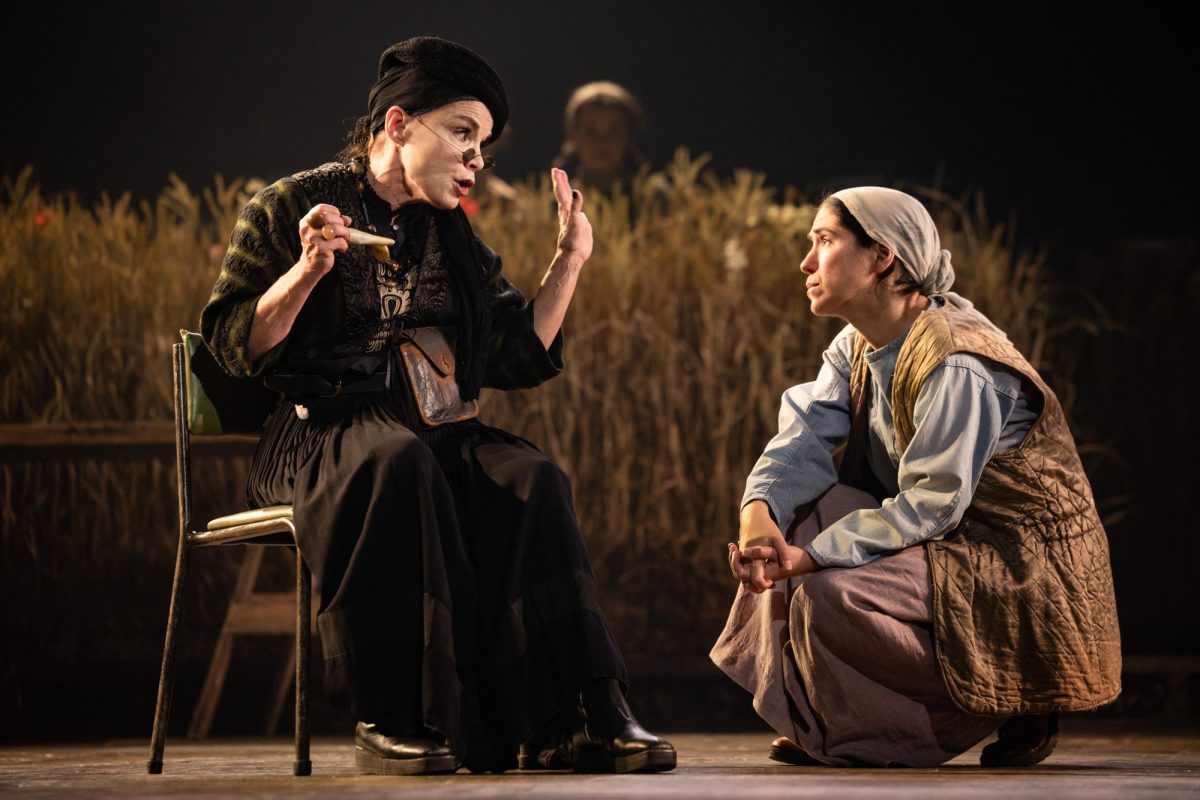
But for all that it deals with perennially heavy topics, Fiddler on the Roof pulses with life. This is a joyous, full-throated production that delivers a palpable sense of community and belonging, of persistence and resilience. While strong feature performances abound – I particularly love Felix Star’s spectrum-coded Motel, and Waters’ blustering Lazar Wolf – it’s the ensemble that particularly impresses.
There’s an old critical cliché, common to film writing, that a location can be a character, and here that’s achieved by filling the stage with bodies – singing, dancing, celebratory bodies, moving to Julia Cheng’s superb choreography (the Bottle Dance remains a banger) and backed by musical director Dominic Woodhead’s noisome, rambunctious band, with acclaimed violinist Ben Adler as the fiddler.
There’s an even worse cliché that runs ‘this is the show we need right now’, but given Fiddler on the Roof is all about hope and community in the face of oppression, maybe it passes muster just this once.