Ten editions on, has the Sydney Contemporary art fair kept its big promises?

While sales have ebbed, signs of market maturity and growing engagement are recalibrating how we register success of Australia’s largest art fair.
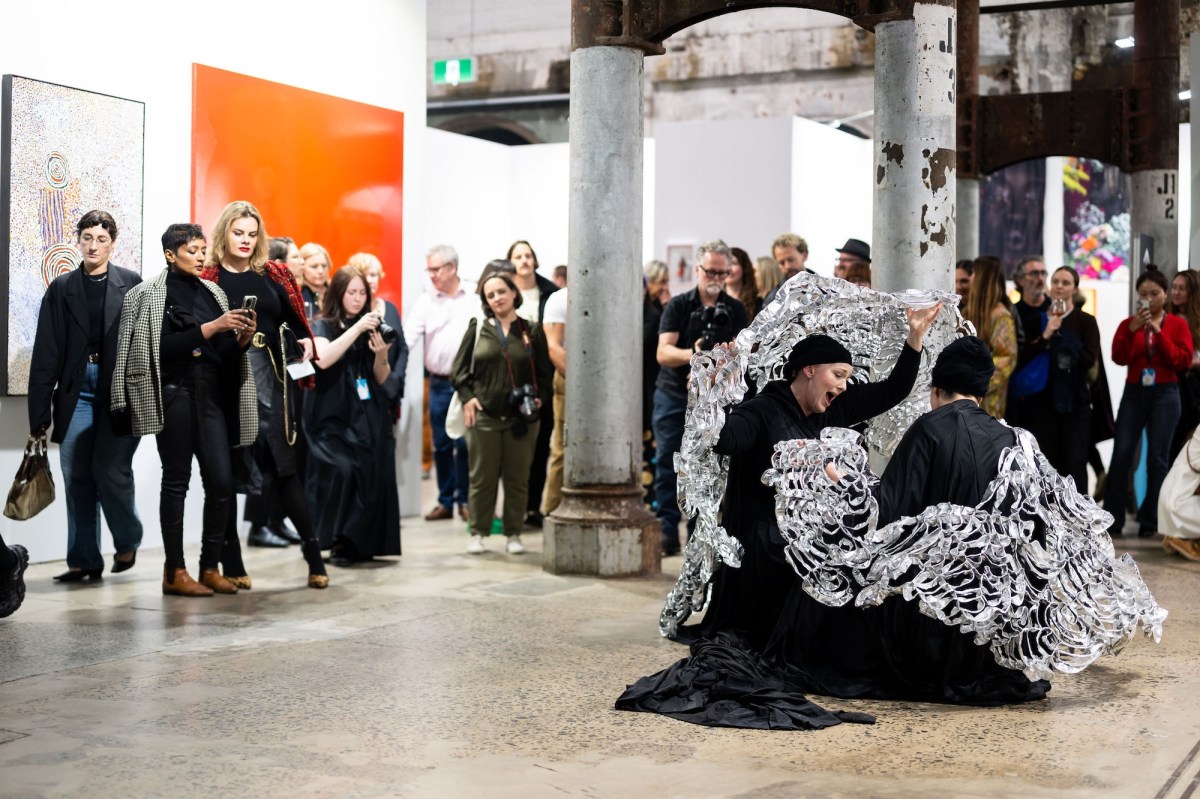
Performance Contemporary, Sydney Contemporary 2025. Photo: Wes Nel Photography.

When Sydney Contemporary made its debut inside the expansive, industrial space of Carriageworks in 2013, the pitch from London-based founder and fair entrepreneur Tim Etchells was unapologetically ambitious.

Australia was to finally have a world-class, commercially aggressive art fair capable of anchoring the Southern Hemisphere. More than a decade later, as it gears up for its 2026 edition from 3 to 6 September, the fair is an undeniable fixture of the Australian cultural calendar. But has it met its goals?

Where we stand now

Over 10 editions, Sydney Contemporary has endured an existential venue crisis, a global pandemic, leadership transitions and a shifting economic tide that has forced it – and its participating galleries – to radically rethink what success looks like.  

The original ambition was clear – to inject vital capital directly into the hands of living artists, to nurture a new generation of contemporary art collectors, and establish a regional hub that could stand shoulder-to-shoulder with the likes of international fairs like Frieze or Art Basel. 

Sydney Contemporary 2025, Carriageworks. Photo: Supplied.

Yet, beneath the glamour of VIP vernissages, champagne and bustling aisles lies a complex narrative.

Has Sydney Contemporary delivered on the grand promises made at its inception? The answer is a nuanced study in commercial triumph, structural disruption and the sober realities of a changing regional market.

The numbers: a $154 million sales catalyst

By purely financial metrics, Sydney Contemporary has proven itself to be a heavyweight of the Australasian commercial art ecosystem. Across its history, the fair has welcomed over 250,000 visitors through the doors at Eveleigh and has generated a staggering $154 million-plus in reported art sales.

It also transformed the traditionally sleepy month of September into Sydney’s primary art-buying week, creating a commercial magnet for galleries from across Australia, New Zealand, Asia and beyond (though perhaps not as much ‘beyond’ as original hoped for).

The sales trajectory, however, reveals a market in transition. The fair hit its commercial high in 2022 with a record $23 million as post-pandemic buying fueled the market. Since then, rising interest rates, inflation, and a lingering cost-of-living squeeze have cooled discretionary spending.

  • 2013: $10 million – inaugural fair kicked off with a rave-like attendance
  • 2017: $16 million – a slow creep, but the sales start to grow as the fair moves from a biennial to annual event
  • 2018: $21 million – five years in and confidence in the event is driving sales forward
  • 2019: $18 million – sales reflected a boarder flatlining in consumer spending, and legislation restricting Super funds holding art
  • 2020: $1.5-1.8 million – Covid pandemic forces pivot to online
  • 2021: $4.5 million – pandemic keeps the fair online, but sales pick up
  • 2022: $23 million – post-lockdown pent-up demand drew just under 29,000 people
  • 2023: $21 million – beginning of broad macroeconomic tightening and new fair director
  • 2024: $17.5 million – selective buying and secondary market moderation, with attendance falling to 25,000
  • 2025: $16 million – surging attendance of 26,440, but more cautious transaction behaviour.

Four consecutive years of declining sales might raise look alarming, but the galleries participating throughout the fair’s history describe it as a more complicated shift in buyer psychology.

Gallerists reflect on growth and collector confidence

Sullivan+Strumpf Gallery Director Ursula Sullivan has watched that change from the beginning. Her gallery, which now has bases in Sydney, Melbourne and Singapore, has participated in every edition, from the early days when Sullivan says Sydney Contemporary was still working out ‘what it meant to the collectors, the city and the broader art community’.

‘It was almost a test as the first “major” art fair for Sydney, and for Australia,’ she says. ‘There was some mad energy to that period, but also a sense of everyone – organisers, galleries, collectors – all trying to make it matter.’

A decade later, that uncertainty has largely disappeared. ‘There have always been mature collectors in Australia, but Sydney Contemporary introduced new people to the concept of contemporary art,’ Sullivan says.

‘A decade ago we were talking to many somewhat new and nervous collectors, a little unsure of their own eye. That’s diminished enormously.’ Those collectors, she says, now buy ‘with real conviction and confidence’, while a younger generation increasingly regards collecting Australian and Asia Pacific art as something to be proud of.

‘Sydney Contemporary has been a genuine engine of that shift,’ Sullivan adds.

That speaks directly to Etchells’ original objectives. In an earlier interview with ArtsHub, he said the key question after a sale was not how much had been sold, but ‘I ask them [participating galleries] who they’ve sold to. Is it somebody they knew? Because I want to deliver new customers for them, that’s my main objective. There’s no point in me just churning people that they already known. I have to help them broaden their base, and that’s something that we do.’

That evolution is also visible in the timing and nature of sales. Etchells has noted that the transaction cycle has lengthened over that decade. Collectors are no longer necessarily panicking to buy on the floor within the first two hours of VIP night; major six-figure deals can be finalised weeks after the booth walls have been packed down.

Triumphs, losses and structural realities

The fair’s 10-edition journey has been anything but smooth sailing. In 2020 its home at Carriageworks went into voluntary administration due to the collapse of event revenue during the Covid pandemic.

Although the precinct was ultimately rescued by philanthropic interventions, the crisis highlighted the fragile infrastructure underpinning Australia’s major arts events.

For Barry Keldoulis, Sydney Contemporary’s inaugural Fair Director (2013-23), the first challenge came even earlier. ‘There was a sometimes-verbalised idea that Sydney was not ready or right for a premium art fair,’ he recalls.

Opening night quickly dispelled that notion. Keldoulis remembers a ‘tsunami of people’ flooding into Carriageworks, with Redfern station temporarily closed because of the sheer volume of visitors. Friends described it as their first-ever ‘art traffic jam’.

Barry Keldoulis, former CEO and Fair Director of Art Fairs Australia, standing in front of a painting Gregory Hodge. Photo: Zan Wimberley.

A former gallerist, Keldoulis had initially envisaged Sydney Contemporary as a Pacific Rim fair, bringing together colleagues from the Pacific, South America, California and Asia alongside Australian exhibitors. ‘International participation was something we aimed for, and achieved, but which ultimately has been stymied, to a certain extent, by circumstances beyond anyone’s control,’ he tells ArtsHub.

‘Then Covid hit, and the cost of international shipping skyrocketed and has not really settled back down,’ he says. The result has been a broader regionalisation of the global art-fair circuit.

‘In a sense, most fairs, apart from the biggest, have become regional affairs,’ Keldoulis says. ‘Which is not necessarily a bad thing, as it’s important to support your own!’

ArtsHub: Exit interview, Barry Keldoulis, Sydney Contemporary

Anna Jackson, Gallery Director at Auckland’s Gow Langsford, has noticed the same shift. ‘In the early days there seemed to be a greater international presence, with more international galleries participating,’ she says. ‘That has shifted over time, and the fair now feels much more focused on the Australian gallery landscape and audience.’

She sees this less as a retreat than a maturing domestic market. ‘I think that reflects the broader maturation of the Australian art market, but also the changing economics and logistics of participating in an international fair,’ she says.

‘Freight, logistics and direct costs have risen significantly, and the kind of international jet-setting that characterised the fair circuit in the past has reduced, particularly since the pandemic,’ says Jackson. At the same time, ‘there is also a much greater number of fairs competing for galleries, artists, collectors and audiences’.

‘Sales are obviously important,’ says Jackson, ‘but we have never relied on fair sales as a predictable percentage of our annual budget because they can be so variable.’

She continues, ‘The landscape is changing rapidly and continues to evolve. While some international fairs are winding up, others are emerging, so there is a constant reassessment of the role and viability of the art fair model.’

Sydney Contemporary is more than just art sales

For galleries, that means a fair can no longer simply be a place to sell stock. ‘For us, fairs have always been as much about audience-building and maintaining relationships as they have been about direct sales,’ Jackson says.

The strategic value of participation has therefore grown. Sullivan sees much the same transformation. ‘Ten years ago, a fair was largely about just being there – you went to see the usual people, and any sales were probably what you would have sold anyway,’ she says. ‘Now fairs are a core part of what we do, and very much a part of audience development.’

Sydney Contemporary 2025. Photo: Wes Nel Photography.

Sullivan continues, ‘I think that role has become even more important as the fair landscape has become more congested. We have to be selective about where we commit our time, resources and artists because you simply can’t do everything.’

The good fairs, Sullivan argues, have to offer something a gallery cannot easily replicate on its own. ‘They compress months of relationship-building into four days and put our artists in front of a large audience we might not otherwise reach in one place.’

From marketplace to expanding cultural platform

Perhaps Sydney Contemporary’s most significant achievement has been its gradual expansion beyond a mere marketplace.

Through sectors such as Works on Paper, Futures, Installation Contemporary and dedicated First Nations and photography presentations alongside talks and performances, the fair has created more entry points for younger collectors and audiences who may not consider themselves art market insiders.

For Fair Director Zoe Paulsen – who took the helm in 2023 – the 10th edition represented not simply an anniversary but a deliberate statement about where Sydney Contemporary goes next.

Paulsen says the marketplace remains central, but the fair increasingly functions as a platform for ideas and experiences around contemporary art. With support from Destination NSW, the 2026 edition also takes work into public spaces with installations at Sydney Fish Markets and Barangaroo.

‘Taking work beyond Carriageworks allows us to bring ambitious contemporary art into unexpected public spaces, and reach people who may not necessarily come through the doors of an art fair,’ Paulsen says. ‘It create a stronger connection between the fair and the city in which it takes place.’

‘So while the anniversary has been a catalyst, I see it much more as the beginning of the next chapter than a one-off celebration.’

Vision vs reality

Measured against its original ambitions, Sydney Contemporary’s record is mixed – but arguably more substantial than the raw sales figures suggest.

It has not turned Sydney into Hong Kong, London or New York. Nor has it become a truly global mega-fair on the scale of Frieze or Art Basel. The Pacific Rim ambition Keldoulis describes was curtailed by forces that affected the entire international fair circuit, from Covid to freight costs and the economics of global gallery travel.

Instead, Sydney Contemporary has become something more regionally specific – a central marketplace and meeting point for Australian contemporary art. That may represent less of a failure of ambition than a recalibration of what a successful art fair can be in a relatively small, geographically isolated market.

Installation view Angela Brenan, The Commercial, 2025 Sydney Contemporary. Photo: Wes Nel Photography.

Jackson sees the fair’s evolution as part of that broader maturation. Its audience now has ‘a greater sense of familiarity and engagement with the fair as an established part of the Australian art calendar’.

For Sydney’s Utopia Gallery, that annual gathering remains a useful measure of the health of the market itself. ‘It’s an indicator of the quality of the art scene, and a test for the local collecting community,’ a gallery spokesperson tells ArtsHub. ‘Every year we try to bring the brightest and the best, to put our best foot forward with classics from our senior artists and the latest from the emerging.’

The fair has also become an annual social ritual, where commerce and cultural spectacle are deliberately intertwined. As Utopia’s spokersperson puts it, ‘Curators, collectors and partygoers unite in a great celebration of art’.

And for Paulsen, the fair remains viable because it continues to solve a real problem for every part of the ecosystem. ‘Galleries need opportunities to present artists to new audiences and build their collector bases; artists need opportunities for their work to be seen, discussed and acquired; and collectors want the opportunity to discover art and engage directly with the people behind it,’ she says. ‘The fair brings all of those things together in a concentrated way.’

That is a more modest proposition than becoming the Southern Hemisphere’s answer to Art Basel, and perhaps also a more meaningful one.

There are galleries that have exhibited since the inaugural edition, collectors who return annually, and artists whose careers have developed alongside the fair. The pressures on that ecosystem, however, are real. Smaller, more accessible events such as the Affordable Art Fair have captured budget-conscious buyers, while high-end collectors are increasingly selective. International fairs are reassessing their models. Galleries are weighing freight bills and crowded calendars against increasingly strategic returns.

The old model of simply turning up, selling hard and moving on is no longer enough.

Sydney Contemporary’s answer has been to broaden rather than retreat: more sectors, more public programming, more emerging artists, more engagement with the city, and a stronger emphasis on the relationships that underpin the market.

‘That combination of continuity and renewal is important,’ Paulsen says. The art market has changed enormously over the past decade, but she argues, the value of physical encounter has not. ‘If anything, that physical encounter, seeing work in person, having conversations with artists and gallerists, discovering something you weren’t expecting, feels more important than ever.’

Sydney Contemporary has not transformed Australia into a global art market capital. What it has done is give the country’s contemporary art scene a commercial backbone, a professional stage and a crucial annual moment in the sun.

Sydney Contemporary will be presented from 3 to 6 September at Carriageworks.

Discover more screen, games & arts news and reviews on ScreenHub and ArtsHub. Sign up for our free ArtsHub and ScreenHub newsletters.

Gina Fairley is ArtsHub's Senior Contributor, after 12 years in the role as National Visual Arts Editor. She has worked for extended periods in America and Southeast Asia, as gallerist, arts administrator and regional contributing editor for a number of magazines, including Hong Kong based Asian Art News and World Sculpture News. She is an Art Tour leader for the AGNSW Members, and lectures regularly on the state of the arts. She is based in Mittagong, regional NSW. Instagram: fairleygina