Profits or losses for contemporary dance companies: who’s in best and worst shape?

In lean times for the sector, contemporary dance companies are maintaining stability while some are securing partnerships to extend their reach.
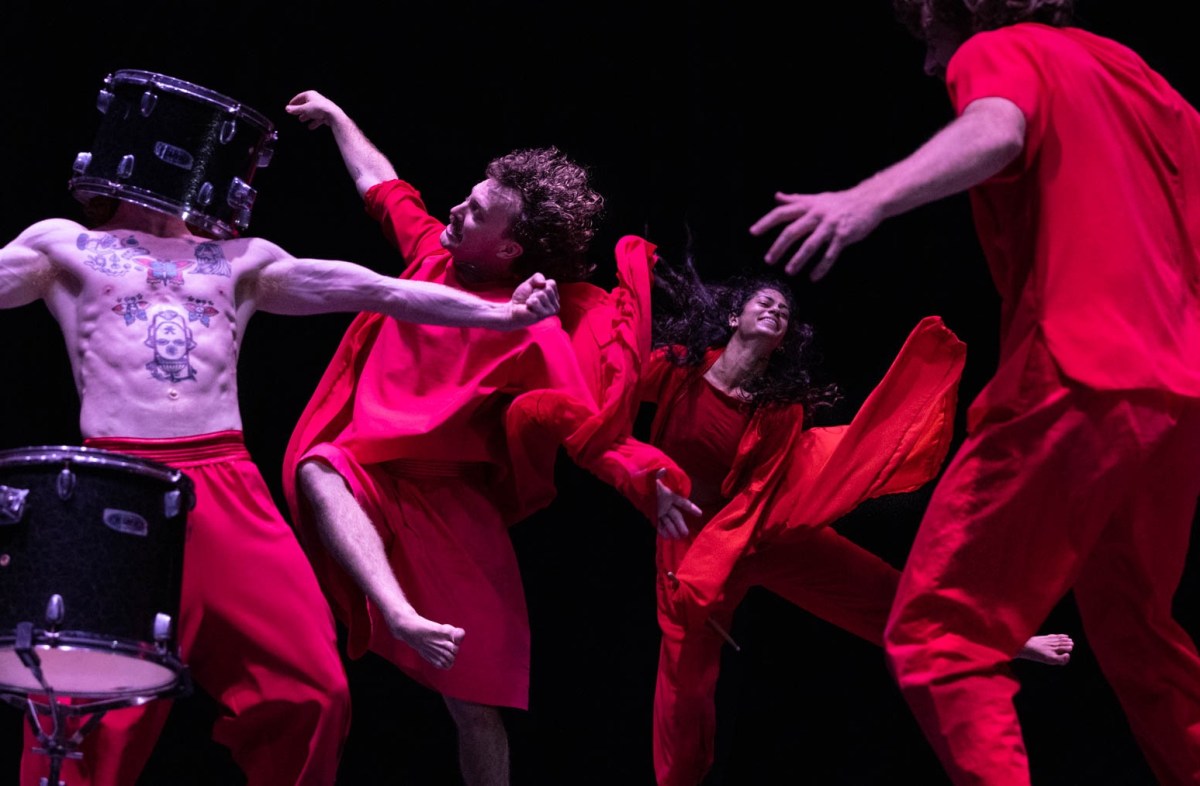
contemporary dance: a photo of four dancers, three of whom are dressed in a bright red costume moving vigorously on stage against a black background. One of the four, a male dancer, is bare-chested and his head is covered with a drum (musical instrument). There is another drum on stage pictured at the of the photo.

The current reporting season for the not-for-profit sector makes it a good time to survey the landscape and reflect on arts companies’ recent financial results.

Particularly interesting is to look at outcomes over the past three years for some prominent Australian contemporary dance companies – a genre typically associated with niche audiences, but also one known for its creative dynamism and works that support high levels of experimentation.

For this survey, ArtsHub has compiled some big picture financial and attendance data from six of Australia’s contemporary dance companies: Australian Dance Company; Australian Dance Theatre; Chunky Move; Co3; Dancenorth; and Sydney Dance Company.

These results, when taken with comments from each company, reveal how each is carefully navigating the difficulties of a tough operating environment.

A large company makes the largest loss

A quick view of the past three years’ annual profits and losses shows the largest company on the list – Sydney Dance Company – has recorded the largest losses. However, when viewed alongside its recent output, and taking the tough external conditions into account, it’s clear to see why deficits have been recorded.

As SDC tells ArtsHub, the company has faced significantly higher touring and production costs in recent years, as well as changing ticket-buying patterns, especially in relation to younger audiences and families.

The company also points out that government funding has not kept pace with real cost growth – an observation reiterated by the other dance companies ArtsHub spoke to for this story (not to mention other not-for-profit government funded performing arts companies who are not part of this article).

Profit or loss snapshot (rounded figures)
Company202320242025
Australasian Dance Company-$194,869-$69,945$41,636
Australian Dance Theatre$11,774$20,388$26,948
Chunky Move-$163,316$10,741-$16,811
Co3-$222,697$28,080$67,341
Dancenorth$139,342$54,051$18,098
Sydney Dance Company-$1.77 million-$1.92 million-$1.09 million

Annual spending indicates dance companies are holding the line

As shown in the data below, the spending and income patterns of each company have fluctuated recently. As the companies themselves describe, these trends are explained by annual programming decisions and touring opportunities.

While each financial outcome has its own bespoke story, it’s noteworthy that most recently, in 2025, all companies here show stable or improved outcomes in their net profit and loss results.

Income (rounded figures)
Company202320242025
Australasian Dance Company$2.3 million$1.74 million$2.6 million
Australian Dance Theatre$3.02 million$2.67 million$3.56 million
Chunky Move$1.77 million$2.2 million$2.4 million
Co3$1.44 million$1.3 million$1.61 million
Dancenorth$2.89 million$4.06 million$2.51 million
Sydney Dance Company$13.3 million$14.3 million$14.4 million
Expenditure (rounded figures)
Company202320242025
Australasian Dance Company$2.49 million$1.81 million$2.59 million 
Australian Dance Theatre$3 million$2.65 million$3.54 million
Chunky Move$1.94 million$2.21 million$2.43 million
Co3$1.27 million$1.66 million$1.55 million
Dancenorth$2.76 million$4.01 million$2.5 million
Sydney Dance Company$15 million$16.2 million$15.5 million

How Australian dance companies are faring

Australasian Dance Company records strong 2025

As ADC Artistic Director and CEO Amy Hollingsworth tells ArtsHub, her company’s recent financial results reveal a deliberate strategy of investing in artistic ambition, audience growth and long-term sustainability.

‘While the results are in-keeping with our board’s careful long-term planning decisions, it’s important to understand that ADC operates with a distinct rhythm. We naturally oscillate between outward-facing years characterised by major performance seasons and touring, and years that are more focused on creation, artistic development and building the relationships that underpin future opportunities.’

She explains that, ‘In 2024, we intentionally prioritised creation and choreographic residencies while also investing time in reconnecting with our alumni community ahead of ADC’s 40th anniversary in 2025. With only one public-facing season presented during the year, attendance figures reflect just one aspect of the company’s activity.’

Hollingsworth notes how important it was for ADC to spend more time in the studio in 2024 preparing works for extensive touring in 2025 – a year the company achieved paid attendance of 21,873 as a result of that activity.

A particular highlight of ADC’s 2025 tours was taking its work Bad Nature on a 36-show journey across France and the Netherlands with Dutch contemporary dance collaborators and co-creators Club Guy & Roni.

Australian Dance Company202320242025
Overall attendance9407208222,826
Paid attendance8205151921,873
Australian Dance Theatre saw a quieter 2024 after huge tours in 2023

ADT’s results from 2023 to 2025 show the company is, financially speaking, performing steadily – spending almost as much as it’s making each year. Its overall company equity – while still a small proportion of its annual spending – is also going in the right direction, and is rising not falling.

In a similar position to ADC, the company’s recent attendance numbers show a more uneven picture – but there are good reasons for this.

As ADT Executive Director Nick Hays tells ArtsHub, ‘the differences between our 2023, 2024 and 2025 attendance numbers are because in 2023 we toured [ADT Artistic Director] Daniel Riley’s work THE HUM to Sydney and Melbourne as part of The Australian Ballet’s Identity season, which saw us move from touring in our usual box office contexts – which are typically black box, smaller scale theatres performing only a few shows in each city – to performing in much larger venues for an extended period of time.’

ArtsHub: ADT’s Faraway review at Adelaide Festival 2026

Hays continues, ‘In Melbourne THE HUM was presented [in 2023] at the State Theatre, which has a capacity of over 2000, and in Sydney it played at the Joan Sutherland Theatre at the Sydney Opera House which has a capacity of over 1000.

‘Additionally, we had a national tour of our work Tracker, made in collaboration with Ilbijerri Theatre, supported by the Major Festivals Initiative, which saw us perform at every major Australian festival.

‘The following year [2024] was very much about getting ready for our 60th anniversary in 2025, developing two major new works and setting up our biggest national tour in decades.’

This 60th anniversary year also saw ADT present a special free exhibition at Adelaide Festival Centre that included ADT archival material and seminal choreographies by each of the company’s artistic directors since 1965. This free exhibition attracted 6000 people and is the main reason ADT’s overall attendance is much larger than its paid attendance in 2025.

Australian Dance Theatre202320242025
Overall attendance33,166205613,164
Paid attendance26,69111255596
Chunky Move records consistently solid results

Overall, Chunky Move’s recent results are solid, but as the company explains, its ‘on-paper’ paid attendance results differ from its overall attendance. That’s because in most cases, the company does not receive ticket income for shows presented by festivals and venues who buy-in Chunky Move work, with these arrangements involving presentation fees rather than box office income.

As a company spokesperson explains, ‘Our ticketing data only reflects income received for seasons we have presented in-house or in a presentation arrangement where we are receiving a portion or all of the box office income.

‘So, our paid attendance figures for 2025 was for the season we presented in-house of Phantasm by Melanie Lane only. We don’t have income figures for the five seasons of our major work U>N>I>T>E>D, the Serendipity Arts Festival season of You, Beauty or Mythosoma, which was presented as part of YIRRAMBOI festival. These were major components of our 2025 performance program.’

Chunky Move202320242025
Overall attendance823810,86519,313
Paid attendance210765776208
Co3’s low-cost year reveals sector challenges

The smallest and youngest company on this list is Perth-based Co3 Contemporary Dance. Executive Director Hilary McKenna tells ArtsHub he is especially cognisant of the increasing cost pressures in the sector, which are presenting particular impediments to the growth of smaller arts companies.

‘The increased costs of project delivery, goods and labour has had a massive impact on Co3, as it has for everyone in the sector,’ he says.

‘Most recently, we been able to offset those higher costs by making savings in some operational areas – such as having a staff position vacant for a lot of 2025 while we were recruiting for a suitable candidate for that role.

‘But the wider concern for us is that this model of cost savings, and this method of achieving an annual surplus, is unsustainable in the long term. While prudent cost management remains important, long-term financial sustainability will ultimately require growth in income and revenue, rather than continued reliance on cost reductions alone.’

Despite these cost pressures, Co3’s most recent attendance figures show a huge spike in overall attendance (more than doubling to 19,298 in 2025). Yet as McKenna explains, this increase needs to be read in the context of the company’s programming that year.

‘Performance is only one of the three pillars of our company, alongside with Pathways and Engagement. In 2025, we were thrilled to be invited to represent Australia at Expo Osaka in Japan, which alone introduced Co3 to an estimated 9800 people,’ Hays says.

‘However, we achieved lower paid ticket sales in 2025 because we presented our mainstage seasons in smaller, more affordable spaces, rather than in venues like the State Theatre Centre or His Majesty’s.’

Co3 Contemporary Dance202320242025
Overall attendance2107661819,298
Paid attendance325554462316
Dancenorth reaches greater audiences through partnerships and tours

For Dancenorth, the past three years have seen somewhat uneven activity, with intense bursts of performances followed by quieter times where smaller-scale intimate projects were either in development or production.

In 2023, 6250 people attended the company’s free, open-air performance Bambarra-ma Dariburu (It’s good to make good) – which was a largescale festival work commissioned by the North Australian Festival of Arts.

Also that year, members of Dancenorth’s ensemble appeared in Opera Australia’s production of Wagner’s Ring Cycle which was exclusive to Queensland Performing Arts Centre. A total of 18,683 people attended that epic season of opera, accounting for 88% of the company’s paid attendance figures in 2023.

The following year, paid attendance was also very strong thanks to national and international tours of the Dancenorth work Wayfinder – a piece seen by a total 9089 people in 2024. But as Dancenorth Co-CEO and Executive Director Hillary Coyne tells ArtsHub, the impact of a work is not necessarily measured by the size of its audience.

ArtsHub: Dance review – Wayfinder, Monash Performing Arts Centre (2024)

‘In an era where the arts remain one of the last domains for genuine connection, experiences with smaller audiences, in smaller venues or in smaller regional communities, feel increasingly vital,’ she says.

She also cites Dancenorth’s 2025 program where, after a huge year of touring in 2024, the company prioritised being home in Townsville to celebrate its 40th anniversary with local audiences.

‘The centrepiece of our 40th anniversary celebration was the development and premiering of a complex site-specific work, A Live Moment,’ Coyne says.

‘In addition, we developed and presented seven short works through our annual Tomorrow Makers program as well as continuing development on a full-length work by Michelle Heaven, due to premiere in 2026. We also commenced development on a major new work in 2025, which is due to premiere in 2027.’

Clearly, these quieter times of research and development are crucial to allow the incubation of quality new works to happen, which inevitably leads to ‘larger’ years for companies as those works are presented and (ideally) toured across the country and the world.

Dancenorth202320242025
Overall attendance44,62612,70111,198
Paid attendance21,07610,5102679
Sydney Dance Company works towards surplus

Alongside significantly higher touring and production costs, SDC also cites the issue of presenters’ budget constraints, which limits the fees it can charge for its performances. A further issue is the impact of non-cash items, such as lease-related accounting, having non-operating cost impacts. (According to SDC, if lease accounting impacts were removed from a 2025 profit and loss assessment, its most recent operational deficit shows a 54% improvement over its 2024 results.)

ArtsHub: Rafael Bonachela to end his tenure with Sydney Dance Company in 2028

As a spokesperson for the company tells ArtsHub: ‘Like many arts companies, Sydney Dance Company has faced a combination of forces impacting financial performance since the pandemic, but there is clear progress towards a surplus result.

‘The sector continues to face cost pressures driven by inflation and other operating costs. Our focus remains on ensuring the organisation is sustainable over the long term whilst maintaining our artistic vibrancy and role in the broader dance ecosystem.’

Sydney Dance Company202320242025
Overall attendance33,71854,04540,622
Paid attendance29,18047,17835,503

Attendance figures at a glance

Australian Dance Company202320242025
Overall attendance9407208222,826
Paid attendance8205151921,873
Australian Dance Theatre202320242025
Overall attendance33,166205613,164
Paid attendance26,69111255596
Chunky Move202320242025
Overall attendance823810,86519,313
Paid attendance210765776208
Co3 Contemporary Dance202320242025
Overall attendance2107661819,298
Paid attendance325554462316
Dancenorth202320242025
Overall attendance44,62612,70111,198
Paid attendance21,07610,5102679
Sydney Dance Company202320242025
Overall attendance33,71854,04540,622
Paid attendance29,18047,17835,503

Dance companies’ bigger picture financial positions

Finally, a look at companies’ overall equity as at December 2025 shows that most of the smaller entities are increasing their equity, which is a great achievement in tough market conditions.

Dancenorth and Chunky Move’s equity levels look strongest compared to their annual spending, while Sydney Dance Companies’ equity is the highest of the group (due to their larger comparative size) and yet its equity has reduced over the past three years.

Company equity (rounded figures)
Company202320242025
Australasian Dance Company$281,420$211,475$253,000
Australian Dance Theatre$189,922$210,312$237,260
Chunky Move$869,587$880,328$863,818
Co3$295,834$323,914$391,255
Dancenorth$836,714$890,765$908,863
Sydney Dance Company$5.79 million$3.86 million$2.77 million

Discover more screen, games & arts news and reviews on ScreenHub and ArtsHub. Sign up for our free ArtsHub and ScreenHub newsletters.

ArtsHub's Arts Feature Writer Jo Pickup is based in Perth. An arts writer and manager, she has worked as a journalist and broadcaster for media such as the ABC, RTRFM and The West Australian newspaper, contributing media content and commentary on art, culture and design. She has also worked for arts organisations such as Fremantle Arts Centre, STRUT dance, and the Aboriginal Arts Centre Hub of WA, as well as being a sessional arts lecturer at The Western Australian Academy of Performing Arts (WAAPA).