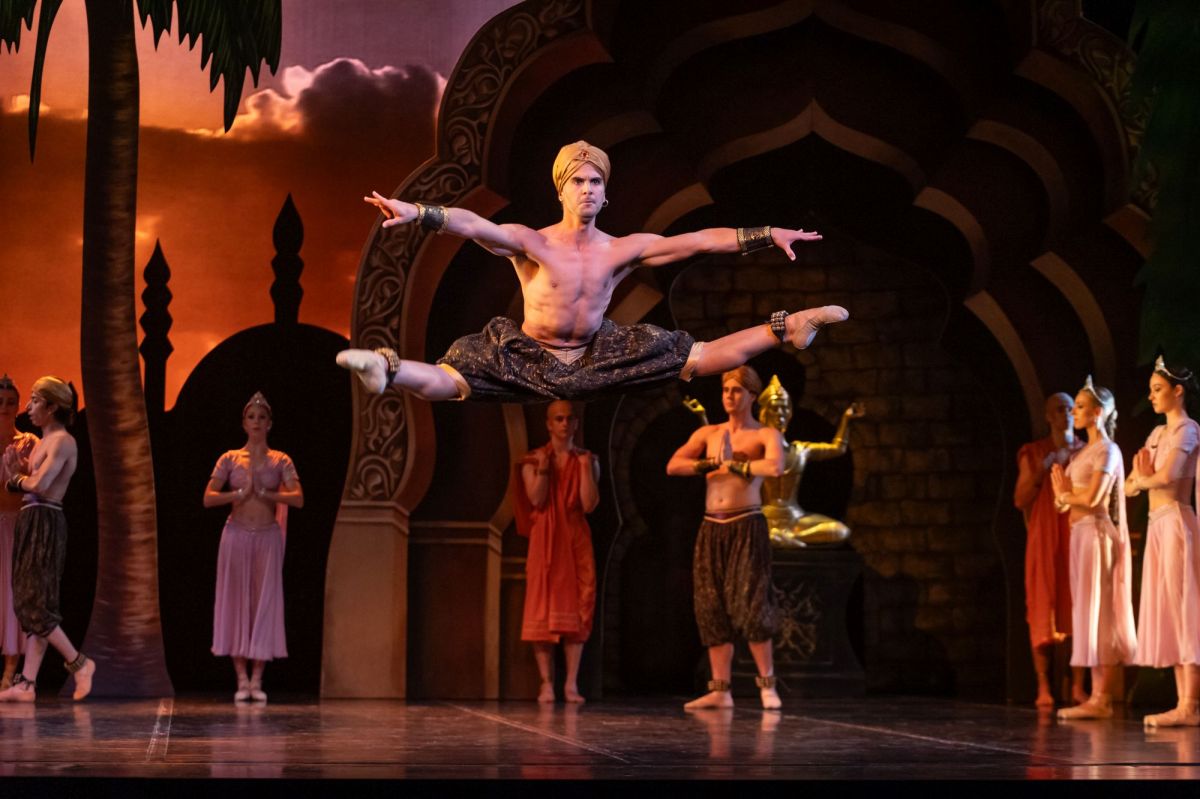
La Bayadère is one of those “classic” 19th century ballets – up there with Swan Lake and Sleeping Beauty for its spectacle, majesty and lashings of tragic romance.
But unlike Swan Lake and Sleeping Beauty, La Bayadère does not lean on European folk tale traditions to draw in its audience.
Instead, its Imperial Russian Ballet Master creators (which included 19th century Russian ballet titan Marius Petipa) placed their dancers in an “imagined Indian setting” to tell a love story that follows an Indian warrior prince who falls for a beautiful Indian temple dancer (la bayadere), at the same time as he is betrothed to another.
From a love story point of view, this work is on par with every other tragic story ballet of 19th century Europe (i.e. boy meets girl, trouble ensues when their love affair is found out and someone – usually the girl – dies in the end).
But La Bayadère’s romantic premise is also based on an entirely Eurocentric and exotically imagined version of India and its people, and presents fictitious notions of Indian culture as seen through the eyes 19th century Europeans.
Does that sound problematic to modern day audiences?
In response to these aspects of the work, increasingly heated conversations about its relevance on our stages are underway, led by figures within the international Hindu community as well as high-profile performers of Asian descent.
Some ballet companies are holding fast to their right to present the piece, while at the same time others are publicly distancing themselves from the historic work.
So, does this mean La Bayadère is in its dying days on our stages? Or will it endure as a ballet world staple for years to come?
In a statement issued last year, the Boston Ballet advised its audiences that, unlike the company’s previous mainstage seasons, its 2024 program would not include a full-length version of La Bayadère in light of ‘its problematic storyline’ and the fact that the company ‘strongly disagree[s] with its appropriation of South Asian culture’.
Instead, this year the Boston Ballet will present a 25-minute excerpt of La Bayadère as part of a double bill (with a staging of Carmen), showing only the former’s most famous choreographic scene known as the Kingdom of the Shades.
In taking this direction, the company’s leadership team has acknowledged the Kingdom of the Shades is ‘one of the grandest examples of 19th century Russian ballet choreography’, and views this iconic piece of choreography as abstract enough to be enjoyed in isolation without reinforcing any negative stereotypes or problematic themes the company sees as evident in the full work.
Meanwhile, the West Australian Ballet (WAB) is currently presenting a short season of La Bayadère in its entirety at his Majesty’s Theatre in Perth. WAB’s reimagined version of the traditional three-act ballet is choreographed by Queensland Ballet’s Chief Ballet Master Greg Horsman, and is a co-production between West Australian Ballet, Queensland Ballet and Royal Winnipeg Ballet. Horsman’s interpretation of the work has already been staged several times before this current WAB season, including a season by Queensland Ballet in 2018 and by WAB in 2019.
David McAllister is currently WAB’s Guest Artistic Director, and says when he realised La Bayadère was scheduled as the company’s opening work of the year, his first reaction was a mixture of surprise and hesitation.
‘When I assumed the helm of the company [at the beginning of 2024] and saw that La Bayadère was on the program, I thought, “Oooh, OK”,’ he tells ArtsHub.
‘Having said that, what I think Greg Horsman has done with this production is to appreciate that it is a tricky production, in that any of those works set in the mid-19th century that draw on themes of Orientalism were not drawing on any kind of real research or experience of what those places were actually like.
‘Greg has realised that, and so he has looked at this particular production through the prism of the impact of colonialism on India at the time of the Raj,’ McAllister continues.
He explains that Horsman’s version sidelines themes related to Hinduism, and replaces them with more political storylines about the British Empire’s footprint in India in the 19th century.
‘Greg has looked more at this idea of how agreements between warring factions happened at that time through marriages between the colonial invaders and the Indian owners of the land,’ McAllister says.
‘So it’s really more about that human experience of being forced into a marriage that is not a love marriage, and the détentes through marriage that happened in those times.’
But even reimagined versions of La Bayadère attract questions of how appropriate it is to keep staging a ballet that features an Indian temple dancer protagonist at a time when many female dancers in India are still struggling to overcome negative stereotypes associated with being a professional classical dancer in that country.
Jay Emmanuel is an Indian-born Australian theatre artist, who is also the founder and Artistic Director of Perth theatre company Encounter. Emmanuel is a trained Indian classical dancer and has recently finished performing in Why Not theatre company’s production of Mahabharata at the Barbican in London.
The artist says that while he has never seen a production of the ballet La Bayadère himself, he feels concerned about this story centred on a female Indian “temple dancer” being seen in 2024, when many female dancers in the Indian arts scene are still pushing hard to overcome historic assumptions about their careers as classical dancers and performers.
‘In India, the term “temple dancer” translates to devadasi, a highly contested term. [It’s a] once revered class of dancers for the deities that became a class of women who were ostracised and stigmatised in colonial and post-colonial India,’ Emmanuel tells ArtsHub.
But Emmanuel adds that, having not seen the work himself, he is not well-placed to critique it in depth, nor is he in favour of singling out individuals or companies for negative criticism in this area.
‘I feel very strongly about not pointing fingers,’ he says. ‘I would rather us gather together to have a conversation about these things and I think, ultimately, the direction we don’t want to go in is where certain stories belong only to certain groups of people.’
As an Indian-born theatre-maker who has spent half his life in Australia, Emmanuel says he has experienced this kind of gatekeeping in the arts first-hand, but says he is also optimistic about where the Australian arts sector is headed, citing recent efforts of many companies to broaden their representation and achieve greater cultural diversity.
‘We need to go in the direction of more collaborations and nuanced cross-cultural works,’ Emmanuel says.
‘I also think that as a leader of a theatre company myself, we, as the people in the leadership roles, have to be accountable and responsible for what we program. That is the job – to take that responsibility.
‘So I do think our arts leaders need to take responsibility for that at some point, otherwise the thinking of the past will continue to be passed on,’ he says.
Another burning question Emmanuel has about the show is how appropriate it is for an Australian audience that includes increasing numbers of Indian-Australian residents and citizens.
‘The Indian diaspora is Australia’s fastest growing large diaspora,’ the artist says. ‘So, my question is: what does presenting and staging La Bayadère mean for this faction of the Australian community? Because the work, by itself, presents an incredibly unrealistic and romanticised view of India.’
Emmanuel is not the only West Australian raising these questions. Since the work’s premiere last Friday, WAB’s Facebook page has lit up with debate about the appropriateness of McAllister wearing a highly decorated Sikh-style turban and a costume beard to play the Indian Maharajah character in the work.
As one audience member posted, ‘Our culture is not a costume’, acknowledging that while effort had been made by the show’s choreographer to update the story, ‘this costume [worn by McAllister] and beard is for a white man to perform as a brown man… in a role that could have instead been given to an actual person of colour to decolonise this production by elevating the voices and performers it has traditionally exploited’.
Many others expressed similar concerns that the staging of the work in this way is insensitive to people of colour and audiences of Indian heritage.
Yet some others have come out in strong support of the work, describing it as ‘a brave move that was not taken lightly’, and a ‘beautiful and thoughtful rendition of the story’, adding that a move towards more authentic casting could end up limiting art’s ability to tell its stories (as they write: ‘How far do we take this? Do non-Russians never do a Chekhov play? Can only French people play in Les Mis?’).
So, as WAB’s season of La Bayadère wraps up this Saturday, one wonders whether the huge investment that has been made (with taxpayers’ dollars) in this spectacular show has indeed hit the right mark for the company’s audiences, which, by the evidence playing out online, is an audience growing beyond ‘its traditional wealthy, Caucasian demographic’ (as one Facebook commenter put it).
Ultimately, the art form of ballet, as one entirely steeped in history, can find itself in a bind in the present day, as sections of its audiences demand aspects of its historic works be left firmly in the past, while others continue to flock to these “classics”, and do not enjoy them being reimagined or reworked if they depart too far from the originals they know and love.
It’s certainly a vexing situation for our arts leaders within these traditional art forms. But if the social media response to WAB’s current season of La Bayadère tells us anything, it’s that its audience is diversifying, and these fans are pushing for a more sensitive and inclusive approach.